

Picture pointing a telescope at Saturn tonight and finding a plain, pale-gold globe where its famous rings should be. Would the planet become unstable? Would its moons tumble away? Or would the loss be mostly cosmetic?
Saturn would survive just fine. Its orbit around the Sun, its rotation, and the paths of its large moons would barely change. But the missing rings would still leave a surprising mark on Saturn's atmosphere and on the small moons that live close to the icy disk. The answer depends on what we mean by “disappear”: magically removing the ring material is very different from sending it crashing into the planet.
The first change would be impossible to miss
From Earth, Saturn would lose the feature that makes it recognizable through even a modest telescope. Instead of a wide, bright oval wrapped around the planet, we would see a softly banded gas giant resembling a calmer-looking Jupiter. Titan and several other moons would still be there, following their usual paths.
That dramatic visual change can be misleading. Saturn's rings look solid from far away, but they are actually countless separate pieces of mostly water ice, from tiny grains to much larger chunks. The main rings stretch an enormous distance across space while typically measuring only about 10 meters (30 feet) thick vertically. They are more like a gigantic, extraordinarily thin swarm of orbiting ice than a single structure.
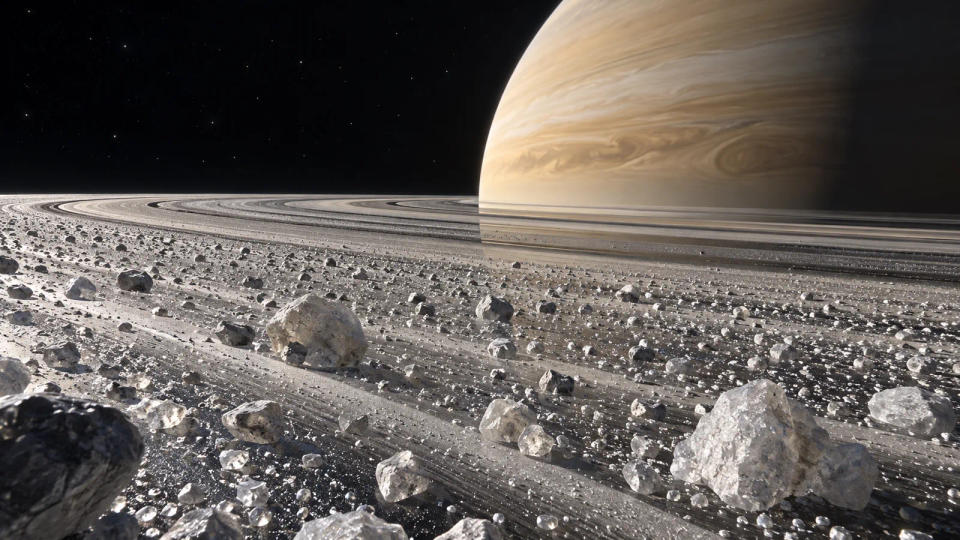
Imagine scattering an immense number of ice cubes along different lanes of a racetrack, then stretching those lanes around a planet. Each particle is held in orbit by its own motion and Saturn's gravity. Remove every particle, and the spectacular racetrack simply ceases to be visible. The planet at its center does not fall apart.
There is already a harmless version of the disappearing act. Roughly every 15 years, the rings appear nearly edge-on from Earth and become difficult to see. That is a viewing-angle trick, not physical destruction. Their apparent disappearance around the 2025 ring-plane crossing was one such case.
Saturn's gravity and its large moons would hardly notice
It is easy to assume something so visually enormous must also be enormously heavy. Yet Cassini's gravity measurements revealed that Saturn's rings contain remarkably little mass compared with the planet itself. Even removing all that ice would take away only a tiny fraction of the mass of the Saturn system.
Think of a fully loaded truck with a thin layer of snow on its roof. Brush off the snow and the truck still behaves like a truck. Saturn is vastly more massive than its brilliant icy decoration. It would keep circling the Sun, and its own gravity would remain almost unchanged.
The same is broadly true for Titan, Enceladus, Rhea, and Saturn's other substantial moons. Their orbits are governed mainly by Saturn, the Sun, and gravitational interactions with one another. They would not suddenly shoot out into space because the rings had gone.
Smaller moons are a more interesting case. Pan and Daphnis travel inside gaps in the main rings, where their gravity sculpts waves through nearby particles. With no ring particles left, those ripples and wakes would disappear. The moons themselves could continue orbiting, assuming our thought experiment removed only ring material rather than the moons. Any tiny moonlets counted as part of the ring swarm might vanish with it, depending on the scenario.
The atmosphere would lose its giant moving shade
Saturn's rings do more than shine. They also block sunlight and cast broad shadows across the cloud tops. As Saturn moves through its long seasons, the position of those shadows changes. Cassini measurements showed that regions emerging from ring shadow can warm noticeably, with accompanying changes in atmospheric temperature and haze.
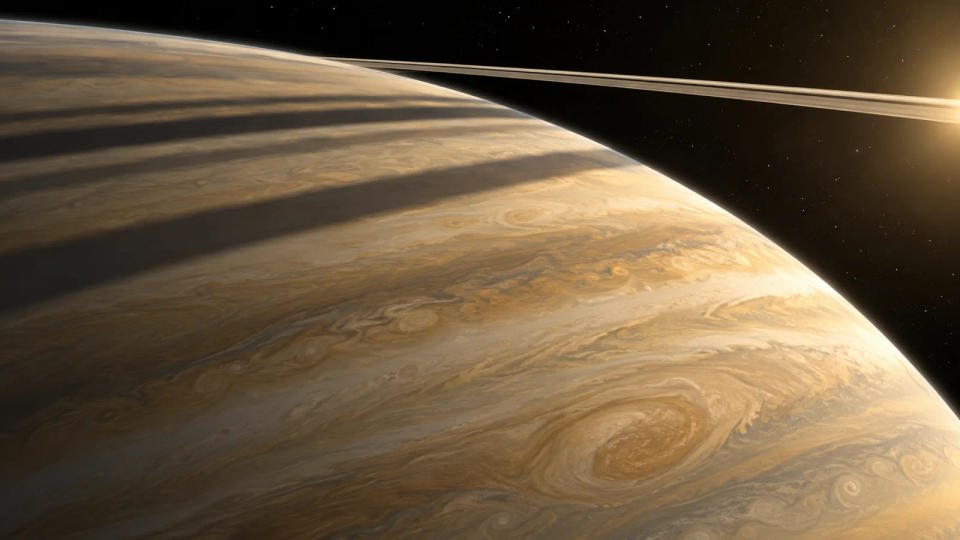
Without the rings, this extra source of shade would be gone. Sunlight would reach areas once darkened by the disk, changing the pattern of heating in Saturn's upper atmosphere. But it would not mean an instant global heat wave. Saturn would still receive relatively weak sunlight at its great distance from the Sun, and its normal seasons would continue because its axis remains tilted.
There is also an invisible connection. Observations show that some electrically charged icy particles escape the rings and travel along Saturn's magnetic field into the upper atmosphere. Scientists call this ring rain. The incoming material affects the chemistry and electrically charged layers of the atmosphere, called the ionosphere.
If all the rings were removed without leaving debris behind, that particular supply of water-rich material would stop. Atmospheric chemistry would then adjust, although scientists could not predict every detail of such an impossible instant-removal experiment. In short, the largest immediate consequence might be something a telescope image cannot show: a change in how the planet's upper atmosphere is heated and supplied with particles.
Could the rings really vanish overnight?
Not by any known natural process. There is no switch that can turn billions of icy fragments into nothing. If an event scattered the particles into new orbits, there would still be debris around Saturn or elsewhere. If the ice instead plunged into the atmosphere, it would deliver material and energy, potentially producing very different effects from the clean disappearance imagined here. The outcome depends on the mechanism, not simply on the absence of a bright ring.
What scientists actually observe is much slower. Studies using ground-based observations and data from the Cassini mission have found ring material migrating toward Saturn. A widely cited 2018 NASA analysis suggested that the present rings could be lost on a timescale of roughly 100 million years when several measured pathways are considered. That is a model-based estimate, not a scheduled expiration date.
Even the rings' age remains debated. Cassini's measurements of their mass helped support the idea that they may be much younger than Saturn, which is billions of years old. Other interpretations allow more complicated histories in which material is recycled and rings evolve over longer periods. Scientists are still working out how the rings formed and how their future will unfold.
One further twist: some faint ring material is replenished by moons. Enceladus, for example, feeds Saturn's diffuse E ring with icy particles from its plumes. A hypothetical Saturn stripped clean of every ring would not necessarily stay completely dust-free if that source continued working. The bright main rings, however, would not simply regrow overnight.
Conclusion
A ringless Saturn would look almost unfamiliar, but it would remain the same giant planet, with nearly the same gravity, seasons, and major moons. The deeper losses would be the ring shadows, the supply of icy particles to its atmosphere, and the intricate patterns created by nearby moons.
Saturn's real rings are not expected to disappear suddenly. Their slow evolution is a reminder that even the solar system's most iconic sights can be temporary on astronomical timescales.
Sources & Further Reading
- NASA Science — Saturn: Facts
- NASA Cassini — Rings
- NASA JPL — Cassini Data Show Saturn's Rings Relatively New
- NASA Cassini — Saturn's Seasons Are Made in the Shade
- NASA Science — Research on Saturn's Ring Rain
- NASA Astronomy Picture of the Day — Saturn's Rings Appear to Disappear
Post a Comment