
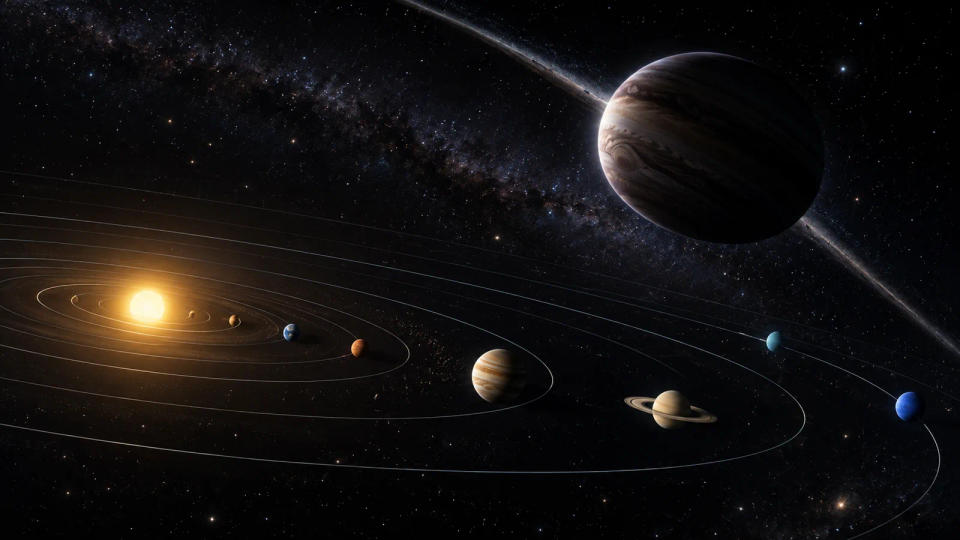
Imagine a planet with no star of its own drifting out of interstellar darkness and entering our Solar System. The first question sounds obvious: would it smash into a planet, moon, asteroid, or even the Sun?
Probably not. Even if a rogue planet crossed the region occupied by the eight planets, a direct collision would still be a surprisingly difficult target to hit. The more serious danger would be gravity. A massive visitor could pass through without touching anything and still alter orbits, scatter smaller bodies, or—in an extreme close encounter—destabilize part of the planetary system.
Why a Rogue Planet Could Miss Every Planet
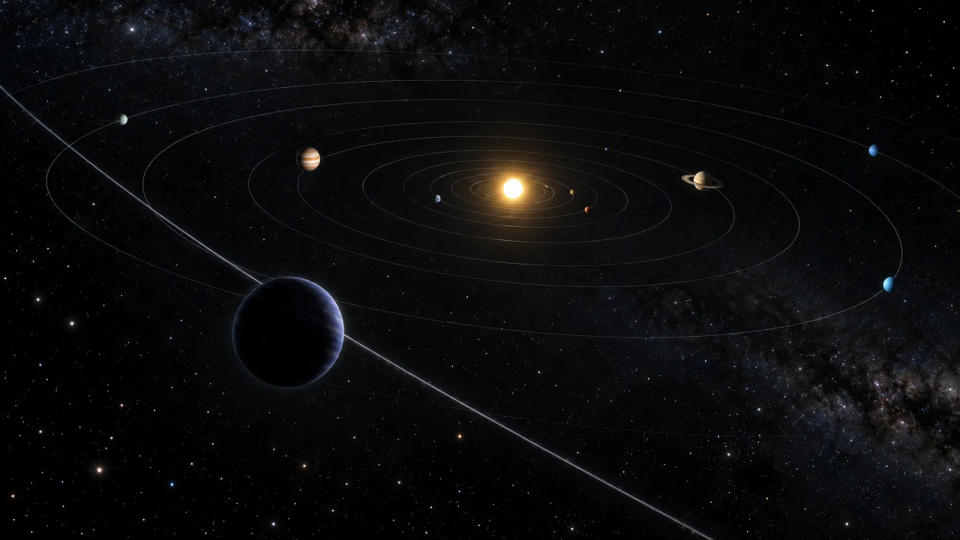
Diagrams make the Solar System look crowded because the planets are drawn far too large and far too close together. Reality is almost the opposite. One astronomical unit, the average Earth–Sun distance, is about 150 million kilometers. Neptune orbits at roughly 30 AU, or about 4.5 billion kilometers from the Sun.
Now compare those distances with the planets themselves. Earth is only about 12,756 kilometers wide. Even Jupiter, the largest planet, is tiny compared with the billions of kilometers separating the outer worlds. At any given moment, each planet occupies a minuscule fraction of the space around its orbit.
That means a rogue planet could cross the plane of the Solar System between planetary positions, approach from above or below that plane, or simply pass through while the planets happen to be elsewhere. The trajectory would have to be very precisely aligned for a physical impact.
We have already seen a small-scale example of this geometry. The interstellar object ʻOumuamua entered the Solar System on a steep path relative to the planetary plane and passed through the inner region without a close encounter with any of the eight major planets. A rogue planet would have vastly more mass and therefore a much stronger gravitational influence, but the empty-space problem would still work in its favor when it comes to avoiding a literal collision.
Gravity Would Matter Long Before an Impact
Missing the planets does not mean passing harmlessly. Gravity reaches across empty space, and the strength of an encounter depends mainly on the visitor’s mass, speed, and closest approach.
An Earth-mass rogue passing far outside Neptune might produce only modest effects on the known planets. A Jupiter-mass object passing much closer could be far more disruptive. It would tug on the Sun and planets as it moved through, changing their velocities by small amounts. A tiny velocity change can translate into a noticeably different orbit over time.
The result would not necessarily be instant chaos. Some flybys would barely matter. Others could increase a planet’s orbital eccentricity, tilt an orbit, disturb resonant populations of asteroids, or send icy bodies onto new paths. The closer and more massive the visitor, the larger the possible disturbance.
This is why astronomers study gravitational flybys with computer simulations rather than thinking only in terms of collisions. A 2025 study in Icarus, for example, explored whether a close substellar flyby in the young Solar System could have helped trigger an early instability among the giant planets. The authors found that certain simulated objects in the range of roughly 3 to 30 Jupiter masses passing within about 20 AU could generate strong dynamical effects. That is a model of the early Solar System, not evidence that such a flyby actually happened.
A Near Miss Could Disturb Comets and Asteroids Too
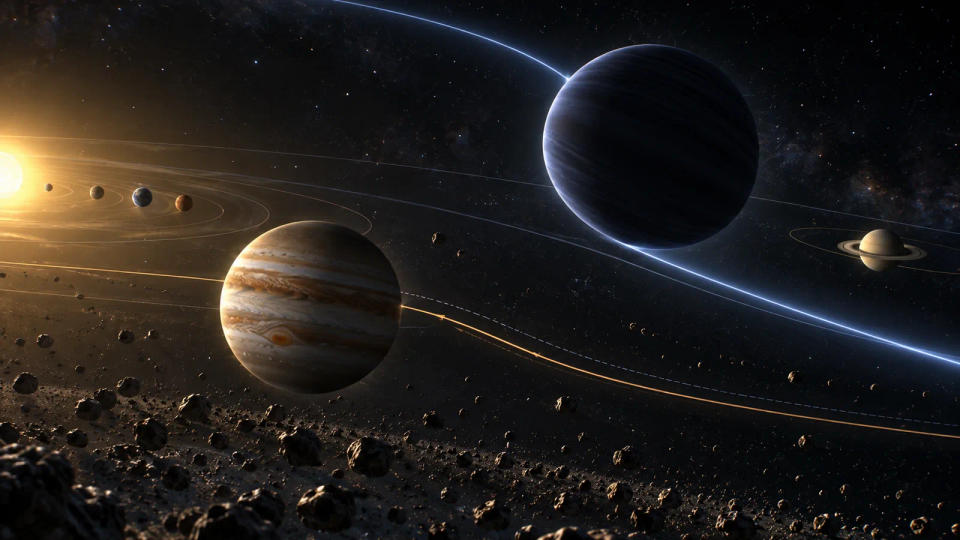
The planets are not the only things that could react. The Solar System contains enormous populations of smaller bodies, from the asteroid belt and Trojan asteroids to the Kuiper Belt and the much more distant Oort Cloud.
A visitor that never came close to Earth might still change the long-term traffic of comets. The Oort Cloud is thought to extend thousands to tens of thousands of AU from the Sun, so it is far more exposed to passing objects than the compact planetary system is. Astronomers already expect passing stars to perturb some Oort Cloud comets over very long timescales. A rogue planet has much less mass than a star, so it would generally need a closer encounter to have a comparable effect, but the same gravitational principle applies.
Closer in, a flyby could also rearrange smaller-body populations. Asteroids near gravitational resonances with Jupiter are especially sensitive to changes in Jupiter’s orbit. Researchers have even tested rogue-planet flybys as possible explanations for unusual structures in Trojan and Hilda asteroid populations. Those ideas remain hypotheses, but they show how a near miss could leave clues without leaving an impact crater.
In the most disruptive cases, a rogue planet could do more than stir debris. Strong three-body interactions can exchange energy between objects, potentially ejecting a planet from its original orbit or sending the visitor away on a very different path. The exact outcome would depend on geometry that cannot be reduced to a simple “hit or miss” question.
Could the Sun Capture a Passing Rogue Planet?
Not easily. If a rogue planet approaches the Sun from interstellar space, the Sun’s gravity accelerates it inward. As the planet leaves, that same gravity slows it down again. In a simple two-body encounter, it usually escapes with enough energy to continue back into interstellar space on a hyperbolic trajectory.
For permanent capture, the rogue planet must somehow lose orbital energy. That can happen in a multi-body encounter—for example, if it passes close enough to an existing planet for energy to be exchanged. Numerical studies of star–planet–rogue-planet interactions show that temporary capture, exchange, and ejection are physically possible outcomes.
But “possible” is not the same as “likely for our Solar System today.” A fast, ordinary flyby with no exceptionally close planetary encounter would be more likely to end with the rogue planet leaving again. The Sun is not a cosmic vacuum cleaner that automatically traps anything entering its gravitational reach.
Conclusion
Yes—a rogue planet could pass through the Solar System without hitting anything. In fact, because the planets are so small compared with the spaces between their orbits, a direct collision would be much harder to arrange than popular diagrams suggest.
The real risk would come from gravity. A sufficiently massive and close visitor could disturb planets, asteroids, or comets even while threading cleanly through the gaps. In celestial mechanics, a near miss can matter far more than a hit.
Sources & Further Reading
- NASA: New Study Reveals NASA’s Roman Could Find 400 Earth-Mass Rogue Planets
- NASA Science: Solar System Facts
- NASA JPL: Small Asteroid or Comet “Visits” from Beyond the Solar System
- ESA: Close Encounters of the Stellar Kind
- Icarus: Was the Solar System’s Dynamical Instability Triggered by a (Sub)stellar Flyby?
Post a Comment