
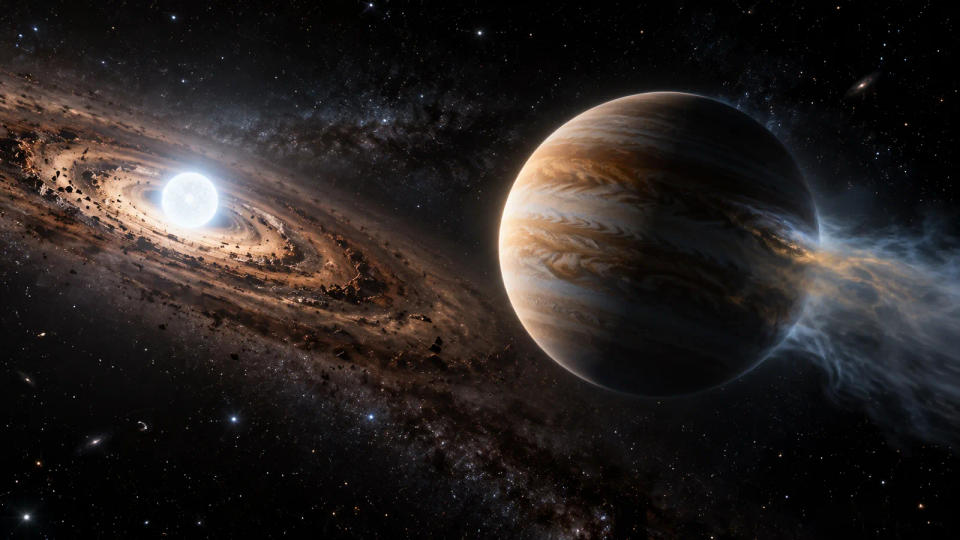
Can new planets form after their stars have died? Possibly. A study published on October 5, 2026, argues that a hot white dwarf called HS 0209+0832 may host a planet assembled from material expelled during its parent star's final giant phase. The intriguing part is not a direct picture of a new world: it is a chemical fingerprint hidden in Hubble observations for more than a quarter century.
If the interpretation survives further tests, a planetary system might get a second chance after its original star has exhausted its fuel. For now, scientists call this a second-generation planet candidate, and that word matters. The measurements are real; the proposed planet and its origin remain an explanation of those measurements.
How Could a Dead Star Give Birth to a Planet?
A Sun-like star normally forms its planets early, when gas and dust left from its own formation settle into a disk. Our solar system belongs to that first generation. Billions of years later, a star of similar mass swells into a red giant, loses much of its outer atmosphere, and leaves a compact stellar core known as a white dwarf. The core no longer generates sustained energy by the same nuclear fusion that powered the original star, although it remains very hot and slowly cools.
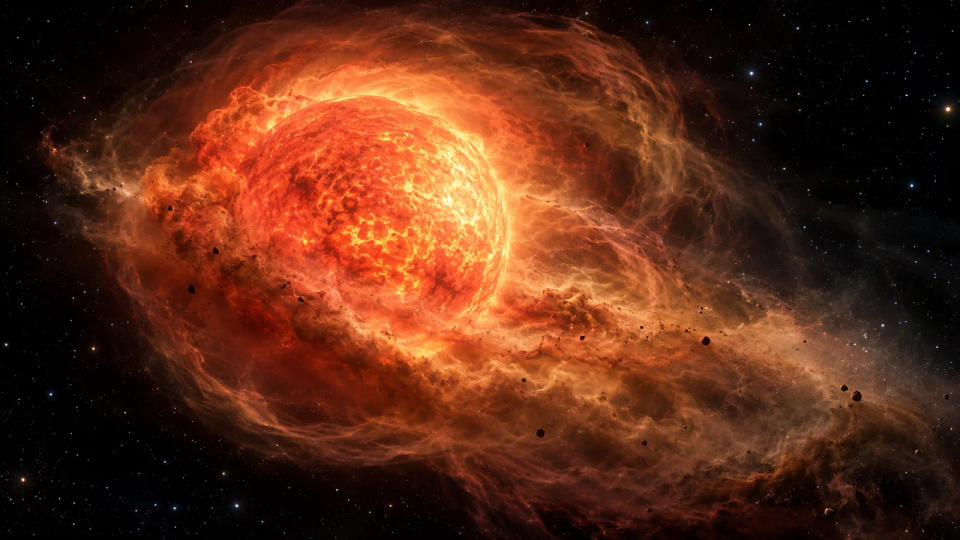
That transition is violent for nearby planets. Some may be engulfed; others may survive on changed orbits. But the expelled gas is not necessarily chemically identical to the cloud that made the first planets. During the late giant stages, nuclear reactions involving slow neutron capture—the s-process—can enrich stellar material in particular heavy elements. If some expelled matter becomes gravitationally bound and gathers into a disk, it might provide ingredients for another round of planet building.
The suggested pathway is not a settled recipe. In one scenario discussed by the researchers, an old companion helps eject the giant star's outer envelope, leaving a chemically enriched disk; a new gas giant could then form from that disk. Another possibility is that an older rocky or icy planetary core acquires a newly made atmosphere. Either way, the phrase 'second generation' describes a proposed history of material, not a planet we have watched forming.
The Hubble Clue: A Chemical Fingerprint That Did Not Fit
The star at the center of the story, HS 0209+0832, has an estimated surface temperature of about 35,000 kelvin and a cooling age of roughly five million years. In 1999, Hubble's Space Telescope Imaging Spectrograph collected far-ultraviolet starlight from it. Astronomers noticed ordinary metals and around 100 absorption features that they could not identify with the atomic information available at the time.
Lead author Jamie Williams and colleagues revisited those archived data with an improved line list. They found strong signatures of niobium, alongside an unusual pattern of zinc, copper and other elements. In particular, the star is enriched in certain elements heavier than iron while appearing poor in familiar rock-forming elements such as silicon and iron. Data from the retired Far Ultraviolet Spectroscopic Explorer also supported the identification of niobium.
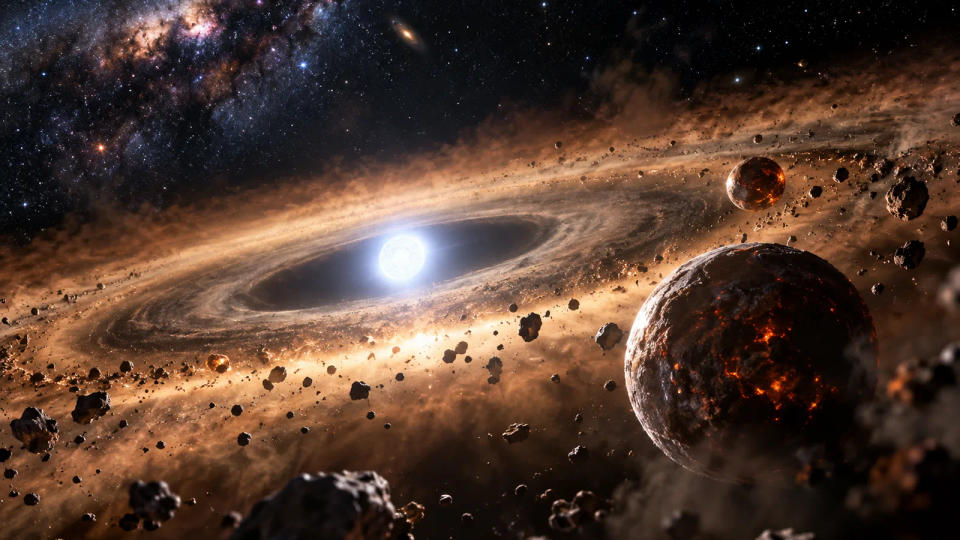
Why is this so surprising? A white dwarf's intense gravity usually pulls heavier elements below its observable atmosphere, so metals seen there suggest material is arriving from outside. Many white dwarfs have swallowed the remains of ordinary asteroids or planets; those remnants often resemble rocky solar-system ingredients. In this case, the mix looks very different. The abundance of elements associated with slow neutron capture is what made the researchers consider material processed by an aging star.
Spectroscopy, however, does not photograph an orbiting world. A spectrum shows which wavelengths of starlight are absorbed, allowing researchers to infer the matter in the star's atmosphere. Hubble measured the chemical evidence; a second-generation planet is the team's interpretation of where some of that matter came from.
A 4.4-Day Signal—and the Questions That Remain
NASA's TESS mission contributed a second clue. Across several observing sectors, the white dwarf's brightness changed in a regular cycle of 4.399 ± 0.026 days, with an amplitude of about 0.120%. The researchers showed that such a signal could fit a close-orbiting planet at roughly 0.04 astronomical units, approximately six million kilometers from the white dwarf—far inside Mercury's distance from the Sun.
Their favored picture features a gas giant of roughly Jupiter's size. Because the white dwarf is still exceptionally hot, strong ultraviolet and higher-energy radiation could strip gas from the planet's atmosphere. Escaping material could spread into a tail or disk, with a fraction eventually falling onto the stellar surface. In that way, Hubble might detect the planet's unusual chemistry indirectly, even though the planet itself is too difficult to see.
But periodic brightness changes do not identify a planet uniquely. The team considered variability consistent with a planet's changing illuminated face or a comet-like tail crossing the line of sight. Models of envelope ejection, planet growth and inward migration add further uncertainties. The original study even allows a hybrid history: a first-generation core that gains second-generation gas. A picture of a newly born Jupiter around this star would therefore be an artist's reconstruction, not an observed fact.
The result is exciting precisely because independent clues agree without being identical: unusual elemental abundances from ultraviolet spectra and a possible orbital clock from visible-light brightness measurements. Additional ultraviolet observations, detailed atmosphere modeling and searches for matching systems are needed before scientists can determine whether this interpretation is correct.
Conclusion: A Second Act for Planetary Systems?
If confirmed, HS 0209+0832 could change the simple story that all planets form only when their stars are young. The star's death may have supplied new material, and a giant planet may now be losing some of that material back to the hot remnant. It would be a remarkably circular story of planetary recycling—but no one has yet watched the process happen.
The strongest conclusion today is carefully limited: Hubble's old data reveal niobium-rich material around a young white dwarf, and TESS detects a subtle repeating signal that can be explained by an irradiated gas giant. The proposed second-generation planet is scientifically plausible and testable, not yet an established discovery. Sometimes the most important space news is a compelling new question that better observations can answer.
Sources & Further Reading
- NASA: Suspected Second-generation Planet Solves Hubble Cold Case
- ESA/Hubble: Suspected Second-generation Planet Solves Hubble Cold Case
- Williams et al., Nature Astronomy (2026): Discovery of a Second-generation Planet Candidate
- NASA: Hubble Spectrum of White Dwarf HS 0209+0832
Post a Comment