
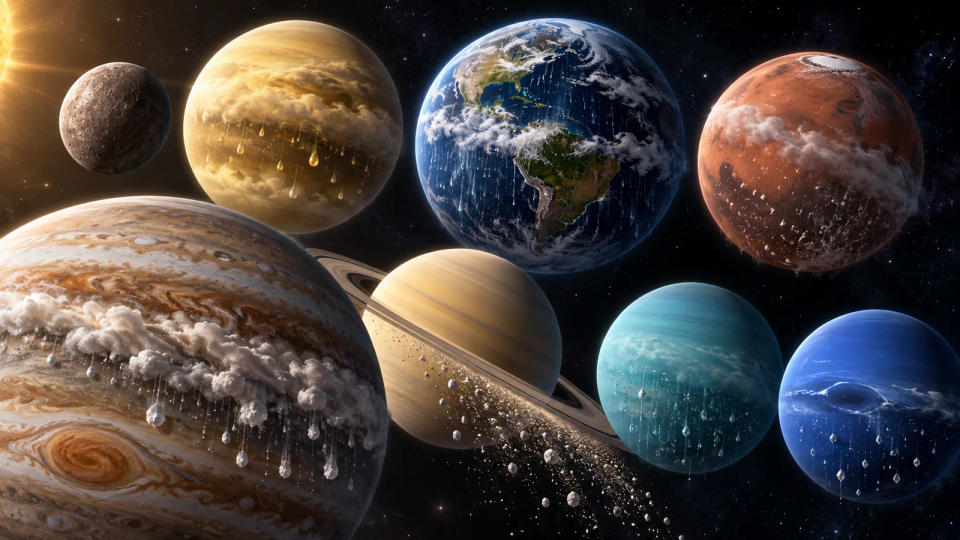
Rain seems simple on Earth: water condenses, drops grow, and gravity pulls them down. Across the Solar System, though, the answer to “what falls from the sky?” changes from planet to planet. Some worlds have acid droplets or dry-ice snow, giant planets can make exotic hail deep in their clouds, and a few famous forms of “rain” are still hypotheses rather than things a spacecraft has directly watched.
The quickest answer is that there is no universal planetary rain. What falls depends on temperature, pressure, atmospheric chemistry, and whether the planet even has a real atmosphere or solid surface.
Mercury and Venus: Almost No Weather vs. Acid Droplets
Mercury is the odd one out. It does not have a substantial atmosphere capable of making clouds, storms, or precipitation. Instead, it has an extremely thin exosphere made of atoms knocked off the surface by sunlight, the solar wind, and meteoroid impacts. Interplanetary dust and small meteoroids certainly strike Mercury, but that is material arriving from space, not weather falling from a sky.
Venus is almost the opposite. Its atmosphere is enormously thick and wrapped in clouds made mostly of sulfuric-acid droplets. Those droplets can settle downward from the cloud layer, producing something comparable to acid rain. But the lower atmosphere becomes so hot that the droplets evaporate long before they can reach the ground. In meteorology, precipitation that evaporates before reaching the surface is called virga.
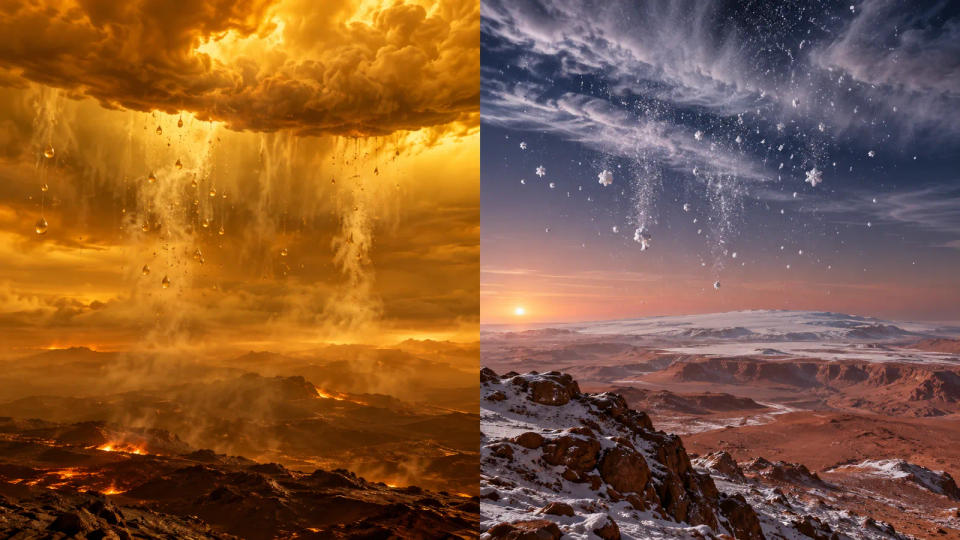
So Venus can have falling sulfuric-acid droplets in its atmosphere, yet a person standing on the surface—ignoring the crushing pressure and extreme heat—would not experience an acid shower reaching the ground.
Earth and Mars: Water Rain and Dry-Ice Snow
Earth is the familiar case. Liquid-water rain, water-ice snow, sleet, and hail all occur because our atmosphere regularly moves water through temperatures and pressures where it can exist as vapor, liquid, and solid.
Mars is much colder and its atmosphere is far thinner. Water-ice clouds form there, but one of the Red Planet’s strangest forms of precipitation is carbon-dioxide snow. NASA’s Mars Reconnaissance Orbiter detected carbon-dioxide snow clouds near the south pole and evidence that dry-ice particles can actually fall to the surface. That makes Mars the only world in the Solar System where carbon-dioxide snowfall has been directly identified in this way.
More recently, Curiosity has also photographed high-altitude carbon-dioxide-ice clouds with white plumes falling beneath them. In those observations, the particles evaporated before descending all the way to the surface. Mars therefore gives us both kinds of behavior: precipitation that can reach the polar ground under the right conditions and ice that falls for a while before disappearing into warmer air below.
Jupiter and Saturn: Hail, Ring Rain, and Falling Helium
Jupiter has no solid surface beneath its clouds, so “falling” means moving downward into an atmosphere that becomes progressively hotter and denser. NASA’s Juno mission revealed shallow lightning high above the deeper water-cloud region. To explain the observations, scientists proposed that water ice can mix with ammonia, creating slushy ammonia-water hailstones nicknamed mushballs.
These mushballs are not little stones photographed by Juno. They are a physics-based explanation supported by the spacecraft’s measurements. In the model, they grow inside powerful storms, become too heavy for the updrafts, fall into deeper layers, and eventually melt and evaporate. Jupiter may also experience helium separating into droplets much deeper inside the planet, but that is an interior process, not a cloud-top rainstorm.
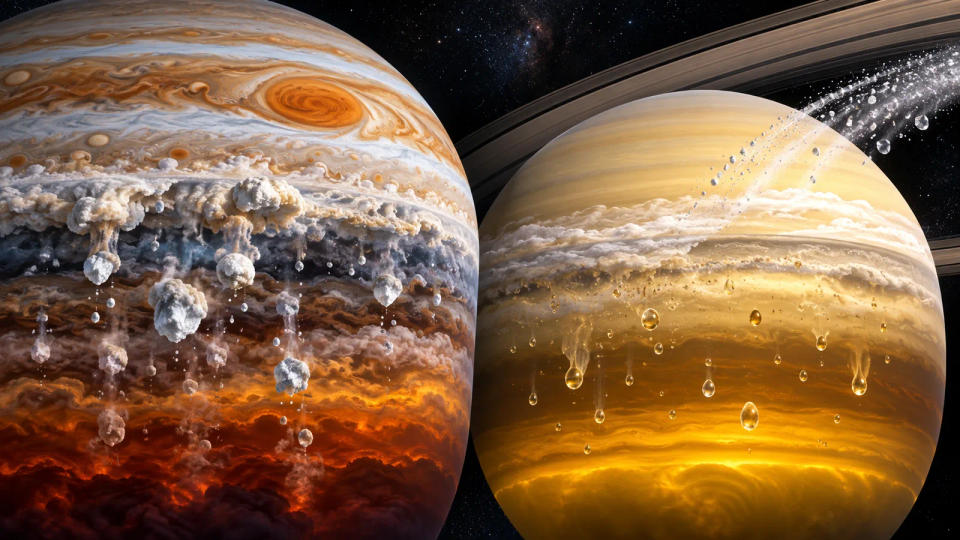
Saturn is similarly complicated. Its visible cloud decks contain ammonia and other condensates, and models of its interior include helium separating from hydrogen and sinking downward. Saturn also has a very different kind of rain that has actually been detected from outside the planet: material from its rings falls into the upper atmosphere. Observations have shown charged water-related particles streaming along Saturn’s magnetic field from the rings into the atmosphere, a process commonly called ring rain.
That means Saturn’s “rain” can come both from atmospheric and interior condensation processes and, uniquely, from the planet’s own ring system.
Uranus and Neptune: Methane Snow and the Diamond-Rain Question
Uranus and Neptune are cold enough for methane to condense in their upper atmospheres. Telescope observations and atmospheric models show methane-ice clouds, and models of the haze layers suggest methane can freeze onto particles and pull them downward in showers of methane snow. Neptune’s more vigorous atmospheric mixing may make that process more efficient than on Uranus.
Then there is the famous claim that it rains diamonds inside both ice giants. The basic idea is plausible: far below the visible clouds, extreme pressure and temperature may break hydrocarbons apart and allow carbon to form diamond that sinks deeper into the planet. Laboratory experiments have produced diamond formation under some relevant high-pressure conditions.
But this should not be presented as observed weather. No spacecraft has watched diamonds fall inside Uranus or Neptune, and laboratory studies do not all agree on exactly how readily diamonds form under the planets’ true interior conditions. “Diamond rain” is best described as an active scientific hypothesis supported by some experiments, not a confirmed forecast.
What Alien Rain Tells Us About a Planet
Precipitation is really a chemistry experiment powered by gravity. A substance rises or exists as vapor, reaches a region where temperature and pressure favor condensation or freezing, forms particles, and then falls when gravity overwhelms atmospheric motion. Change the chemistry and the same basic physics can produce water rain, sulfuric-acid droplets, carbon-dioxide snow, methane ice, or ammonia-water hail.
That is why planetary scientists care about what falls. Precipitation can move material between atmospheric layers, reveal temperatures we cannot measure directly everywhere, and even help explain puzzling chemical shortages. Jupiter’s proposed mushballs, for example, may carry ammonia and water to depths where Juno sees less of them higher up. Saturn’s ring rain provides evidence that its rings and atmosphere are chemically connected.
Conclusion: Earth may be the only planet where ordinary liquid-water rain reaches a familiar solid landscape, but it is far from the only world with things falling through its skies. The Solar System turns precipitation into a tour of planetary chemistry—sometimes observed directly, sometimes inferred from measurements, and sometimes still waiting for a future mission to prove it.
Sources & Further Reading
- The Planetary Science Journal — Hydroxide Salts in the Clouds of Venus
- NASA JPL — Observations Point to Dry-Ice Snowfall on Mars
- NASA JPL — Shallow Lightning and Mushballs on Jupiter
- NASA Science — Rain From Saturn’s Rings
- NASA Science — Why Uranus and Neptune Are Different Colors
- ACS Earth and Space Chemistry — Does It “Rain” Diamonds on Neptune and Uranus?
Post a Comment