
Explore the eight planets in order from the Sun, their defining features, and how their equatorial diameters compare.
Start at the Sun and travel outward: Mercury, Venus, Earth, Mars, Jupiter, Saturn, Uranus, and Neptune. That is the order of the eight recognized planets, but it is not a ranking by size. Jupiter is the largest, even though it sits fifth, while distant Neptune is slightly narrower than Uranus. Keeping those two lists separate makes the solar system much easier to understand.
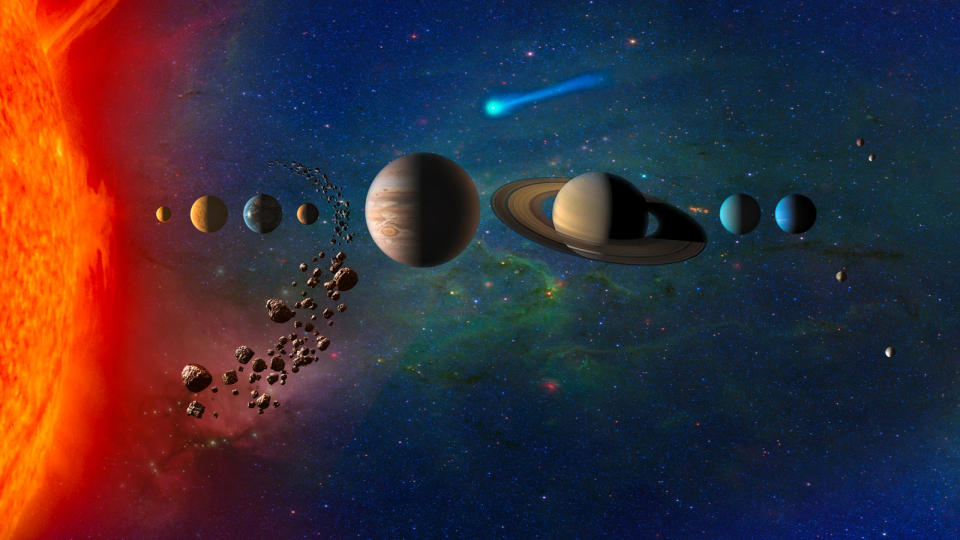
The opening NASA illustration brings the worlds together for an overview. Their sizes and separations are deliberately compressed or altered, so it is a guide to the members of the system rather than a scale model. Credit: NASA/JPL-Caltech; cropped for presentation.
The Eight Planets in Order From the Sun
The sequence begins with four terrestrial planets: Mercury, Venus, Earth, and Mars. They have rocky surfaces. Beyond them lie four giant planets: Jupiter, Saturn, Uranus, and Neptune. Jupiter and Saturn are gas giants; Uranus and Neptune are ice giants. These categories describe important differences in composition and internal structure, rather than simply how warm a planet feels.
Mercury comes first and is also the smallest planet. Venus follows, then Earth, then Mars. The main asteroid belt occupies the region between Mars and Jupiter. It is a population of separate bodies spread through space, rather than a continuous wall that spacecraft must crash through. Jupiter begins the sequence of outer planets, followed by ringed Saturn and the two ice giants.
“In order” refers to their orbits around the Sun. It does not describe where they appear across tonight's sky, and it does not mean that all eight currently form a straight line. Each planet moves around the Sun on its own orbit. A classroom lineup is a useful arrangement for learning names, not a photograph of the actual planetary positions.
Pluto is absent because it is classified as a dwarf planet. The International Astronomical Union adopted the solar-system planet definition in 2006. This classification did not make Pluto disappear or stop orbiting the Sun; it changed the category used to describe it. The Sun itself is a star, and the Moon is Earth's natural satellite, so neither belongs in the eight-planet list.
What Makes Each Planet Distinct?
Mercury's identity is a small, rocky world close to the Sun, with a heavily cratered appearance. Venus is almost Earth's size but has an exceptionally thick atmosphere. Its powerful greenhouse effect makes it the hottest planet, despite Mercury orbiting closer to the Sun. NASA gives Venus a surface temperature of about 467 degrees Celsius. Distance alone therefore does not determine surface conditions.
Earth is the third planet and the largest terrestrial planet. Its oceans, land and cloud systems make its appearance distinctive. It is also the only world where life has been confirmed. That last point is a statement about evidence: it does not establish that life elsewhere is impossible, or that another planet's size alone can predict whether it supports organisms.

Credit: NASA; Apollo 17 crew, December 7, 1972. This is an actual photograph, unlike the opening illustrative arrangement.
Mars is fourth, smaller than Earth and Venus, and recognizable by its reddish surface. Jupiter is fifth and dominates the size comparison. Its banded atmosphere is a reminder that the visible edge of a giant planet is not a rocky coastline. Saturn follows, with its prominent rings. Those rings make Saturn look especially broad in pictures, but they are excluded when comparing planetary body diameters.
Uranus, seventh, has an axial tilt of about 98 degrees and appears to rotate on its side. Neptune is eighth and is the most distant recognized planet. NASA places its average solar distance at about 30 astronomical units, compared with Earth's one. Both ice giants are much wider than Earth, although their diameters are far below those of Jupiter and Saturn.
Comparing Sizes With One Consistent Measurement
A fair comparison needs the same measurement for every world. The figures below use equatorial diameter: the width across a planet's equator. They are rounded reference values in kilometers from NASA's planet-size guide. They are not radii, masses, ring widths, or the planets' changing distances from Earth.
| Order from Sun | Planet | Equatorial diameter | Earth = 1 |
|---|---|---|---|
| 1 | Mercury | 4,880 km | 0.38 |
| 2 | Venus | 12,104 km | 0.95 |
| 3 | Earth | 12,756 km | 1.00 |
| 4 | Mars | 6,792 km | 0.53 |
| 5 | Jupiter | 142,984 km | 11.21 |
| 6 | Saturn | 120,536 km | 9.45 |
| 7 | Uranus | 51,118 km | 4.01 |
| 8 | Neptune | 49,528 km | 3.88 |

Composite: NASA/JPL-Caltech illustration elements and NASA/JPL-Caltech/Space Science Institute Cassini imagery, resized to a common equatorial-diameter scale. Numbers identify order from the Sun; placement and spacing do not represent orbital distances. Discs are illustrative and normalized for comparison, not simultaneous observations.
Read the size ranking as Jupiter, Saturn, Uranus, Neptune, Earth, Venus, Mars, and Mercury. Jupiter's equatorial diameter is about 11.2 times Earth's; Saturn's is about 9.45 times Earth's. Venus is about 0.95 Earth diameters, while Mars is about 0.53. These are width ratios. An elevenfold diameter does not mean an elevenfold volume or mass.
Uranus and Neptune illustrate why careful wording matters. Uranus is the wider planet in this table. A ranking described only as “biggest” can become confusing if another source is discussing mass instead. Always check the quantity, the unit and whether rings are included before deciding two figures contradict each other.
Conclusion
Remember the outward sequence first, then add the physical families and size ranking. Four rocky worlds are followed by two gas giants and two ice giants. Earth is the biggest rocky planet, Jupiter is the widest overall, and Mercury is the smallest. A consistent diameter table explains those differences more reliably than a dramatic illustration whose scale has been adjusted to fit the page.
Sources & Further Reading
- NASA: About Planets
- NASA: Planet Sizes and Locations in Our Solar System
- NASA: Venus Facts
- NASA: Uranus Facts
- NASA: Neptune Facts
Post a Comment