
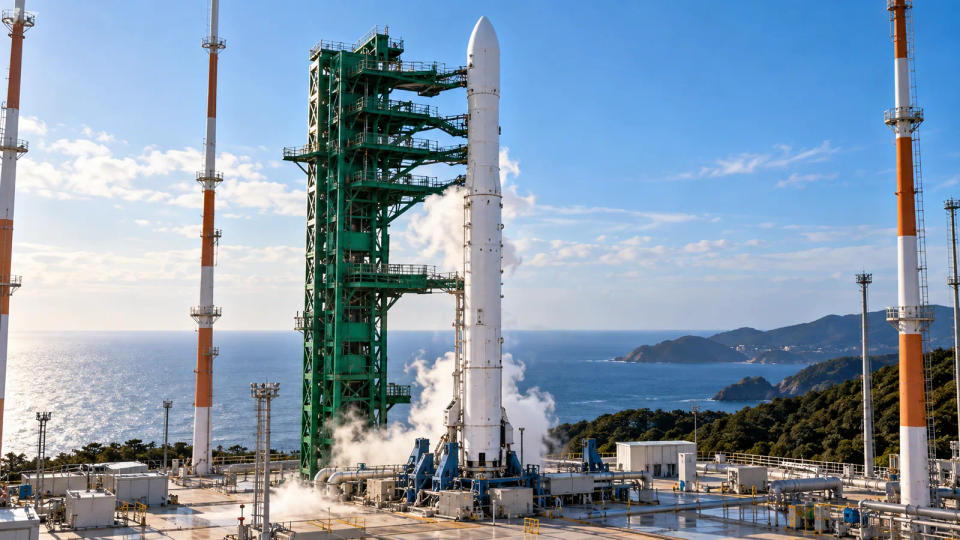
Nuri is still the same basic three-stage rocket that first flew in 2021, but the job it is being asked to do has changed dramatically. Its first mission carried a satellite mock-up and fell just short of orbit; its fifth is scheduled to carry 15 real satellites, including five spacecraft that must be released as part of Korea’s first domestically launched microsatellite constellation.
That is the clearest way to understand Nuri’s evolution. The rocket did not suddenly become much larger. Instead, each flight added a new layer of confidence, payload complexity, deployment precision, and operational responsibility. As of October 6, 2026, Nuri’s fifth flight has been moved to the launch pad at Naro Space Center for a scheduled October 7 launch.
Flights 1 and 2: First prove the rocket can reach orbit
Nuri’s first flight on October 21, 2021 was close to success, but “close” is not enough in orbital flight. The first stage, fairing, second stage, and third stage all performed much of their planned sequence, and the satellite mock-up reached the target altitude of about 700 kilometers. The problem was speed.
The third-stage engine shut down at about 475 seconds instead of the planned 521 seconds. That left the payload short of the roughly 7.5 kilometers per second needed to remain in orbit. An investigation later traced the failure to a helium tank that came loose inside the third-stage oxidizer tank, damaging the structure and contributing to the premature engine shutdown.
Engineers strengthened the third-stage oxidizer-tank area before the second flight. On June 21, 2022, Nuri completed the orbital mission successfully. It deployed a performance-verification satellite along with a satellite mass simulator. The verification satellite also carried four CubeSats that were released later.
The important change was not simply that flight 2 “worked.” Nuri had gone from demonstrating that its engines and stages could survive a full ascent to proving that the complete vehicle could deliver payloads to a stable orbit.
Flight 3: Nuri became a practical satellite launcher
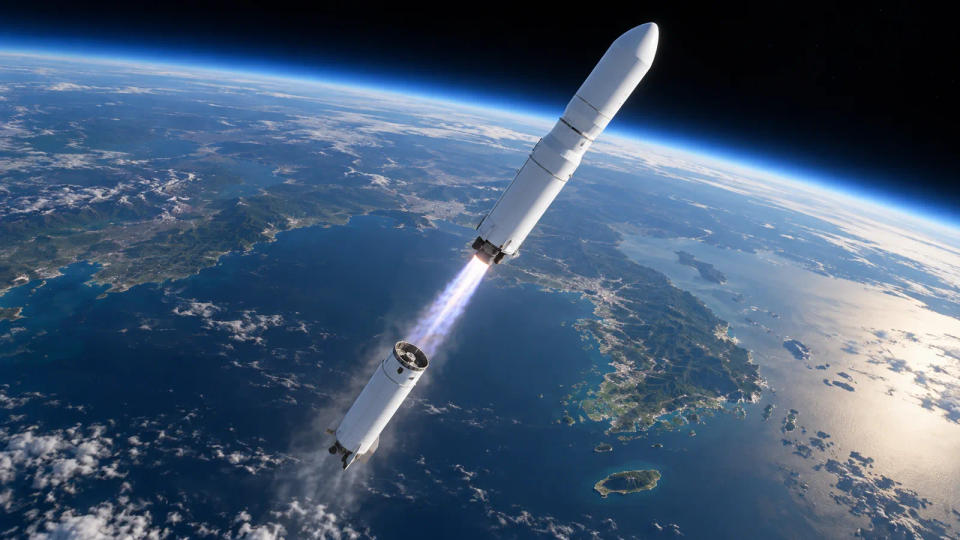
The third launch, on May 25, 2023, changed the meaning of the program. Instead of focusing mainly on whether the rocket itself could fly, the mission centered on delivering working spacecraft that had their own scientific and technology goals.
The main payload was NEXTSAT-2, a roughly 180-kilogram satellite built to test technologies including a small synthetic-aperture radar and to measure the space environment. Seven CubeSats also rode on the third stage. Unlike the second flight, where CubeSats were carried inside the performance-verification satellite, the third stage now included dedicated deployment hardware so Nuri could release multiple small spacecraft directly.
That distinction matters. A launch vehicle is not only a machine that reaches a certain altitude. It is also a delivery system. The third flight required Nuri to arrive in the correct orbit, orient the upper stage properly, separate the main satellite, and then manage a sequence of additional deployments without creating dangerous close approaches.
KARI described the mission as Korea’s first commercial-grade satellite launch service. In practical terms, Nuri had moved beyond proving itself and started doing the work it had been built to do.
Flight 4: Reliability and repeatability became part of the mission
Nuri’s fourth flight on November 27, 2025 pushed the program toward a different kind of maturity: doing a complex mission again, with more spacecraft and a growing private-sector role in production and launch operations.
The rocket successfully placed the CAS500-3 satellite and 12 CubeSats into their target orbit at about 600 kilometers. That made 13 satellites on one launch, a major jump from the payload arrangement of the early test flights. CAS500-3 itself carried instruments for space-weather research and a space-biology demonstration, while the CubeSats came from universities, research organizations, and companies.
At the same time, Nuri’s enhancement program was designed to build reliability through repeated production of the same launch vehicle. Hanwha Aerospace’s role as system integrator expanded, meaning the program was also testing whether Korea could move from a government-led development project toward a more industrialized launch system.
Flight 5: Fifteen satellites make deployment the hard part
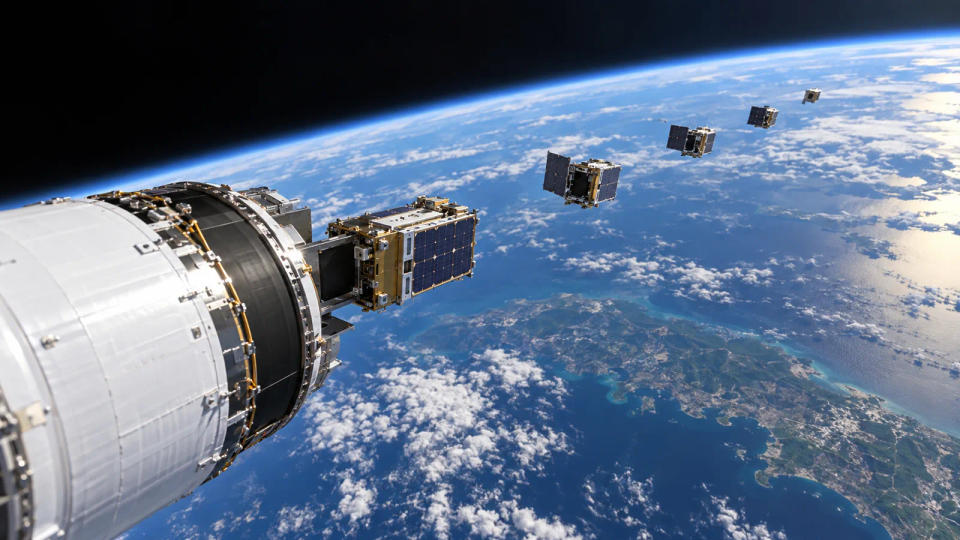
The fifth flight raises the satellite count again, but the headline number is only part of the challenge. Nuri is scheduled to carry five NEONSAT microsatellites as the primary payloads and 10 CubeSats as secondary payloads, for a record 15 satellites in total.
The five NEONSAT spacecraft are especially important because they are designed to work together. Each weighs under 100 kilograms and carries an electro-optical camera for Earth observation. Once the full ten-satellite constellation is completed, the system is expected to image the Korean Peninsula more than three times a day and revisit the same area within 24 hours, improving access to imagery for national security, disasters, wildfires, floods, and other time-sensitive events.
Launching a constellation changes the deployment problem. The five microsatellites cannot simply be pushed out together. They are planned to separate one at a time, roughly 35 to 40 seconds apart, with different release directions to reduce collision risk and help establish the desired spacing. The 10 CubeSats then add more deployment events, each with its own timing and mission requirements.
This means flight 5 is a test of mission choreography as much as rocket performance. The vehicle must reach the required sun-synchronous orbit, control its attitude, manage a longer and more complicated separation sequence, and verify that the satellites leave the upper stage safely. Repeated launches are supposed to make the rocket itself familiar; the payload mission is becoming less familiar on purpose.
That is why carrying 15 satellites is more meaningful than simply setting a Nuri record. It shows the launcher being asked to handle the kind of multi-payload missions that are increasingly common in modern low-Earth orbit operations.
What five launches reveal about Nuri’s evolution
Nuri’s history is a good reminder that launch-vehicle development is not a single finish line. Flight 1 exposed a structural weakness. Flight 2 proved orbital insertion. Flight 3 introduced practical satellites and direct multi-payload deployment. Flight 4 increased the satellite count while strengthening repeatable production and private-sector participation. Flight 5 is designed to add constellation deployment and an even denser sequence of payload releases.
The rocket’s core specifications remain recognizable: Nuri is about 47.2 meters tall, has three liquid-fueled stages, and was designed to place a roughly 1.5-ton-class payload into low Earth orbit. What has evolved is the confidence in how that hardware can be used.
If the fifth mission succeeds, the most important result will not be that Nuri carried 15 satellites instead of 13. It will be that South Korea has moved another step from developing a rocket toward operating a space-transportation system that can repeatedly serve increasingly complicated missions.
Sources & Further Reading
- Korea Aerospace Research Institute — Korean Launch Vehicle Nuri
- Korea AeroSpace Administration — Successful 4th Launch of Nuri
- Korea AeroSpace Administration — Fifth Launch of Nuri Set for October 7
- Korea AeroSpace Administration — Five Batch-Produced Microsatellites Ready for Launch
- Korea Aerospace Research Institute — Nuri Flight Model 5 Begins Transfer to Launch Pad
Post a Comment