
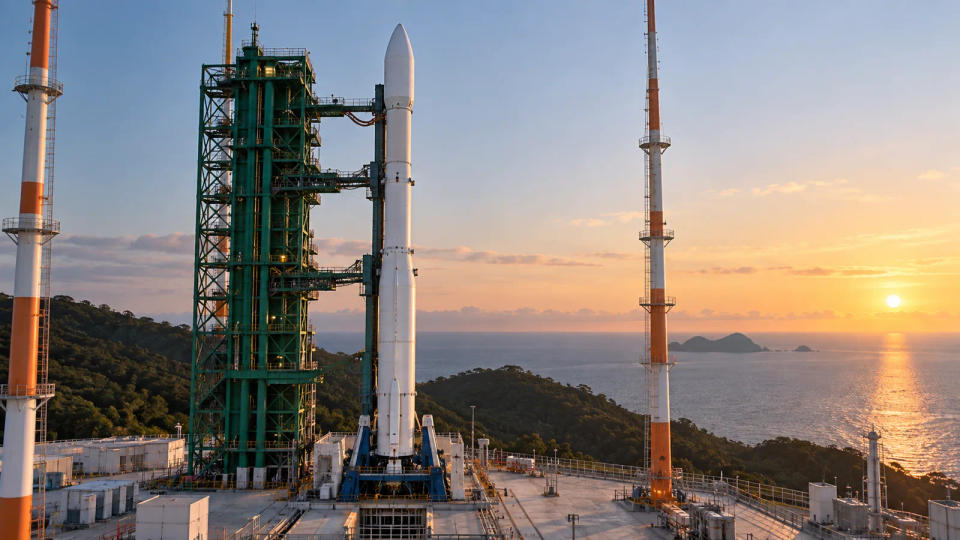
One Nuri launch is about to look more like a small fleet launch than a single-satellite mission. South Korea’s fifth KSLV-II Nuri flight is scheduled for October 7, 2026, carrying a record 15 satellites if final launch-day checks allow it to proceed.
The mission combines five primary Earth-observation microsatellites with 10 smaller CubeSats. That unusually crowded payload is not just about fitting more hardware under the fairing. It is meant to test something more important: whether Nuri can place a constellation and a rideshare group into orbit in one carefully choreographed mission.
As of October 6, Nuri had begun its move from the assembly building to the second launch pad at the Naro Space Center. The final liftoff time is due to be decided on launch day after reviews of technical readiness, weather, the space environment, and possible orbital collision risks. KASA has set a launch window from 12:23 to 13:23 KST, with October 8–14 reserved as backup dates.
Why is Nuri carrying 15 satellites this time?
The simplest answer is that this flight has two jobs at once. Its main mission is to deploy five NEONSAT Earth-observation spacecraft, numbered 2 through 6. Alongside them are 10 CubeSats from universities, companies, research groups, and public organizations.
Nuri is designed to carry substantial payloads into low Earth orbit, including missions to sun-synchronous orbit. A group of small spacecraft can therefore share a launch when their orbital needs are compatible. Instead of dedicating an entire rocket to one satellite, the flight can deliver a primary payload while giving smaller missions a ride at the same time.
That approach also explains why the number matters. Nuri’s successful fourth flight in November 2025 deployed 13 satellites. The fifth flight raises that total to 15, but the more meaningful step is the change in mission style: from proving the rocket can reach orbit to proving it can manage a more complicated multi-satellite deployment.
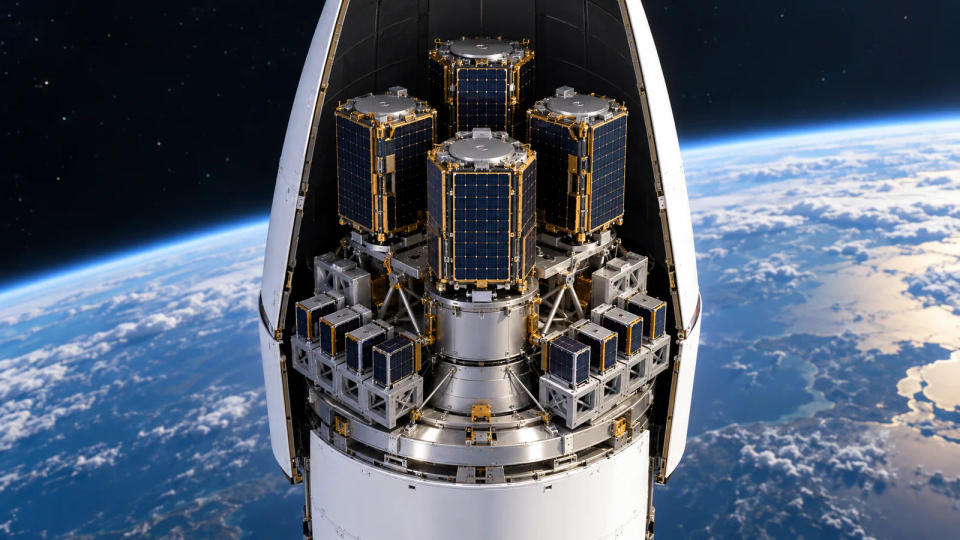
The five NEONSAT spacecraft are the heart of the mission
The five primary satellites are the first batch-produced units of Korea’s Microsatellite Constellation System. Each weighs less than 100 kilograms and carries an electro-optical camera capable of roughly 1-meter black-and-white imaging and 4-meter color imaging from low Earth orbit.
One satellite can revisit only so often. A constellation changes that equation. Korea plans to operate 10 of these microsatellites across two orbital planes. Five are scheduled to go up on this fifth Nuri launch, while another five are planned for the sixth Nuri flight in 2027.
Once the full constellation is operating, KASA says it should be able to image the Korean Peninsula more than three times per day and revisit the same location within 24 hours. That faster refresh rate is useful when conditions change quickly, such as during wildfires, floods, other disasters, or security-related events.
The fifth launch is therefore not simply carrying five similar satellites for convenience. It is trying to put the first major block of an operational constellation into space in a single mission. That makes coordinated deployment just as important as the rocket’s basic ability to reach orbit.
The other 10 CubeSats turn one launch into a shared laboratory
The remaining 10 spacecraft are smaller secondary payloads, but they are not all doing the same thing. Their missions span technology testing, Earth observation, space-environment measurements, and experiments that would be difficult or impossible to perform on the ground.
KASA has described missions that include observing the ionosphere, checking how domestically developed electronic parts perform in space, studying ocean-current patterns linked to marine debris around Jeju, monitoring fine dust, collecting hyperspectral imagery, examining urban change, and conducting biological or materials-related experiments in microgravity.
That variety is one reason rideshare launches are valuable. A CubeSat team does not need a full-size rocket of its own. By flying as a secondary payload, a university laboratory, startup, local government, or research institute can get real hardware into orbit while sharing the cost and launch opportunity with a larger mission.
For Korea’s space sector, the benefit is broader than the data returned by any one CubeSat. Every successful mission gives engineers experience with spacecraft construction, environmental testing, launch integration, ground communications, and real-world operation in orbit.
Deploying 15 satellites is harder than simply carrying them
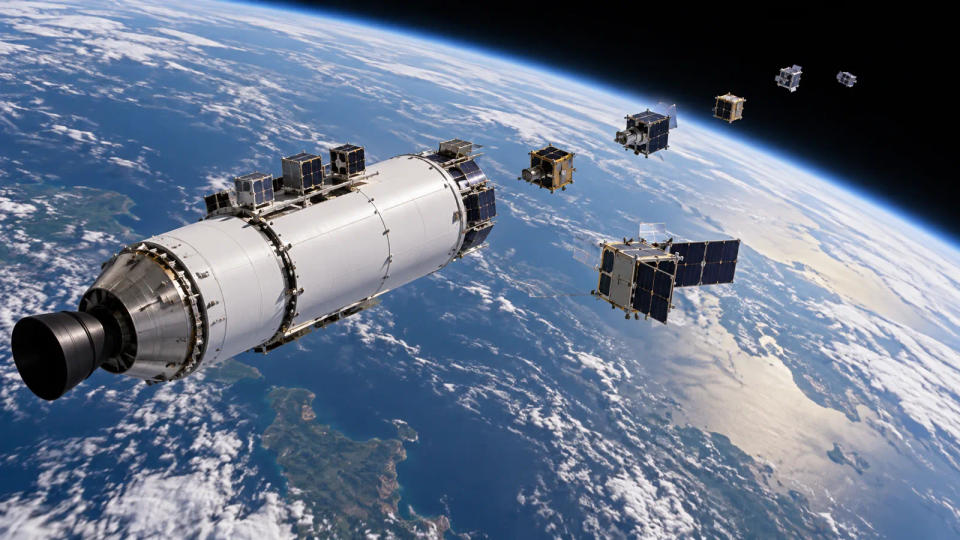
A crowded payload bay creates a traffic-management problem. Satellites cannot all be released at once and allowed to drift wherever they happen to go. Their separation timing, direction, and the rocket stage’s attitude all have to be planned so the spacecraft do not interfere with one another.
For the five NEONSAT spacecraft, KASA says Nuri will use a newly applied low-shock separation system to reduce the mechanical jolt during release. The satellites are planned to separate at intervals of about 35 to 40 seconds and in different directions to reduce the chance of a collision after deployment.
That is a very different challenge from carrying a single main satellite. The upper stage has to behave more like a delivery vehicle making a sequence of precise drop-offs. The remaining CubeSats also need their own planned release sequence so that each spacecraft begins its mission from the intended conditions.
Why the fifth Nuri launch matters beyond the record
The headline number is 15, but the deeper story is the move toward routine space transportation. Early Nuri flights were largely about proving that South Korea could build and fly its own orbital launch vehicle. More recent missions are asking a harder question: can that vehicle support a growing mix of real users and increasingly complex payload plans?
The fifth flight links several pieces of that transition at once. It carries batch-produced satellites rather than one-off spacecraft. It attempts Korea’s first launch of a satellite constellation as the main payload. It gives multiple CubeSat teams access to orbit. And it tests separation hardware and mission operations designed for many spacecraft instead of one.
That experience matters if Nuri is to become a repeatable launch service rather than a technology demonstration. KASA has also said it intends to support sustained Nuri launches and greater commercial participation in future missions. A successful multi-satellite flight would add another data point to the rocket’s reliability record while giving the satellite industry a practical path to orbit.
Of course, none of that is complete until the vehicle actually launches and the satellites separate as planned. On October 6, the mission was still in final preparation, with the exact launch time awaiting the next day’s readiness review.
Conclusion
Nuri’s fifth launch is carrying 15 satellites because one rocket is now being asked to do much more than deliver one spacecraft. The mission combines a five-satellite Earth-observation constellation deployment with 10 rideshare CubeSats, turning a single flight into a test of launch capacity, precision deployment, and a broader space ecosystem.
If the mission succeeds, the record number will be less important than what it represents: a launch vehicle moving from demonstration flights toward the more complicated work of supporting constellations, shared launches, and regular access to orbit.
Sources & Further Reading
- KARI — Nuri Flight 5 begins transport to the launch pad, October 6, 2026
- KASA — Fifth Launch of Nuri (KSLV-II) Set for October 7
- KASA — Nuri Flight 5 and Korea’s first constellation deployment mission
- KASA — Five batch-produced microsatellites ready for launch
- KASA — Secondary payload satellites selected for Nuri’s fifth launch
- KARI — Korean Launch Vehicle NURI
Post a Comment