

Nuri’s fifth flight is scheduled to attempt something South Korea has never done before: place a five-satellite constellation batch into orbit while also carrying ten smaller spacecraft on the same rocket. That makes 15 satellites in total, the largest payload count yet for a Nuri mission.
But the rocket does not technically need 15 satellites in order to fly. The number comes from mission design. Five NEONSAT Earth-observation satellites are the primary payload, while ten CubeSats use the same launch as secondary passengers. Putting them together lets one launch build a useful constellation, provide spaceflight opportunities for smaller projects, and test Nuri’s ability to deploy many spacecraft safely.
As of October 6, 2026, KARI said Nuri had begun moving to the launch pad for its planned October 7 flight. The exact launch time is to be confirmed by the launch management committee after checking the vehicle, weather, space environment, and possible conjunction risks.
Fifteen satellites, but two very different jobs
The easiest way to understand the mission is to split the payload into two groups.
The first group is the main reason for the launch: five NEONSAT microsatellites, numbered 2 through 6. Each weighs less than 100 kilograms and carries an electro-optical camera designed for roughly 1-meter black-and-white imagery and 4-meter color imagery. They are part of a planned ten-satellite Earth-observation constellation.
The second group is made up of ten CubeSats from universities, companies, research institutes, and public organizations. Their missions are much smaller and more varied. Some will test Korean-made electronic parts in orbit, while others will study the low-Earth-orbit environment, track ocean currents and marine debris around Jeju, examine fine-dust patterns, or demonstrate other technologies.
So this is not one giant 15-satellite system. It is one major constellation-deployment mission that also has room for a collection of smaller rideshare payloads.
Five NEONSATs make sense as a single launch batch
A constellation becomes more useful when several spacecraft can work together. One satellite can photograph a location only when its orbit carries it overhead. Add more satellites in carefully planned orbital positions, and the same area can be observed more often.
South Korea’s plan is to operate ten NEONSAT spacecraft in two orbital planes. The five satellites on Nuri’s fifth launch are the first mass-produced batch. Another five are planned for the sixth Nuri launch in 2027, completing the operational constellation.
Once all ten are in place, KASA expects the system to image the Korean Peninsula more than three times a day and return to the same location within 24 hours. That faster revisit rate can matter for wildfire monitoring, floods, emergency response, coastal changes, and national-security observation, where yesterday’s image may already be too old.
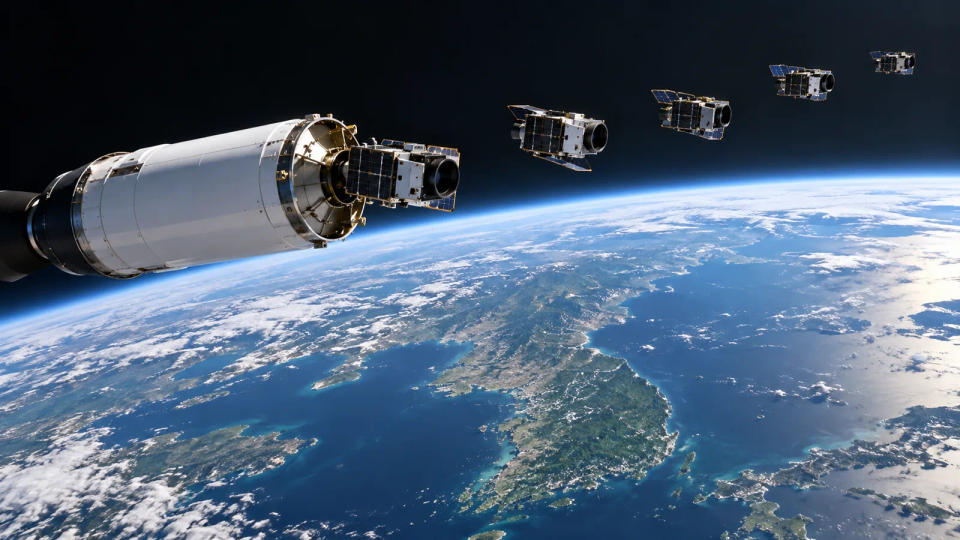
Launching five near-identical satellites together also matches the way they were built. Rather than treating each one as a separate custom spacecraft with its own dedicated launch, the program is moving toward batch production and constellation operations. That is a different model from the traditional approach of building one large satellite at a time.
The other ten satellites are rideshare experiments
If five NEONSATs are the core mission, why add ten more spacecraft? Because a rocket launch is an expensive opportunity, and small satellites do not always need an entire launch vehicle to themselves.
Nuri was designed to place about 1.5 metric tons into a 600–800 kilometer sun-synchronous orbit, although the usable payload for any particular flight depends on the exact trajectory and mission requirements. The five sub-100-kilogram NEONSATs do not automatically consume every kilogram or every available mounting position. Smaller CubeSats can therefore share the trip when their orbital needs are compatible with the primary mission.
This is the same basic idea as carpooling, but with much stricter engineering. A secondary satellite must fit within mass, volume, structural, electrical, safety, and deployment limits. It also has to be released in a way that does not threaten the primary payloads or the rocket stage.
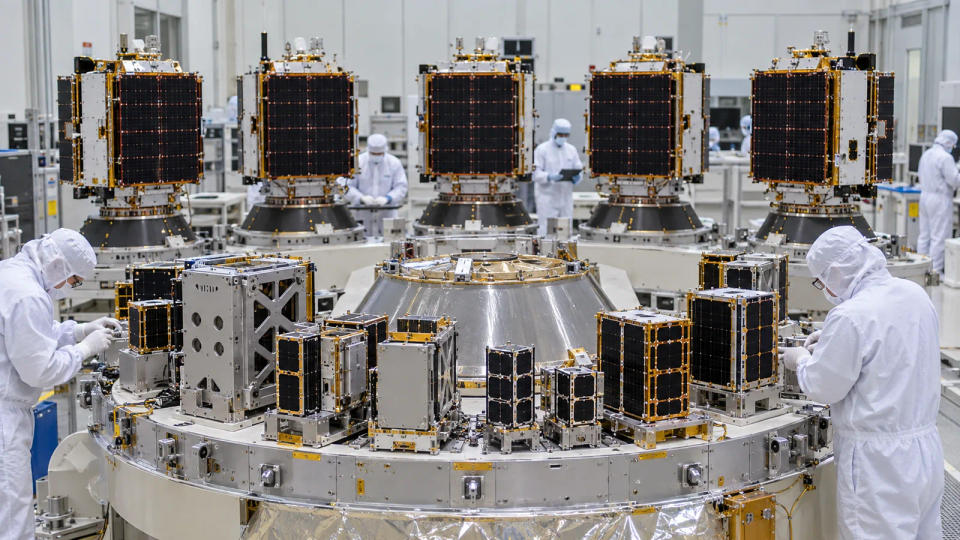
For the CubeSat teams, sharing a Nuri flight creates a rare chance to test hardware in the real space environment. A component that works perfectly in a laboratory still has to survive launch vibration, vacuum, temperature swings, radiation, and months of operation in orbit. That is why technology-demonstration satellites can be valuable even when they are tiny compared with the main payload.
Multi-satellite deployment is part of the test
Carrying 15 spacecraft is only useful if Nuri can separate them without creating a traffic problem immediately after deployment.
The five NEONSATs are especially important because they must be inserted sequentially as a coordinated group. KASA says Nuri will use a new low-shock separation device for this mission. The five primary satellites are planned to separate roughly 35 to 40 seconds apart and in different directions, reducing the chance that one spacecraft could drift into another.
That turns the fifth launch into more than a delivery flight. It is also a demonstration of mission complexity. Earlier Nuri flights proved that the rocket could reach orbit and deploy satellites. The fourth launch successfully released 13 spacecraft. The fifth flight raises the count to 15 and, more importantly, adds the challenge of deploying multiple primary constellation satellites with planned spacing and direction.
This capability matters because modern space programs increasingly rely on groups of smaller satellites rather than a single enormous spacecraft. A launch system that can handle several payloads, separation devices, and deployment sequences becomes more useful to government programs, universities, and commercial satellite operators.
So why carry all 15 at once?
Launching the satellites one by one would be simpler in some ways, but it would also require more rockets, more launch campaigns, more time, and far more cost. The NEONSAT program specifically benefits from placing several spacecraft into orbit as a batch, because the whole point is to build a constellation that can revisit the same regions frequently.
Meanwhile, the ten CubeSats gain access to orbit without each needing a dedicated rocket. Nuri gains a more demanding real-world mission that tests its ability to carry and deploy many spacecraft. South Korea’s satellite program gets to practice batch production, integration, and simultaneous operations rather than repeating the older one-satellite-at-a-time model.
That is the real reason behind the record 15-satellite manifest. The number is not a requirement imposed by Nuri’s engines. It is the result of combining one constellation-building mission with a rideshare opportunity—and using a single launch to advance several parts of the country’s space ecosystem at once.
Sources & Further Reading
- KARI — Nuri Flight 5 begins transfer to the launch pad, October 6, 2026
- KASA — Nuri Flight 5 to open Korea’s first satellite-constellation era, September 15, 2026
- KASA — Five batch-produced microsatellites ready for launch, August 14, 2026
- KASA — Fifth launch of Nuri set for October 7, August 27, 2026
- KARI — Korean Launch Vehicle NURI specifications
- KASA — Successful fourth launch of Nuri and 13-satellite deployment, November 27, 2025
Post a Comment