
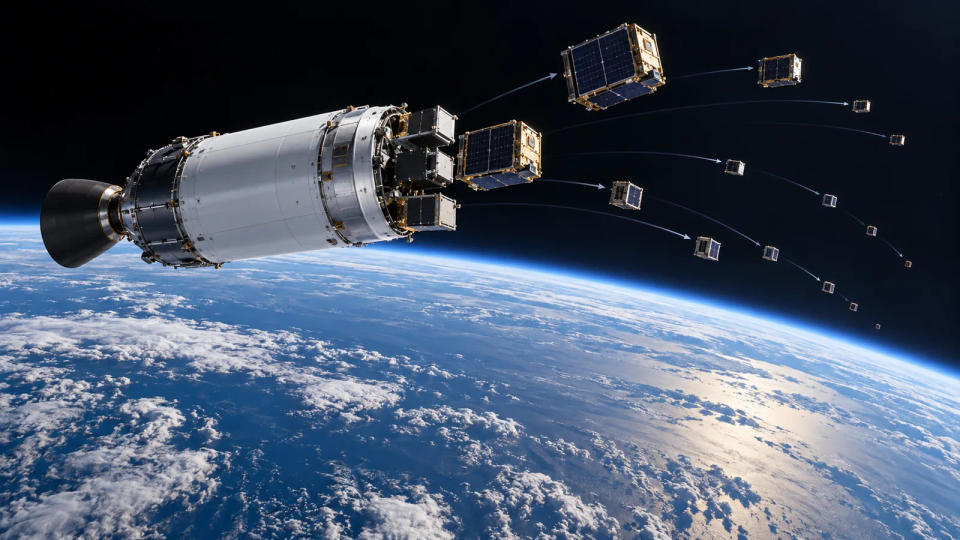
Launching 15 satellites on one rocket sounds like a traffic-control nightmare. Nuri’s fifth flight is designed to avoid that problem by treating deployment as a carefully timed sequence: the larger NEONSAT spacecraft leave one at a time, the rocket changes its attitude between releases, the smaller CubeSats follow in controlled pairs, and the upper stage finishes with a collision-avoidance maneuver.
That choreography will begin only after Nuri reaches its target orbit. South Korea’s fifth Nuri launch is scheduled for October 7, 2026, carrying five NEONSAT microsatellites and 10 CubeSats—the most satellites Nuri has ever carried on a single mission. On October 6, the Korea Aerospace Research Institute said the rocket had begun moving to the launch pad for final preparations.
Why releasing 15 satellites is harder than launching one
A rocket does not simply open a door and let every satellite float away. At orbital speed, even a small difference in direction or timing can determine whether two objects move safely apart or drift back toward the same region later.
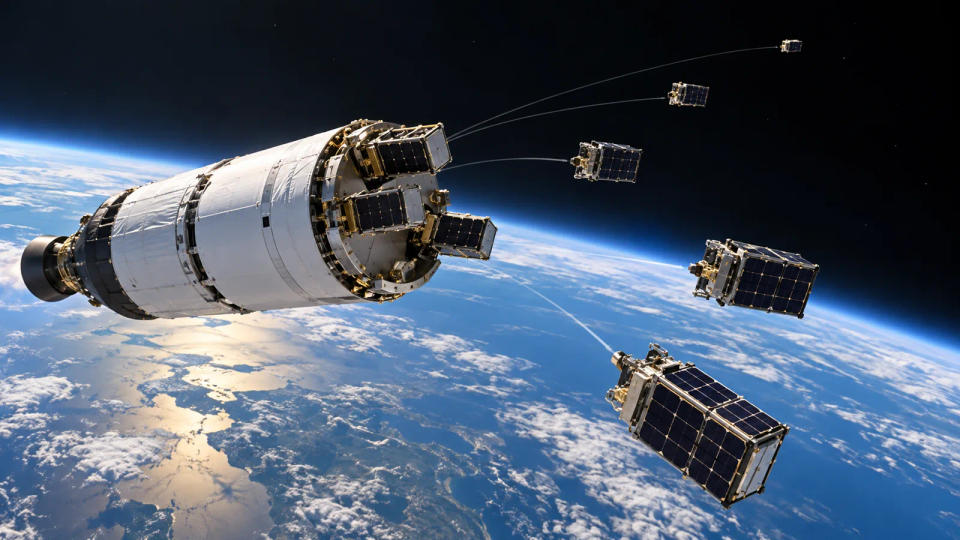
Nuri’s payload also mixes two kinds of passengers. The five primary spacecraft are NEONSAT 2 through 6, each weighing less than 100 kilograms. They are part of a planned Earth-observation constellation. The other 10 payloads are CubeSats built by companies, universities, research organizations and a local government for technology demonstrations and scientific missions.
Keeping those spacecraft from interfering with one another begins with the hardware. For the fifth flight, Nuri uses a newly applied low-shock separation device for the primary satellites. The goal is not only to release each spacecraft reliably, but to reduce the mechanical jolt during separation. The CubeSats are mounted in their own deployment hardware lower in the payload section.
The five NEONSATs will leave 35 to 40 seconds apart
The first major safety measure is simple: do not release the five NEONSATs at once. According to the Korea AeroSpace Administration, they will be separated individually at intervals of about 35 to 40 seconds.
That delay gives each satellite time to move away from the upper stage before the next one is released. The spacing was chosen after trajectory analysis, not as an arbitrary pause. Engineers had to balance two competing needs: give the previous spacecraft enough time to open a safe gap, but complete all 15 deployments within the limited time available for the mission sequence.
The first NEONSAT is expected to separate roughly 810 seconds after liftoff, when the third stage is near the mission’s roughly 570-kilometer target orbit. The remaining four then follow in sequence. In other words, the collision-avoidance plan begins with time itself: every release happens only after the previous spacecraft has had a chance to get clear.
Timing alone is not enough. If every satellite were pushed away along nearly the same line, later spacecraft could still follow earlier ones too closely. So Nuri’s third stage will also adjust its attitude during the deployment sequence and send satellites in different directions.
This is one of the technically demanding parts of the mission. The upper stage must point accurately, release a spacecraft, wait for the planned interval, turn to the next commanded orientation and repeat the process without disturbing the orbit enough to spoil later deployments. Korean officials have highlighted precise attitude control as a key challenge of the fifth launch.
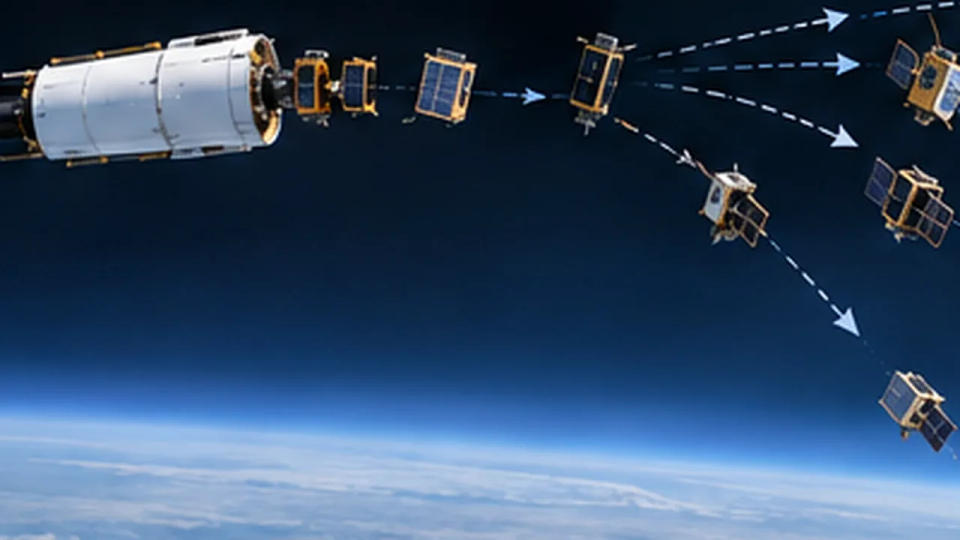
The basic physics is helpful once the releases are properly arranged. A satellite that is given a small separation velocity in a different direction follows a slightly different path from the stage and from its neighboring spacecraft. The important point is that Nuri is creating separation deliberately—first through timing, then through direction—rather than depending on chance after release.
The 10 CubeSats come next, followed by an avoidance maneuver
After all five NEONSATs are clear, the deployment pattern changes. Korean reports citing KARI officials say the 10 CubeSats will be ejected two at a time, with roughly 10 seconds between the five paired releases. That makes the full operation a sequence of 10 deployment events: five individual NEONSAT separations followed by five CubeSat pair releases.
Recent mission details put the last CubeSat release at about 1,035 seconds after liftoff, meaning the satellite deployment phase lasts only a few minutes. During that short window, the third stage has to maintain the correct orbit, point in the right direction and execute each release at the planned time.
Then comes one more safety step. After the satellites are gone, Nuri’s third stage is planned to perform a collision-avoidance maneuver so that the spent stage does not later drift back toward the freshly deployed spacecraft. Remaining gas in the stage is also vented as the flight sequence is completed. The mission is expected to finish its main flight and separation operations in about 20 minutes from liftoff.
Why this deployment test matters beyond one launch
The fifth Nuri flight is not just about carrying a record number of satellites. It is South Korea’s first Nuri mission in which multiple primary satellites performing the same mission are deployed as part of a constellation.
That changes what “launch success” means. Reaching the correct altitude is still essential, but a launcher that wants to serve more complex missions must also be able to deliver several spacecraft in the correct order, with controlled spacing and reliable separation. Multi-satellite missions are especially useful for constellations, where many spacecraft may need to reach similar orbits without crowding one another immediately after deployment.
The five NEONSATs launched on this flight are intended to join the first spacecraft in the program, while another five are planned for Nuri’s sixth launch in 2027. Once the 10-satellite constellation is complete, the system is intended to improve repeated observation of the Korean Peninsula for applications including disaster response and national security.
So the answer to the collision question is not a single piece of technology. It is a sequence: low-shock release hardware, 35-to-40-second gaps for the primary satellites, changes in the rocket’s pointing direction, paired CubeSat deployments, and finally an avoidance maneuver by the upper stage. The satellites do not need to dodge one another after they are released; the mission is designed to make sure they start moving apart from the very beginning.
Sources & Further Reading
- Korea AeroSpace Administration — Nuri fifth launch to open Korea’s first satellite-constellation era
- Korea Aerospace Research Institute — Nuri flight model 5 begins transport to the launch pad
- Korea.net — Nuri to bring Korea’s first microsatellite constellation into space
- Newsis — Detailed Nuri fifth-launch satellite deployment sequence
- KARI — Korean Launch Vehicle Nuri overview
Post a Comment