
Neptune's dark storms appear, drift, and fade. Explore what Hubble and VLT observations reveal about these elusive vortices.
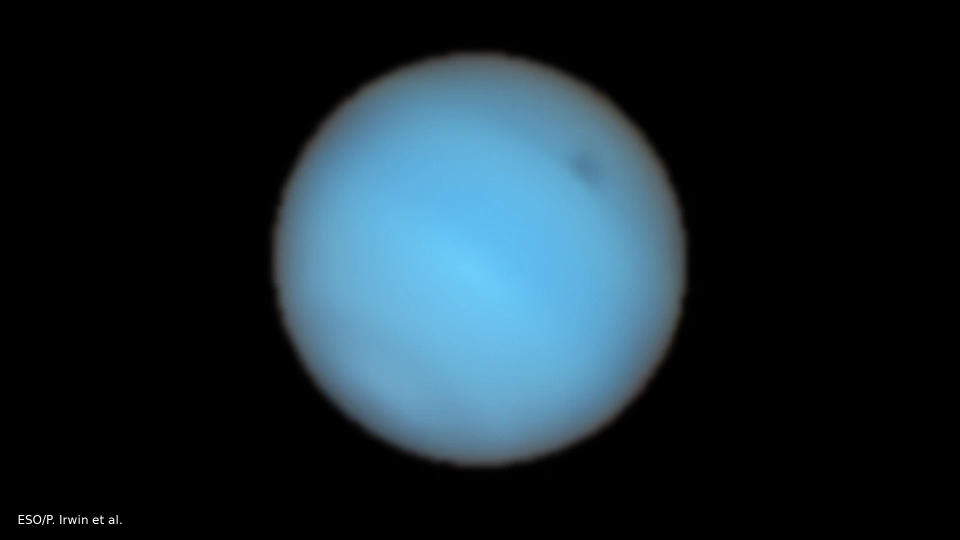
Neptune can lose a storm large enough to dominate a planetary portrait, then produce another elsewhere. These dark features are atmospheric vortices rather than permanent markings. Their changing appearance reflects both atmospheric circulation and the particles that scatter sunlight. Observations establish that spots come and go; explaining every stage of their formation and disappearance remains an active research problem.
A dark spot is a weather system, not a permanent landmark
Voyager 2 photographed the Great Dark Spot during its 1989 encounter. When Hubble examined Neptune in 1994, that feature and another dark storm were absent. A later dark oval therefore should not automatically be identified as the original Great Dark Spot returning. Similar appearance does not establish that two observations show the same weather system.
The distinction matters when reading a collection of Neptune photographs. Images taken years apart are samples of a changing atmosphere, not successive views of an unchanging surface. Before comparing spots, check the observation dates, hemisphere, instrument, and processing. An attractive planetary collage can otherwise suggest continuity that the observations do not support.
Dark vortices are described as high-pressure, anticyclonic systems. The familiar word “storm” can be misleading if it makes us imagine an ordinary terrestrial hurricane. Earth's hurricanes are low-pressure systems. Their appearance, pressure pattern, and surroundings cannot simply be transferred to Neptune by changing the color of the clouds.
Bright clouds near a dark feature also need care. Some companion clouds consist of methane ice at higher altitudes. They are related atmospheric clues, but their brightness does not outline a solid object beneath them. A dark oval and a neighboring white cloud can trace different levels of one complicated atmospheric environment.
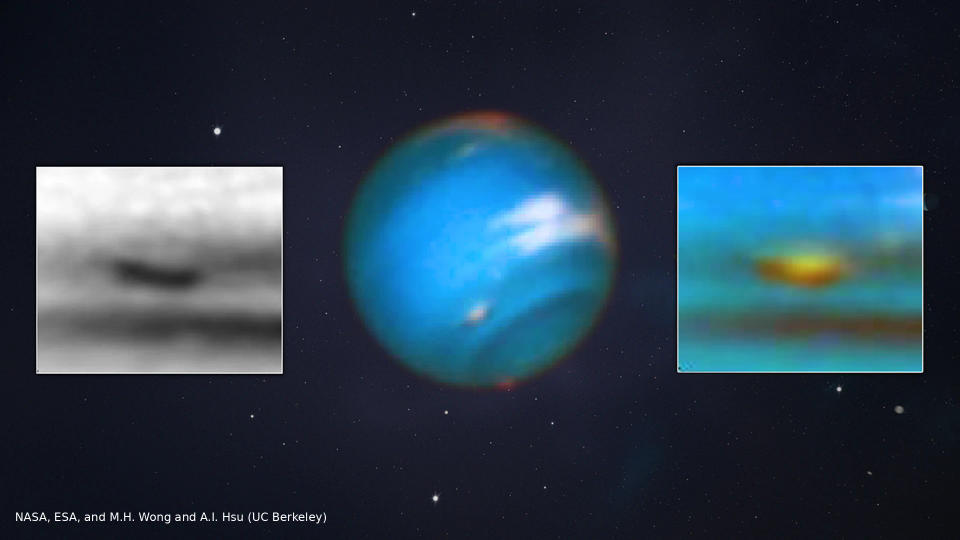
Image: NASA, ESA, and M.H. Wong and A.I. Hsu (UC Berkeley). This published contextual composite is not a chronological sequence.
Why can a vortex fade, drift, or change direction?
A useful starting point is the surrounding wind field. A vortex occupies moving air, so its evolution depends on interactions with that flow. NASA's discussion of the storm first noticed in 2015 identified instability in winds with differing velocities as a likely origin. That is a proposed physical explanation, not a direct observation of the complete birth mechanism.
Rotation also influences the organization of atmospheric motion through the Coriolis effect. This influence varies with latitude and weakens toward the equator. Simulations have consequently suggested that some dark vortices drifting equatorward could become unstable and break apart. Such a calculation provides a hypothesis to test; it does not prescribe the route of every actual spot.
The observations contain useful surprises. Hubble followed a northern storm discovered in 2018 as it moved toward lower latitudes, then found that its direction had reversed by August 2020. A smaller dark feature appeared nearby during that interval. Researchers considered whether it was a fragment, but the relationship was not established as a certainty.
A different storm, discussed in NASA's 2018 report, faded while moving poleward rather than taking the expected equatorward route. Together these examples show why “all storms disappear at the equator” is too strong. Latitude-dependent dynamics help frame the problem, while individual histories reveal the limits of a simple model.
There is another distinction: a visible spot and the underlying circulation are not identical measurements. A dark feature becoming harder to see describes changing contrast in reflected light. Understanding whether circulation weakened, particles changed, or several processes acted together requires more evidence than a single before-and-after photograph.
Why does the storm look dark?
In 2023, ESO reported the first ground-based observation of a Neptune dark spot. The Very Large Telescope's MUSE instrument supplied spatially resolved spectra, allowing researchers to compare reflected light at many wavelengths. Adaptive optics reduced the blur introduced by Earth's atmosphere, and careful processing helped expose subtle features.
The analysis argued against a simple clearing in the clouds. Instead, it favored particles becoming darker in an atmospheric layer below the main visible haze. This is a conclusion about the observed feature and the atmospheric model used to interpret its spectrum. It should not be inflated into a finished chemical explanation for every dark spot ever recorded.
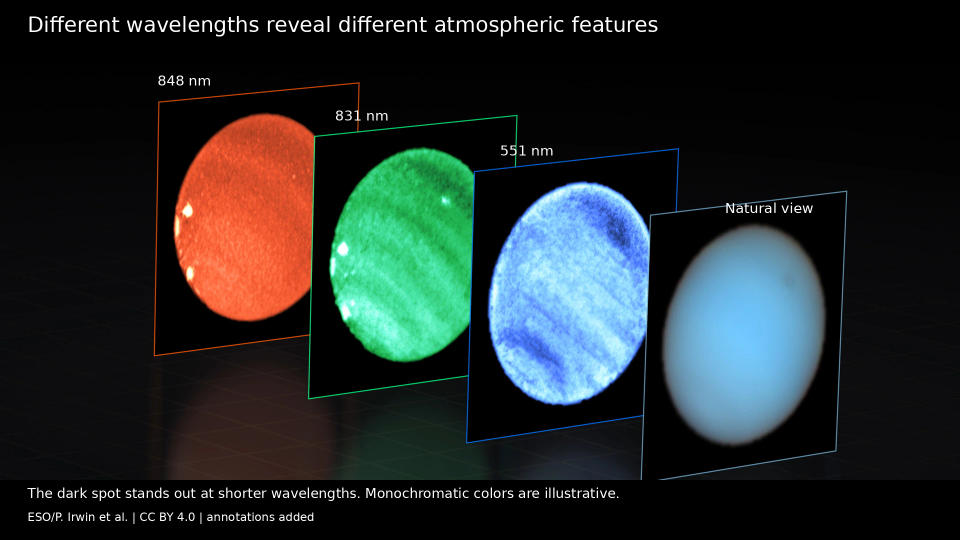
Image: ESO/P. Irwin et al., CC BY 4.0; explanatory labels added. The single-wavelength display colors are illustrative. Cover: ESO/P. Irwin et al., CC BY 4.0; reframed.
Wavelength matters because the atmosphere does not absorb and scatter all light equally. A feature can stand out in one spectral view and nearly disappear in another without physically moving between exposures. Comparing those views adds information about atmospheric depth and optical behavior that an ordinary color portrait compresses into one picture.
MUSE also revealed a bright cloud near the dark spot at a similar atmospheric level, distinct from previously known high-altitude companions. “Bright cloud” therefore does not specify one universal altitude. The spectrum, rather than appearance alone, supplies the evidence needed to distinguish different cloud populations.
For readers, the practical habit is to ask what each image actually measures. A date tells us when a feature was visible; a wavelength tells us which light was selected. Neither alone supplies a complete history of the air beneath the visible haze.
Conclusion
Neptune's disappearing storms teach two connected lessons: circulation evolves, and visible contrast depends on atmospheric particles. Repeated observations test how vortices move and weaken, while spectroscopy investigates why particular regions look dark. The most accurate explanation combines those approaches and keeps their uncertainties visible. Neptune offers a changing weather record, with enough surprises to keep a simple universal storm life cycle out of reach.
Sources & Further Reading
- NASA: Hubble Tracks the Lifecycle of Giant Storms on Neptune (2019)
- NASA: Hubble Sees Neptune's Mysterious Shrinking Storm (2018)
- NASA: Dark Storm on Neptune Reverses Direction, Possibly Shedding a Fragment (2020)
- ESO: Mysterious Neptune dark spot detected from Earth for the first time (2023)
Post a Comment