
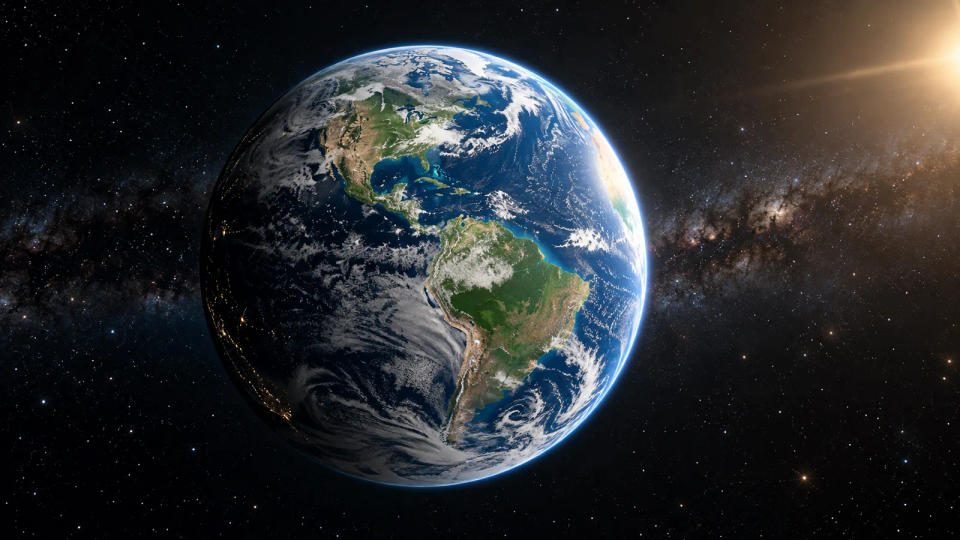
In The Wandering Earth, humanity tries to save its home by turning the whole planet into a spacecraft. Could we actually push Earth through space? In principle, its orbit can be changed, but moving an entire planet with engines—or sending it out of the Solar System—is vastly beyond any technology we possess. The interesting part is that physics does not completely forbid moving Earth; it tells us why the practical barriers are so extraordinary.
The first surprise is that Earth is already traveling through space. It circles the Sun at roughly 29.8 kilometers per second while carrying oceans, atmosphere, rocks, and life along for the ride. The problem is not starting planetary motion from rest. It is changing an enormous planet's existing motion in precisely the right direction without making its surface uninhabitable.
How Would You Push an Entire Planet?
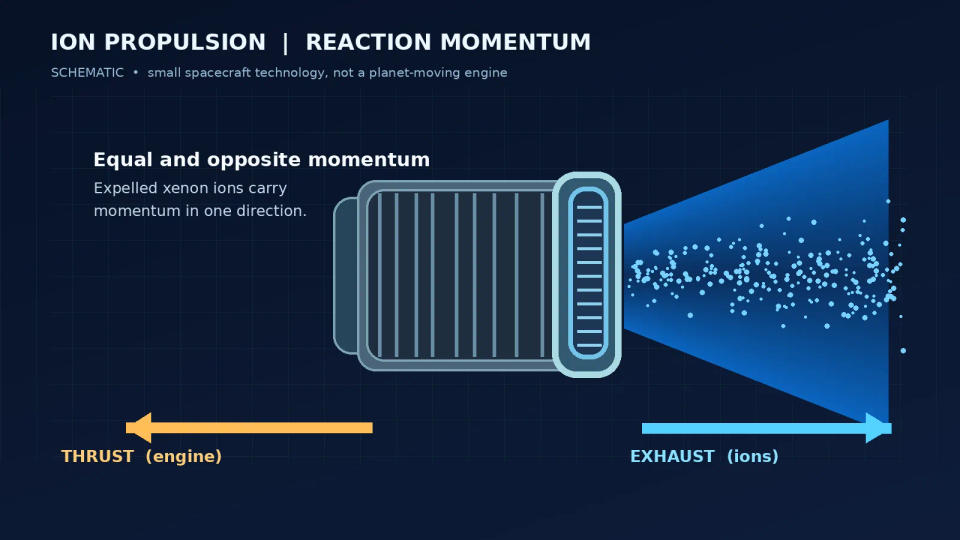
A rocket moves by ejecting material in one direction so that the vehicle gains momentum in the opposite direction. The same principle would work on Earth in theory: propulsion equipment attached to the planet could exert a net force if it expelled reaction mass into space. Unlike a fictional force field, the thrust would need a physical source of momentum, a tremendous energy supply, and a way to survive the stresses placed on the hardware and ground.
But Earth has a mass of approximately 5.97 × 1024 kilograms, according to NASA. Even a modest change in its speed calls for a staggering amount of total momentum. A long, gentle push could lower instantaneous acceleration, but it would not erase the momentum that ultimately has to be transferred or the practical question of where all the expelled material comes from.
Present-day electric propulsion illustrates the gap. NASA's Dawn spacecraft used xenon ion engines capable of efficient operation over long periods; a unit produced only about 91 millinewtons at maximum thrust. That is valuable for a relatively light spacecraft, not a planet. Scaling from millinewton engines to planetary engineering is not a matter of simply adding a few launchpads.
Another trap is pointing the engines the wrong way. A rocket that boosts Earth along its direction of orbital travel can raise the size of its solar orbit; a push against that motion can lower it. An upward-looking plume in a movie may look impressive, but an actual orbital maneuver depends on the direction, timing, and duration of the thrust. The mathematics is the same basic orbital mechanics NASA uses to plan spacecraft trajectories.
How Much Energy Would Moving Earth Require?
Consider a deliberately simplified example: transfer Earth from a circular orbit at 1 astronomical unit, its current average distance from the Sun, to a circular orbit at 1.5 astronomical units. Using the standard Sun–Earth two-body orbital-energy equation and NASA's approximate Earth mass, the difference in orbital energy is about 8.8 × 1032 joules. That is an idealized change in orbital energy, not a complete fuel bill or a proposed mission plan.
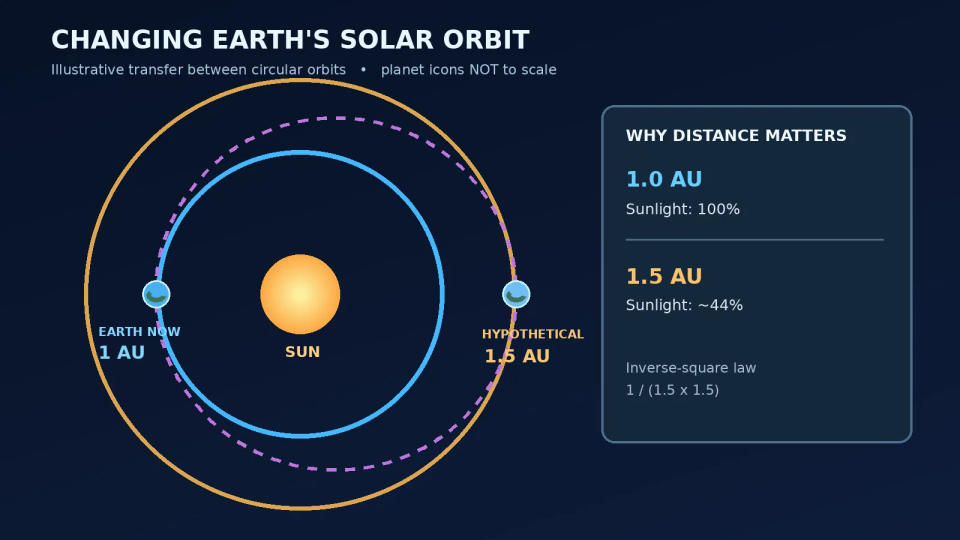
For scale, 1.5 astronomical units is 50 percent farther from the Sun. The sunlight received per square meter would be about 44 percent of today's value, assuming the Sun remains unchanged and ignoring atmospheric feedbacks. Moving outward might eventually address a brighter Sun, but pushing Earth too far today would dramatically alter its energy balance. Keeping the planet physically intact would not guarantee that its climate stayed familiar.
Leaving the Sun altogether is harder still. In a simplified circular-orbit calculation, Earth would need roughly another 12.3 kilometers per second of instantaneous prograde speed to reach solar escape at its current distance, with no help from another body. The required increase in its solar orbital energy is approximately 2.6 × 1033 joules. These are theoretical benchmarks, not engineering estimates for rockets fixed to Earth; actual sustained thrust trajectories and losses would differ.
And escaping the Sun would not magically deliver a habitable new star system. Interstellar distances are immense; without a nearby energy source, Earth would lose most of its solar illumination. Oceans and atmosphere would undergo severe changes unless humanity supplied extraordinary artificial heat and protected ecosystems. A traveling Earth might keep its mass and gravity, but it would not keep Earth's present living conditions automatically.
Could Gravity Assists Work Better Than Giant Engines?
One serious scientific thought experiment takes a different approach: rather than firing world-sized engines, borrow orbital energy from another planet. Spacecraft already use gravity assists, passing moving planets at carefully selected angles to trade energy and momentum. NASA describes how the technique helps probes reach distant destinations while conserving onboard fuel. The planet making the assist also exchanges energy, although a spacecraft's effect on it is tiny.
In a 2001 research paper, D. G. Korycansky, Gregory Laughlin, and Fred C. Adams modeled a highly speculative way to expand Earth's orbit over geological timescales. Their scheme sends a massive asteroid- or Kuiper Belt–sized object past Earth so that Earth gains orbital energy. That body later encounters Jupiter, replenishes its energy, and can potentially return for repeated carefully timed passes.
The published scenario calculated that, for a passing object of about 1022 grams, encounters roughly every 6,000 years could compensate for the Sun's gradual brightening in the model. This is a modeled possibility, not a tested technology, an approved mission, or a safe near-term solution. The same paper discusses severe hazards: a misdirected flyby could threaten Earth, and repeated encounters might perturb the Moon and the rest of the planetary system.
There are other conceptual approaches, including collecting outside reaction mass or using enormous off-world infrastructure. None currently offers a demonstrated, controllable means to reposition Earth. A real design would need to account for the planet's rotation, the Moon, ocean and atmospheric responses, collision risk, and extremely accurate control over timescales far longer than human institutions normally plan for.
Conclusion
The central idea behind The Wandering Earth is not a violation of Newton's laws: a planet's trajectory can, in principle, change. What makes the film science fiction is the scale. Today's propulsion systems cannot push Earth as a practical vehicle, and escaping the Solar System would create a second crisis by taking our biosphere away from sunlight. If planetary orbit engineering ever becomes imaginable, its likelier first step would be understanding small, gradual gravitational changes—not building a planet-sized rocket overnight.
Sources & Further Reading
- NASA Glenn Research Center — Earth
- NASA — Facts About Earth
- NASA — Basics of Space Flight: Chapter 4, Trajectories
- NASA — Dawn Ion Propulsion
- Korycansky, Laughlin & Adams (2001) — Astronomical Engineering: A Strategy for Modifying Planetary Orbits
Post a Comment