
New lunar fault maps suggest the Moon's radius shrank about 45 meters over 400–800 million years. Here's what the evidence shows.
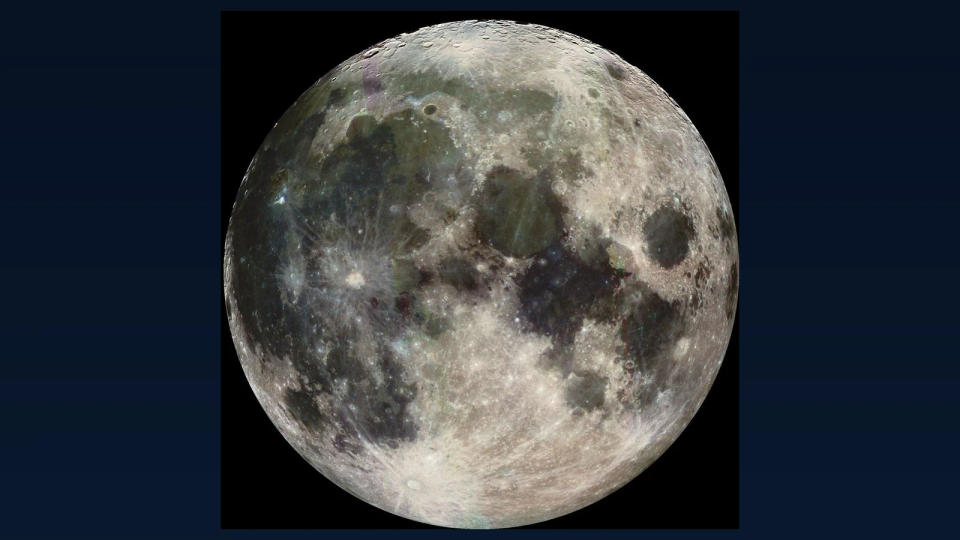
Cover: NASA/JPL/USGS, Galileo spacecraft, PIA00405. The camera data use enhanced colors, including infrared-sensitive filters.
The Moon looks almost unchanged when we see it from Earth. Yet a study published on October 14, 2026, argues that its radius has contracted by roughly 45 meters (148 feet) during the past 400–800 million years. Scientists reached that estimate by mapping more than 10,000 relatively young compressional fault features in NASA Lunar Reconnaissance Orbiter images—not by watching the entire Moon visibly shrink in real time.
That modest change is an important clue to the Moon's cooling interior, its fractured crust, and the moonquakes that may still occur along some faults. The discovery is about slow geological evolution, not an approaching collapse or a sudden danger to Earth.
What Does a 45-Meter Decrease in Lunar Radius Actually Mean?
The key word is radius. The 2026 estimate concerns the distance from the Moon's center to its surface, averaged over its spherical geometry. It should not be casually repeated as a 45-meter decrease in diameter. If a spherical body loses 45 meters of radius, its diameter changes by twice that amount in the simplest geometric interpretation, although the actual Moon is not a perfect sphere.
The research by Thomas R. Watters and colleagues in The Planetary Science Journal uses the surface deformation recorded in faults to infer late-stage global contraction. The roughly 400–800-million-year interval describes the proposed period of widespread fault formation, not a precisely timed continuous measurement. If contraction had been steady throughout that interval, the implied average radius change would be on the order of 6–11 centimeters per million years. Scientists do not know that its rate was perfectly uniform.
Much of the Moon's early energy came from its formation, bombardment, and radioactive decay. As the interior loses heat, its volume gradually decreases. The outer rocky shell does not respond like stretchable rubber: compressive stress can build until brittle rock breaks, allowing one block to move over another along a thrust fault.
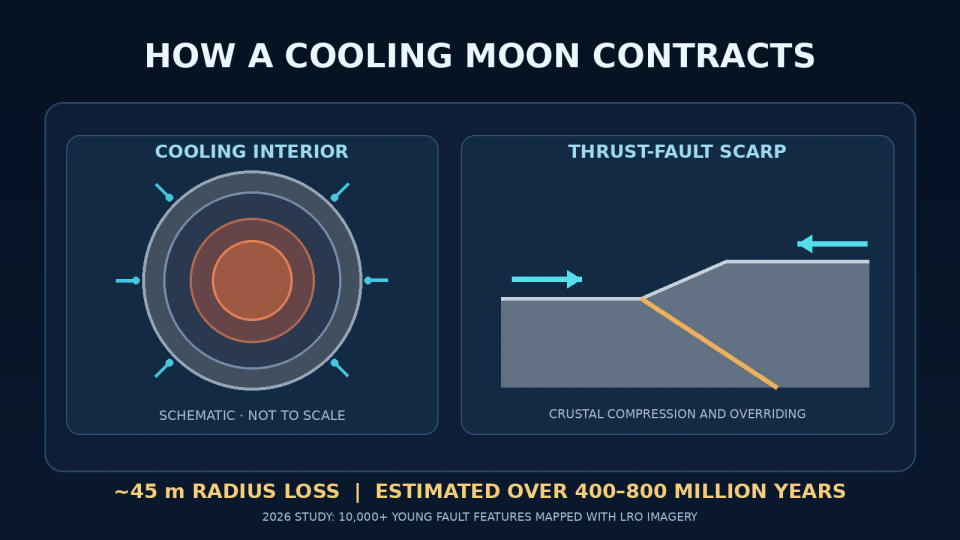
Editorial science schematic based on Watters et al. (2026); not to scale. The 45-meter figure is an inferred change in radius, not a visible size difference in the drawing.
An earlier NASA explanation in 2019 discussed a roughly 50-meter decrease in the Moon's diameter over several hundred million years. That is not the same geometric quantity as the new paper's radius estimate. The two figures also reflect different analyses and should not be treated as interchangeable measurements.
What Do More Than 10,000 Young Fault Features Reveal?
For decades, lunar geologists have identified small, curved steps in the terrain known as lobate scarps. They are the surface expression of compressional faults: rocks have been shortened and displaced, leaving a low cliff or ridge. NASA's Lunar Reconnaissance Orbiter Camera (LROC) has made it possible to recognize and map these landforms over far more of the Moon than Apollo-era photographs alone could reveal.
The 2026 survey brings together thousands of young scarps and small ridges in the dark basaltic plains called maria. These structures are different from ordinary impact craters. Their patterns, locations, and geometry record stress in the crust, although the mapped count does not mean that every feature is an independently observed earthquake or an actively slipping crack today.
Crucially, the faults do not occur at Earth-like plate boundaries. The Moon lacks Earth's network of mobile tectonic plates. Instead, stresses affect a largely continuous outer shell, and thrust faults appear across different regions. Their uneven distribution may help constrain how thick crust and a porous, insulating layer of broken rock shaped the cooling history. The proposed insulation effect is a scientific interpretation that still requires testing, not a directly photographed underground blanket.
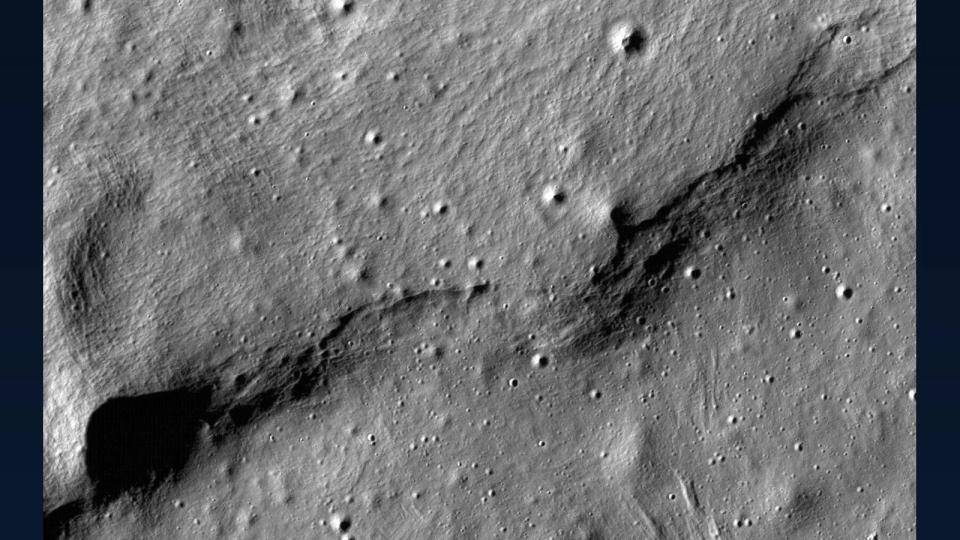
Actual LRO observation near Mare Frigoris: NASA, Photojournal PIA23236. The winding raised landform is a lobate scarp; this is not an AI reconstruction.
Mapping such surface relief also lets researchers estimate the horizontal shortening accommodated by faults. Converting that shortening into an overall reduction in radius involves geological assumptions, including fault geometry and which landforms belong to the relevant contractional episode. The new number is therefore a model-based estimate supported by observations, not a ruler reading of the entire Moon.
Could a Shrinking Moon Still Produce Moonquakes?
Possibly—and several independent observations make the question serious. Apollo seismometers recorded 28 shallow moonquakes between 1969 and 1977. A 2019 analysis found eight events close enough to mapped fault scarps to support a possible association, while acknowledging uncertainty in the estimated quake locations. Earth also exerts tidal forces on the Moon, which can add stress to faults already compressed by long-term cooling.
NASA-funded research in 2024 modeled potential strong shaking and landslide susceptibility near the lunar south pole, a region of interest for future exploration. A later 2025 study combined LRO images and Apollo 17 rock evidence to investigate past shaking along the Lee-Lincoln fault. These studies strengthen the case for geological activity, but they do not establish that all 10,000-plus mapped structures are moving now or predict the date of any future quake.
For lunar explorers, the practical lesson is regional risk assessment. Site planners need to consider nearby faults, slope stability, loose regolith, equipment lifetime, and the scarcity of modern seismic measurements. A fault map is one ingredient in that process, not a universal "danger map". Much more monitoring will be necessary to determine how often individual faults slip.
Conclusion
The Moon's quiet appearance hides a long geological history of cooling, compression, and crustal movement. The 2026 study's approximately 45-meter radius-loss estimate and catalogue of more than 10,000 young fault features offer a new way to measure that history. The biggest insight is not that the Moon is disappearing, but that its surface still preserves evidence of changes unfolding over hundreds of millions of years. As lunar exploration expands, understanding those faults could help scientists investigate the interior and make better-informed decisions about where lasting surface infrastructure belongs.
Sources & Further Reading
- Watters et al. (2026), Thrust Faulting and the Late-stage Contraction of the Moon, The Planetary Science Journal
- NASA (2019), Shrinking Moon May Be Generating Moonquakes
- NASA (2024), Shrinking Moon Causing Moonquakes and Faults Near Lunar South Pole
- NASA (2025), NASA's Apollo Samples, LRO Help Scientists Forecast Moonquakes
- NASA Photojournal, Lobate Scarps on the Moon (PIA23236)
Post a Comment