
Mimas looks frozen and cratered, yet its motion points to a young ocean hidden beneath Saturn's Death Star moon.
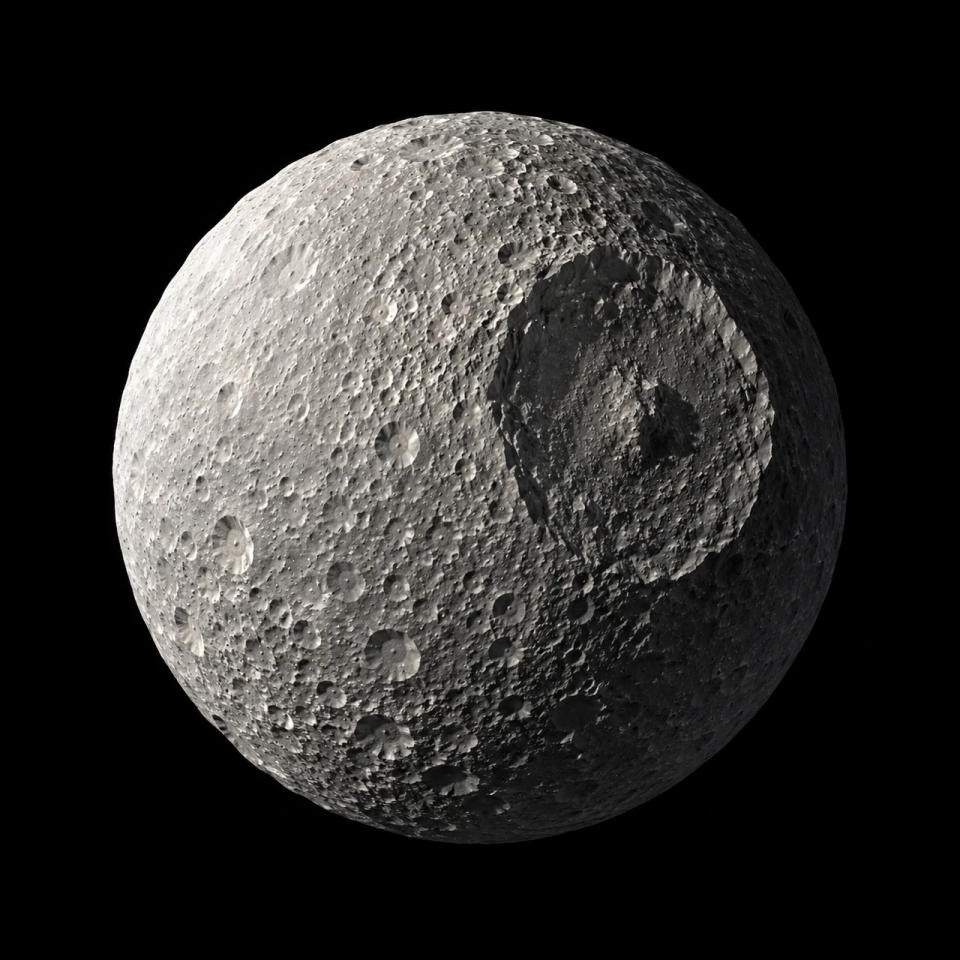
A giant crater gives Mimas its famous resemblance to the Death Star, but the real mystery is beneath the ice. Analyses of Cassini measurements strongly support a global liquid-water ocean under its surface, although no spacecraft has directly photographed or sampled that water. The evidence comes from how the moon rotates and moves around Saturn, rather than from an obvious opening in its frozen exterior.
That distinction makes the story more interesting. Mimas challenges the assumption that an ocean moon must advertise its interior through fresh fractures or spectacular eruptions. Its scarred face and its measured motion appear to tell different stories, and researchers are working out how both can be true.
How can a moon's motion reveal an ocean?
Mimas keeps approximately the same face toward Saturn, but that does not mean its rotation is perfectly uniform. Cassini observations revealed a small periodic rocking called libration. Such motion depends on the distribution of mass inside the moon and how its layers respond to gravitational forces. Earlier interpretations allowed two very different interiors: an unusually shaped solid core or a liquid layer separating the outer shell from deeper material.
A study by Valéry Lainey and colleagues, published in Nature in February 2024, added a powerful constraint by analyzing Mimas's orbital motion. The team focused particularly on the drift of its periapsis, the point in an orbit closest to Saturn. The way this direction changes provides information beyond the rotational wobble alone, allowing competing interior models to be tested against more than one observation.
Their preferred explanation is a global ocean beginning roughly 20–30 kilometers beneath the surface. That figure describes the depth through the overlying ice shell, not a measurement of the ocean's own thickness. The distinction matters: knowing where liquid begins does not automatically reveal how deep the water extends or exactly what lies at the seafloor.
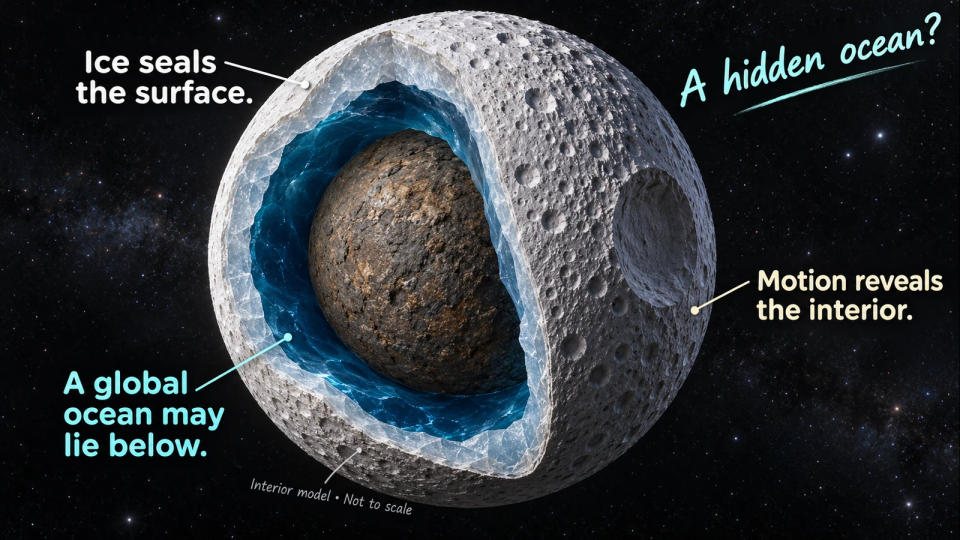
This is a strong inference from measured behavior and physical modeling, rather than an image of a hidden sea. A cutaway illustration makes the proposed structure understandable, but its colors and layer proportions should not be mistaken for observations. The scientific question is whether a model reproduces the moon's behavior while remaining compatible with its geology.
Why does Mimas still look frozen and inactive?
NASA describes Mimas as a small, slightly elongated, ice-rich moon about 400 kilometers across. Its heavily cratered terrain preserves a record of impacts. The most recognizable feature is Herschel, an enormous basin with a raised rim and central peak. These are geological structures, not artificial machinery, and the cinematic nickname tells us nothing about the moon's composition.
A young ocean offers a way to reconcile this battered exterior with liquid below. Lainey's team inferred an ocean younger than about 25 million years. Their simulations suggest its upper boundary reached within 30 kilometers of the surface only during the last 2–3 million years. Those are model-dependent timescales, not ages established by collecting rocks or directly dating water.
The idea is that substantial interior change can precede obvious surface transformation. An intact cold lid can conceal what is happening underneath, especially if melting and ice-shell thinning developed relatively recently. The presence of old-looking craters therefore cannot, by itself, settle whether every layer inside the moon is frozen today.
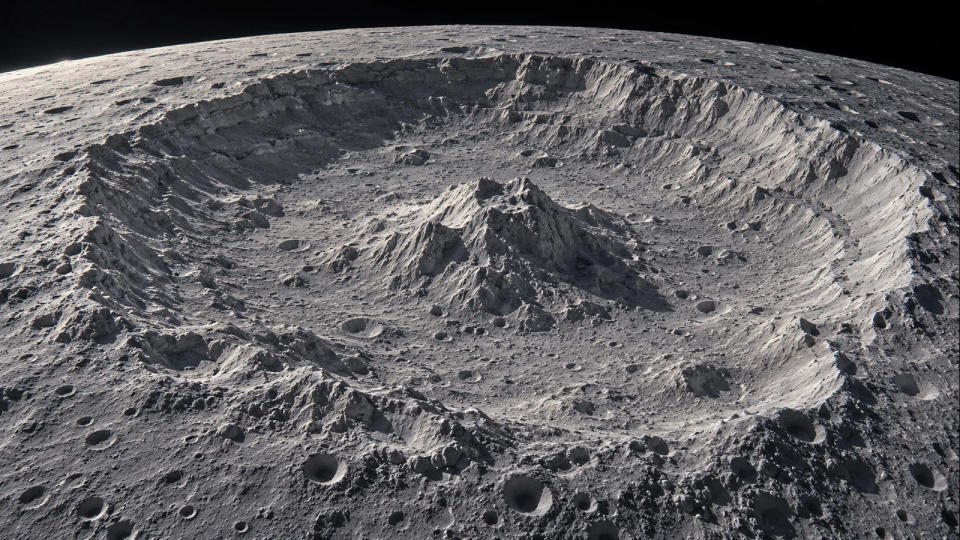
A 2025 study by C. A. Denton and A. R. Rhoden revisited Herschel's formation using impact simulations. It found that the basin could be compatible with several earlier interior structures, including a fully frozen shell warm enough to approach melting. The crater is therefore not a simple yes-or-no test for an ocean at the moment of impact. This later work refines the geological constraints without replacing the separate evidence from Mimas's motion.
What could keep the water liquid—and could it host life?
Sunlight is not the only way to supply heat. Saturn's gravity can repeatedly deform a moon on a noncircular orbit. Internal resistance converts some orbital and rotational energy into heat, a process called tidal dissipation. Researchers must balance that heating against cooling: enough energy can maintain liquid, while excessive heating would be difficult to reconcile with a thick, comparatively quiet ice shell.
A 2024 thermal-orbital study by Alyssa Rhoden and colleagues modeled how those processes evolve together. In their scenarios, the ocean could grow while Mimas's orbit became more circular, provided melting began recently and the earlier orbital eccentricity was substantially larger. Their models favored formation within roughly the past 10–15 million years under the tested conditions. This is a conditional evolutionary explanation, not a uniquely established history.
The same calculations also allow a later freezing phase as orbital eccentricity declines. That possibility is a model outcome, not a forecast with a scheduled date for eruptions or complete freezing. Mimas's future depends on the coupled evolution of its orbit, heat production and interior structure.
Liquid water makes a world scientifically compelling, but it does not establish habitability or life. Researchers would still need to constrain the chemistry, available energy and interactions between water and rock. An inferred ocean cannot tell us that organisms exist, or that conditions have remained suitable long enough for biology. Mimas is valuable even if it is lifeless: it offers a test of how small icy moons begin and sustain hidden seas.
Conclusion
Saturn's Death Star moon is a strong ocean-world candidate because its motion is difficult to explain with a wholly frozen interior. The leading interpretation places liquid beneath a 20–30-kilometer ice shell and links its quiet exterior to a relatively young ocean. Its cratered appearance is part of the puzzle, while the ocean's age, evolution and chemistry remain questions for further investigation. All three article images are AI-generated scientific visualizations; the cutaway is a schematic model, not a view beneath real ice.
Sources & Further Reading
- Lainey et al. — A recently formed ocean inside Saturn's moon Mimas (Nature, 2024; abstract)
- NASA Science — Mimas
- Rhoden et al. — The evolution of a young ocean within Mimas (2024)
- Denton and Rhoden — Herschel impact basin probes the onset of a young ocean on mimas (2025)
- Southwest Research Institute — SwRI scientist uncovers evidence for an internal ocean in small Saturn moon (2022)
- NASA Science — Flying by the “Death Star” Moon
Post a Comment