
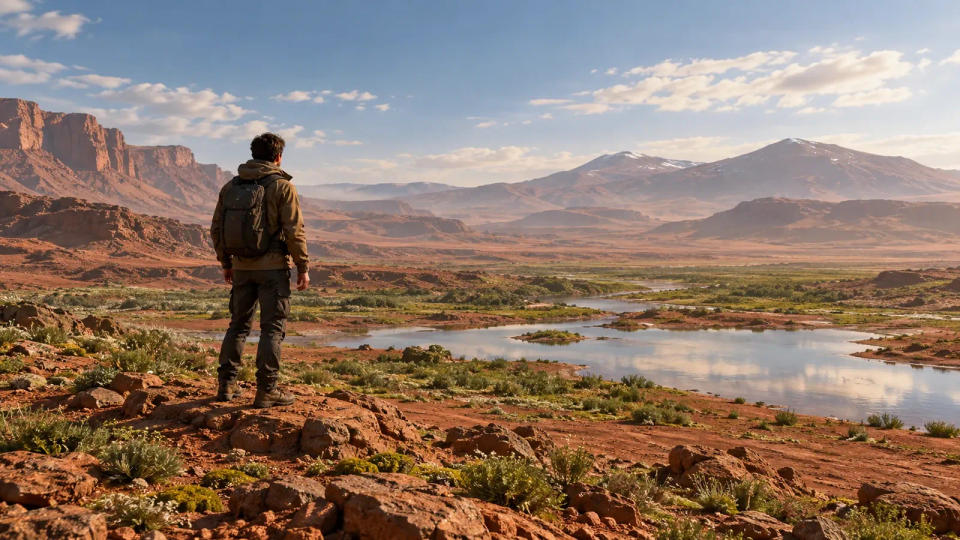
Imagine opening an airlock on Mars, stepping onto the red ground, and leaving the helmet behind. Could humans ever do that? In principle, yes—but only after changing Mars so profoundly that it would no longer have anything like the atmosphere it has today.
Right now, walking outside without a pressure suit would be fatal. Mars is cold, its atmosphere is extremely thin, almost all of that atmosphere is carbon dioxide, and the planet offers far less protection from energetic radiation than Earth does. The dream of walking outdoors in ordinary clothing is therefore not mainly about designing better astronauts. It is about rebuilding an entire planetary environment.
Why Today’s Mars Makes a Spacesuit Essential
Mars has an average surface pressure of only about 6.36 millibars, compared with roughly 1,013 millibars at sea level on Earth. Its atmosphere is about 95% carbon dioxide, while oxygen makes up only a tiny fraction. The average surface temperature is around -59°C (-74°F), though local temperatures vary widely with season, time of day, and location.
That combination creates several problems at once. There is not enough oxygen to breathe, the total pressure is far too low for normal human physiology, and the cold would quickly become dangerous without protection. A Mars spacesuit therefore has to do much more than carry oxygen. It acts as a tiny personal atmosphere, maintaining pressure, controlling temperature, removing carbon dioxide and moisture, and shielding the wearer from dust and part of the radiation environment.
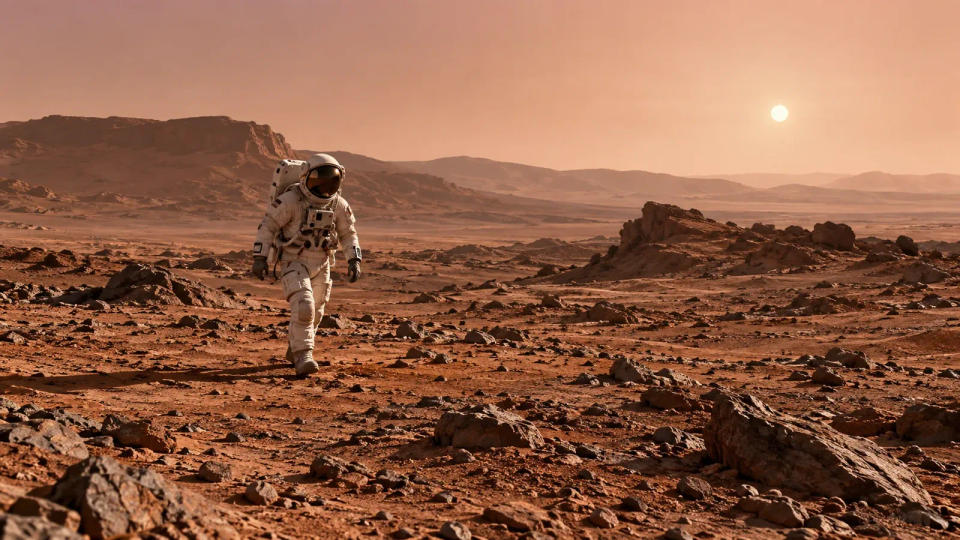
The pressure problem is especially easy to underestimate. NASA spacesuits operate at much lower pressure than Earth’s atmosphere, but they compensate by using very high oxygen concentrations. Mars cannot do that naturally today because it has neither enough total pressure nor enough oxygen.
A Thicker Atmosphere Would Have to Come First
Before future Martians could worry about breathing outdoors, Mars would need a much denser atmosphere. A thicker blanket of gas would raise surface pressure, hold heat more effectively, and give the planet more protection from incoming radiation. It could also make liquid water more stable at the surface under suitable temperatures.
For decades, one popular terraforming idea has been to release carbon dioxide frozen in the polar caps or trapped in the soil and rocks. More carbon dioxide would strengthen the greenhouse effect and increase pressure. The problem is scale. A NASA-sponsored study concluded that Mars does not appear to have enough readily accessible carbon dioxide to create the kind of thick, warm atmosphere envisioned in classic terraforming scenarios using present-day technology.
That does not prove terraforming is impossible forever. It means the easy version—simply releasing enough native carbon dioxide to transform the planet—is not supported by what we currently know. A civilization attempting something more ambitious might have to manufacture greenhouse gases, import volatile material from elsewhere in the Solar System, or process enormous quantities of Martian rock. All of those ideas are far beyond current engineering.
Oxygen Can Be Made, but Not Yet on a Planetary Scale
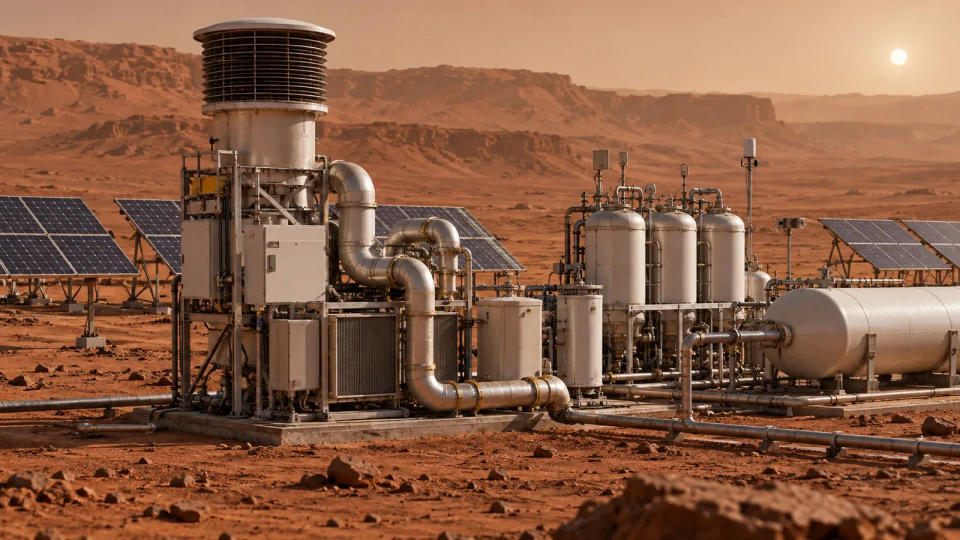
NASA has already demonstrated one important piece of the puzzle. The MOXIE experiment aboard the Perseverance rover pulled carbon dioxide from the Martian atmosphere and electrochemically split it to produce oxygen. Across 16 runs, MOXIE produced a total of 122 grams of oxygen, reaching as much as 12 grams per hour at its best.
That was a major technology demonstration because future crews could use scaled-up systems to make breathing oxygen and, even more importantly, oxidizer for rocket propellant. But keeping a habitat supplied with oxygen is very different from filling an entire planet’s atmosphere with it. Terraforming would require changing the composition of an atmospheric reservoir on a planetary scale and then maintaining that atmosphere for extremely long periods.
Plants are sometimes imagined as the next step, but they cannot simply be scattered over present-day Mars and expected to solve the problem. They would first need survivable pressure, temperatures, water availability, light conditions, nutrients, and protection from the harsh environment. Biology could potentially become part of a long-term atmospheric engineering strategy only after many of the hardest physical problems had already been addressed.
Radiation, Temperature, and Dust Would Still Matter
Suppose Mars somehow gained enough air and oxygen for humans to breathe. That still would not automatically make the surface comfortable or safe. Earth’s thick atmosphere and global magnetic field help reduce radiation exposure at the surface. Mars lacks a comparable global magnetic field, and its present atmosphere is too thin to provide Earth-like shielding.
Curiosity’s Radiation Assessment Detector has measured radiation on the Martian surface from galactic cosmic rays and solar energetic particles. A much thicker atmosphere would help because more material above a person means more shielding, but exactly how much protection a terraformed atmosphere would provide would depend on its density and composition.
Temperature would also have to rise enough to avoid constant life-threatening cold. Then there is Martian dust. It is extremely fine, easily lofted, and chemically reactive material in the soil includes perchlorates. Even on a warmer, wetter Mars, settlers might still use masks, goggles, filters, or protective clothing in dusty regions—much as people on Earth use specialized gear in deserts, polar environments, or polluted areas without needing full pressure suits.
Conclusion: Could Humans Ever Step Outside Bareheaded?
In the most optimistic far-future scenario, yes. If Mars had a sufficiently thick atmosphere, a safe oxygen partial pressure, tolerable temperatures, stable surface water, and enough atmospheric shielding, a human might be able to walk outside without a pressure suit. The first versions of that freedom would probably not look like a summer afternoon on Earth. People might still need warm clothing, eye protection, respirators during dust events, or medication and acclimatization if the atmospheric pressure were low.
The important distinction is between local life support and planetary transformation. Technologies such as MOXIE suggest that humans may eventually live on Mars by creating breathable air inside habitats and vehicles. That is an engineering challenge we can meaningfully work on now. Making the entire Martian outdoors safe enough to breathe is a vastly larger task, likely requiring technologies, energy systems, and timescales that do not yet exist.
So the dream is not forbidden by the laws of physics. It is simply much farther away than the first human footprints on Mars. Long before anyone strolls across the planet without a helmet, the more realistic path is pressurized habitats, protected rovers, and increasingly capable spacesuits—small islands of Earth-like conditions on a world that remains unmistakably Mars.
Sources & Further Reading
- NASA NSSDC: Mars Fact Sheet
- NASA: Mars Terraforming Not Possible Using Present-Day Technology
- NASA: Oxygen-Generating Experiment MOXIE Completes Mars Mission
- NASA Science: Radiation Measurements on Mars
- NASA Science: Curiosity Rover Science
Post a Comment