
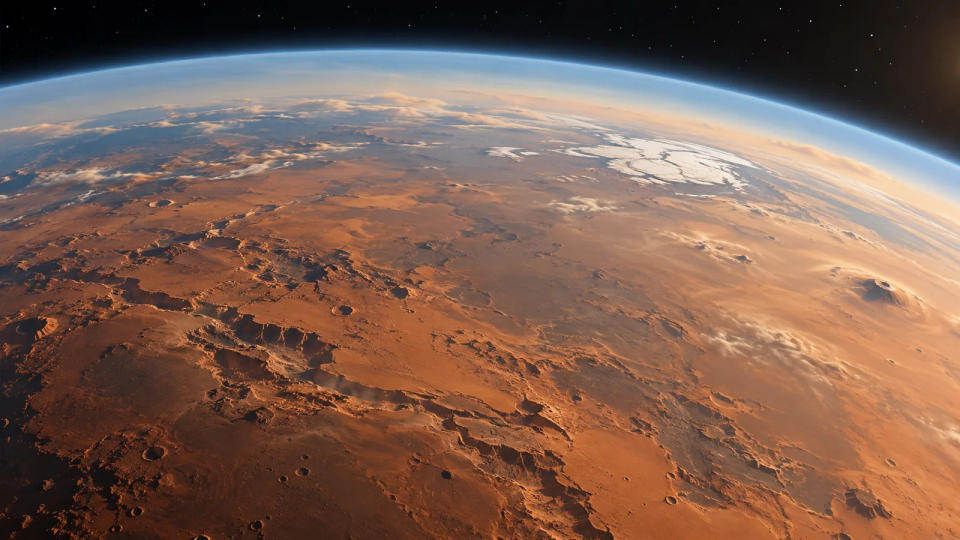
Mars already has an atmosphere. The problem is that it is so thin, cold, and dominated by carbon dioxide that a human standing outside would still need a pressure suit, oxygen supply, and thermal protection.
So could terraforming ever give Mars an atmosphere thick enough for people to survive in the open? In principle, physics does not forbid it. In practice, the challenge is enormous: Mars would need vastly more atmospheric mass, a carefully controlled mix of gases, major warming, and planetary-scale industry operating for centuries or longer.
How thin is the Martian atmosphere today?
Average surface pressure on Mars is only about 6 millibars, roughly 0.6 percent of Earth’s sea-level pressure. NASA lists the atmosphere as about 95 percent carbon dioxide, with small amounts of nitrogen and argon. That is enough to make wind and dust storms possible, but nowhere near enough to protect an unpressurized human body.
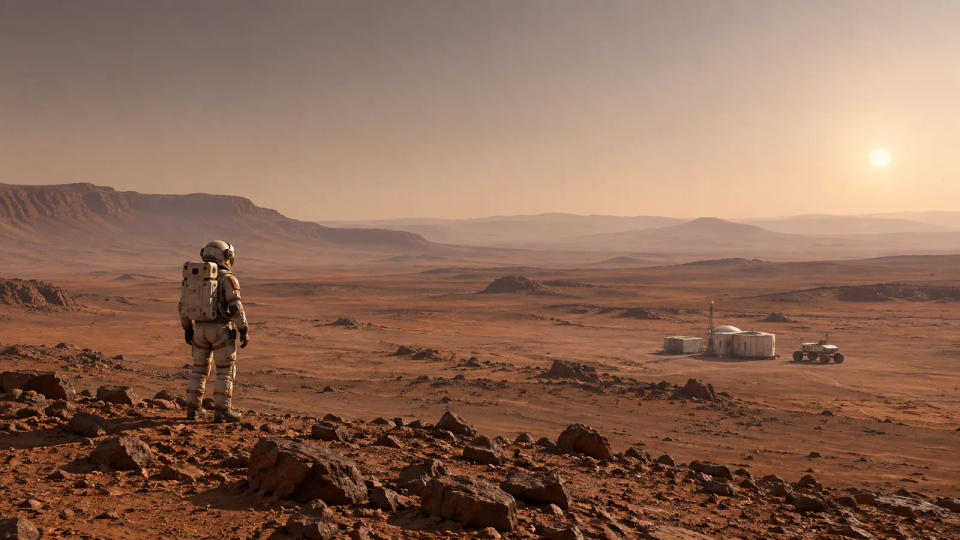
Pressure matters separately from oxygen. NASA human-spaceflight standards for long-duration exposure put habitable total pressure in the range of about 34.5 to 103 kilopascals, depending on atmospheric composition. Mars is currently around 0.6 kilopascals. Even if the Martian air suddenly contained oxygen, the total pressure would still be far too low for people to walk around without pressure protection.
This distinction is important because “breathable” does not simply mean adding oxygen. Humans need enough oxygen partial pressure for metabolism, enough total pressure for normal physiology, and a safe diluent or buffer gas so the atmosphere is not an extreme fire hazard or a medically unsuitable oxygen-rich environment.
How much gas would Mars actually need?
The numbers quickly become planetary. A 2026 analysis in APS Open Science estimated that every additional millibar of global average pressure on Mars requires about 3.89 × 10¹⁵ kilograms of atmospheric gas. Human-relevant open-air pressures therefore require roughly 1017 to 1018 kilograms of added atmosphere.
For an illustrative breathable end state, the same study considered oxygen at 21 kilopascals and nitrogen at 50 kilopascals. That corresponds to about 9 × 10¹⁷ kilograms of oxygen and 1.9 × 10¹⁸ kilograms of nitrogen. Together, those two gases alone would total about 2.8 × 10¹⁸ kilograms.
For comparison, NASA’s Mars fact sheet gives the mass of the entire present Martian atmosphere as roughly 2.5 × 10¹⁶ kilograms. A genuinely breathable open atmosphere would therefore involve adding atmospheric mass on the order of one hundred times greater than what Mars has now, while also changing its chemistry.
Could Mars simply release enough carbon dioxide from its poles, soil, and minerals? Current evidence says no. A NASA-sponsored 2018 study concluded that known accessible carbon dioxide reservoirs are insufficient for full terraforming with present-day technology. A newer 2026 system-level analysis similarly treats accessible native CO2 as an order-of-tens-of-millibars resource, useful for some warming but far short of a breathable atmosphere.
Warming Mars is easier than making it breathable
There has been genuine progress in ideas for warming Mars. A 2024 Science Advances study modeled specially engineered microscopic particles made from materials that could, in principle, be produced on Mars. The particles would interact with sunlight and outgoing infrared radiation in a way that could produce far more warming per unit mass than conventional greenhouse gases. In the modeled scenario, sustained release could raise global temperatures by tens of degrees.
Follow-up work published in 2026 examined whether such radiatively active particles released near the surface could actually spread through the atmosphere. The simulations found that self-lofting and changes in atmospheric circulation could help distribute them, although important engineering and climate uncertainties remain.
That is encouraging if the goal is melting some ice, improving local habitability, or making water easier to access. But warming and breathing are different problems. A warmer Mars can still have a thin, toxic atmosphere. Heat does not magically create nitrogen, nor does it produce the enormous oxygen inventory humans would need.
In other words, climate engineering may reduce one barrier while leaving the biggest mass-and-composition problem almost untouched.
Could future industry manufacture a breathable atmosphere?
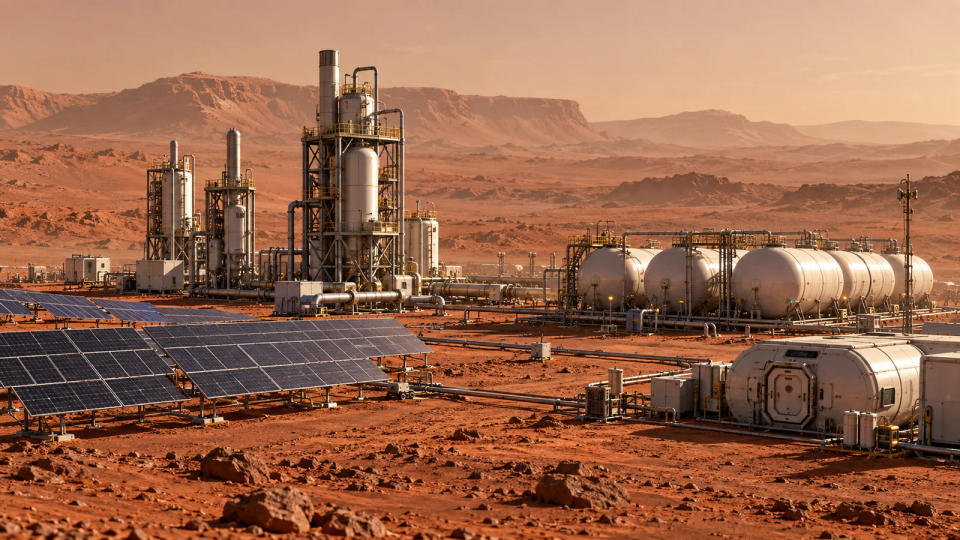
Humans can already make oxygen on Mars in tiny quantities. NASA’s MOXIE experiment aboard Perseverance demonstrated that carbon dioxide from the Martian atmosphere can be processed to produce oxygen. It operated 16 times and showed that the basic technology works under real Martian conditions.
Scaling that idea from a rover experiment to a planetary atmosphere is another matter. The 2026 feasibility analysis estimated that producing an Earth-like oxygen inventory from water would require a minimum energy on the order of 1025 joules before real-world inefficiencies and chemical losses are counted. Mars also lacks an obvious, easily accessible supply of enough nitrogen to provide an Earth-like buffer gas, so large amounts might have to come from newly discovered reservoirs or be imported from elsewhere in the Solar System.
Then there is the ground itself. Fresh oxygen would not all stay in the air. Martian rocks and soil contain reduced minerals that can react with oxygen, meaning the planet would act as a chemical sink until much of that material had been oxidized. Any serious terraforming plan would have to manufacture atmosphere faster than it is being absorbed, trapped, condensed, or lost.
Atmospheric escape is not quite the instant disaster it is sometimes portrayed as. Recent system studies note that heavy gases such as carbon dioxide and nitrogen in a thick atmosphere would likely be lost on geological timescales even without a global magnetic field. Light hydrogen escapes much more readily. The practical problem is therefore not that a finished atmosphere would vanish overnight, but that building and maintaining it would require long-term control of sources, sinks, climate, and escape.
So could humans ever walk on Mars without pressure suits?
Not with any technology close to what exists today. The latest research makes a useful distinction: warming selected regions, building large covered habitats, and creating locally pressurized environments may be physically plausible far earlier than transforming the whole planet.
That may be the realistic path for many generations. Mars settlements could gradually use local water, oxygen production, greenhouses, underground spaces, and large enclosed environments while scientists continue learning how the planet’s atmosphere and climate respond to intervention.
A thick, breathable Martian atmosphere is therefore not impossible in the same sense as violating a law of physics. It is better described as a planetary engineering project whose material, energy, timescale, and resource demands are far beyond present civilization. The most difficult ingredient may not be a clever greenhouse trick. It may simply be finding and moving enough gas.
Sources & Further Reading
- APS Open Science — Terraforming Mars: Mass, forcing, and industrial throughput constraints (2026)
- NASA — Mars Terraforming Not Possible Using Present-Day Technology
- NASA — Human-spaceflight atmospheric pressure and composition requirements
- NASA JPL — MOXIE Completes Mars Mission
- Science Advances — Feasibility of keeping Mars warm with nanoparticles
- Geophysical Research Letters — Atmospheric Dynamics of IR-Active Particles Released From Mars’ Surface (2026)
Post a Comment