
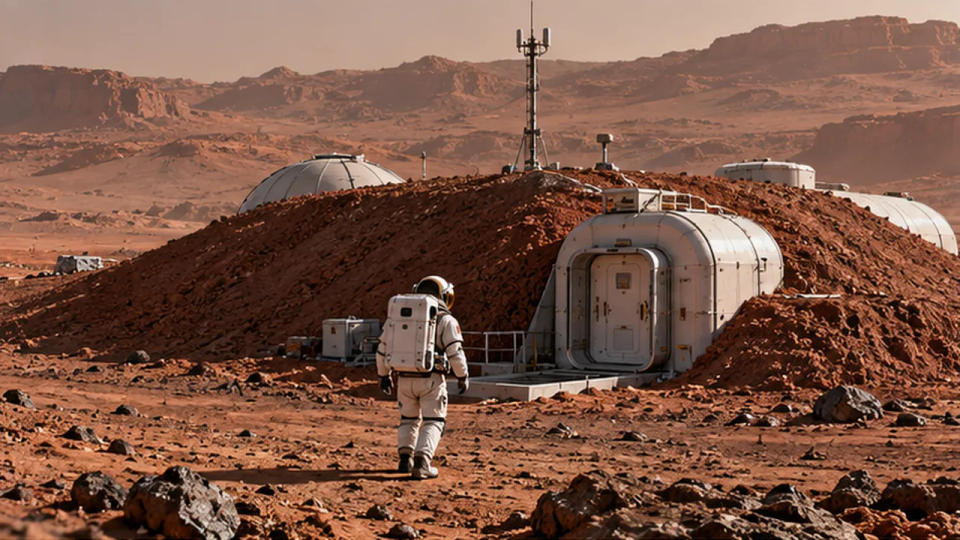
Mars looks calm from a distance, but its surface is constantly exposed to energetic particles from the Sun and deep space. For future settlers, that invisible radiation could be as important as air, water, temperature, or pressure. The practical answer is not likely to be one giant planetary shield. It is more likely to be layers of protection: terrain, buried habitats, water and plastics, storm shelters, space-weather warnings, and careful limits on time spent outside.
That matters for any serious discussion of terraforming Mars. Even if people could warm the planet and make its atmosphere denser, radiation protection would still shape where the first towns were built and how their residents lived.
Why Mars Leaves Humans So Exposed to Radiation
Earth protects us in two major ways. Its global magnetic field deflects many charged particles, while its thick atmosphere absorbs much of what gets through. Mars has neither an Earth-like global magnetic field nor anything close to Earth’s atmospheric depth, so far more high-energy radiation can reach the ground.
The danger comes mainly in two forms. Galactic cosmic rays are extremely energetic particles arriving from outside the Solar System. They create a steady background exposure and can be difficult to stop because the most energetic particles can penetrate substantial shielding. Solar energetic particles are different: they come in bursts associated with solar activity and can cause sharp increases in radiation over a much shorter time.
NASA got a vivid example on May 20, 2024, when a powerful solar event reached Mars. Curiosity’s Radiation Assessment Detector measured the largest radiation surge it had recorded since landing in 2012. NASA estimated that a person standing beside the rover would have received about 8,100 micrograys during the event, roughly the dose of 30 chest X-rays. NASA emphasized that this was not a deadly dose, but it showed how quickly conditions on the surface can change.
The First Line of Defense Could Be Mars Itself
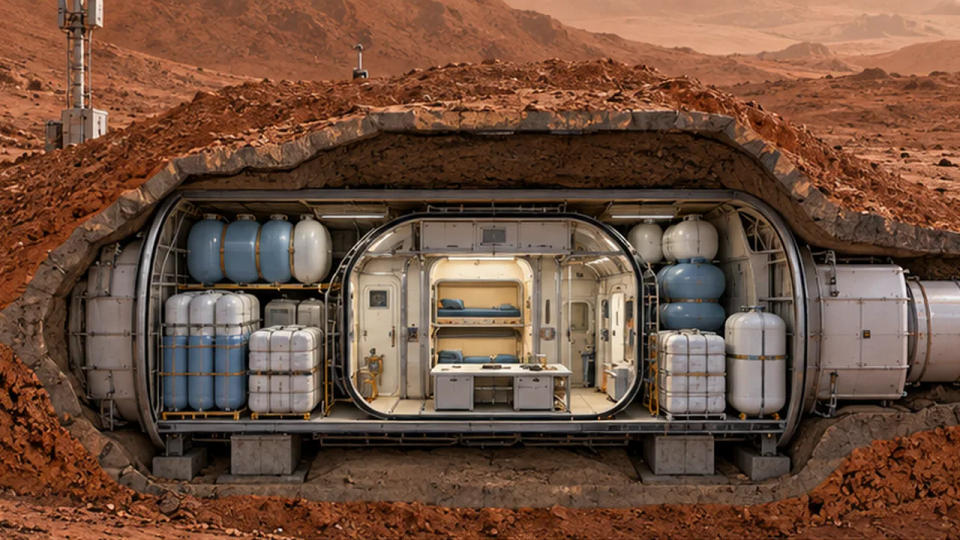
The cheapest shielding material on Mars may already be lying everywhere: rock and soil. Instead of landing a lightweight habitat and leaving it exposed, settlers could pile Martian regolith over the roof, build thick berms around the sides, or place living spaces partly below ground. Every extra layer of material puts more mass between people and the open sky.
This is not just a theoretical idea. Curiosity has measured a small but real shielding effect from natural terrain. While the rover was parked beside a butte in Gale Crater, the rock formation blocked part of the sky. Researchers reported about a 4% reduction in the expected overall dose rate and a 7.5% reduction in the neutral-particle environment. A single cliff is not enough to make Mars safe, but the result is a useful proof of principle: Martian terrain can reduce exposure.
A permanent base could take that idea much further. Habitats might be assembled on the surface and then covered, or crews could build inside excavated trenches. The challenge is engineering. Thick shielding is heavy even when the material does not have to be launched from Earth, and a buried habitat still needs reliable entrances, airlocks, power, ventilation, emergency exits, and ways to inspect or repair the structure.
Water and Plastic Could Protect the Crew Twice
Not all shielding materials are equally useful against space radiation. NASA has long studied low-atomic-number, hydrogen-rich materials such as water and polyethylene because they can be effective against many energetic particles while producing less troublesome secondary radiation than some heavier materials.
That creates a clever design opportunity. A Mars base has to store water anyway. Instead of keeping every tank in one utility room, engineers could place water around sleeping quarters or a compact radiation shelter. Food, supplies, certain plastics, and even processed waste could also be arranged so that mass already needed for daily life becomes part of the shielding system.
This does not mean a wall of water would make cosmic rays disappear. Galactic cosmic rays are unusually difficult to shield completely, and adding unlimited material is not practical. The more realistic goal is to reduce exposure as much as possible and reserve the best-protected area for periods of elevated solar activity.
Could Lava Tubes Become Mars’ Safest Neighborhoods?
Nature may offer an even thicker roof. Mars has volcanic terrain containing long channels and collapsed features interpreted as lava tubes. ESA’s Mars Express, for example, imaged tube-like structures on Pavonis Mons that formed in ancient lava flows.
A stable underground tube could place meters of rock between people and space, potentially providing far more passive shielding than a thin surface habitat. It could also help moderate temperature swings and protect equipment from micrometeoroids. That makes caves and lava tubes attractive targets when scientists think about future settlement sites.
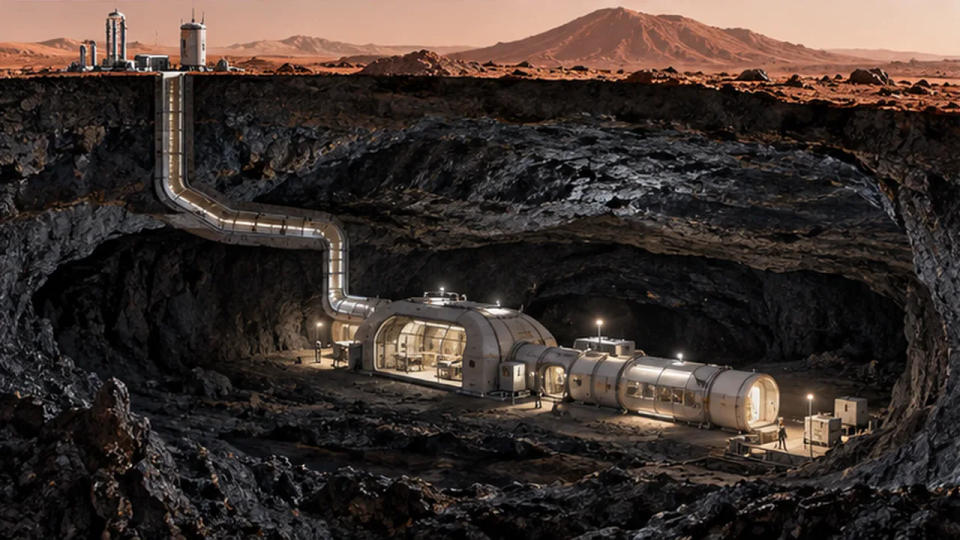
But there is a big difference between seeing a possible lava tube from orbit and declaring it ready for human occupation. Future explorers would need to map its interior, test the strength of the roof, understand dust and rockfall hazards, find safe access points, and determine whether a large pressurized structure could actually be installed there. Lava tubes are promising natural shelters, not ready-made Martian cities.
Terraforming Would Help, but It Would Not Remove the Need for Shelters
If Mars somehow gained a much thicker atmosphere, that atmosphere would provide more shielding than the planet has today. Lower-altitude regions already benefit slightly from having more atmosphere above them. But building an atmosphere dense enough to transform the radiation environment would be an enormous planetary-engineering project, and Mars would still lack Earth’s strong global magnetic field.
Creating an artificial magnetic shield for an entire planet is sometimes proposed, but that remains far beyond any demonstrated engineering system. Even localized magnetic or electric shielding around habitats faces major challenges involving power, size, field strength, and mass. For the foreseeable future, passive shielding is much more practical.
Operations would matter too. Mars crews could use orbital and surface instruments to watch space weather, avoid unnecessary excursions during risky periods, and retreat to a compact storm shelter when a major solar particle event is expected. NASA already treats radiation as one of the central hazards of sending humans beyond Earth’s protective magnetosphere.
So the first Martian settlements may not look like glass domes standing proudly in the open. They may look more like protected bunkers: partly buried, wrapped in useful supplies, tucked against terrain, or hidden inside volcanic rock. Terraforming might one day change the planet above them, but shielding the people inside could be one of the first technologies that makes long-term life on Mars possible.
Sources & Further Reading
- NASA — NASA Watches Mars Light Up During Epic Solar Storm
- NASA/JPL — How NASA’s Curiosity Rover Is Making Mars Safer for Astronauts
- NASA Human Research Program — Hazard: Space Radiation
- NASA — Real Martians: How to Protect Astronauts from Space Radiation on Mars
- Journal of Geophysical Research: Planets — Natural Radiation Shielding on Mars Measured With the MSL/RAD Instrument
- ESA — Lava Tubes on Pavonis Mons
Post a Comment