
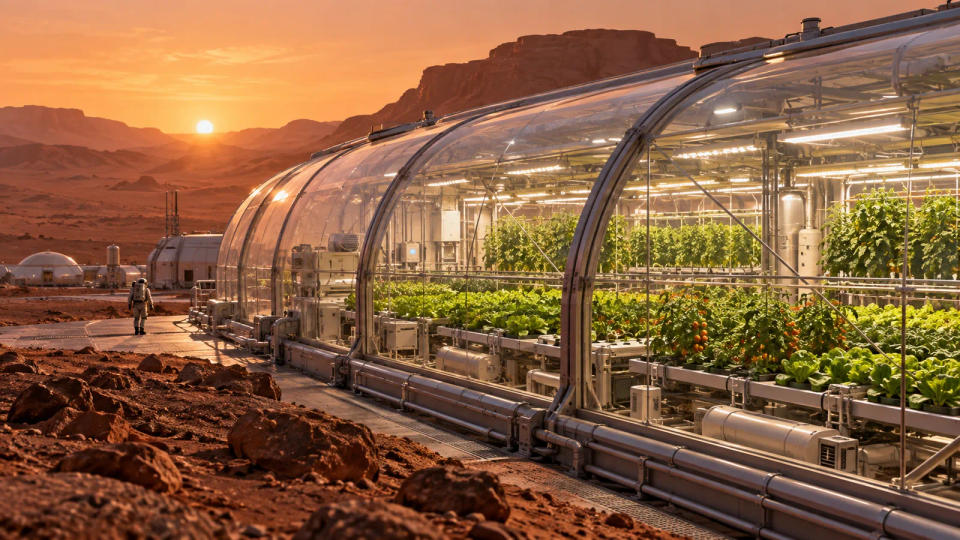
Mars already has the raw ingredients for photosynthesis: sunlight, carbon dioxide, water ice, and a surface rich in minerals. So the idea sounds beautifully simple—build greenhouses, grow plants, and let them turn the Red Planet’s carbon dioxide into oxygen.
Inside a sealed habitat, that could genuinely help. Across an entire planet, however, plants alone would face a problem far bigger than gardening: Mars is too cold, too dry, too thin-aired, and too exposed for ordinary crops to survive outside. The realistic future is not forests spreading across Mars, but carefully engineered greenhouses and bioreactors helping astronauts recycle air.
Plants really can be part of a Martian oxygen system
Photosynthesis takes carbon dioxide and water, uses light energy, and stores carbon in plant tissue while releasing oxygen. In a closed habitat, that is exactly the chemistry a crew wants. Astronauts breathe oxygen and exhale carbon dioxide; crops can use that carbon dioxide and return oxygen to the cabin.
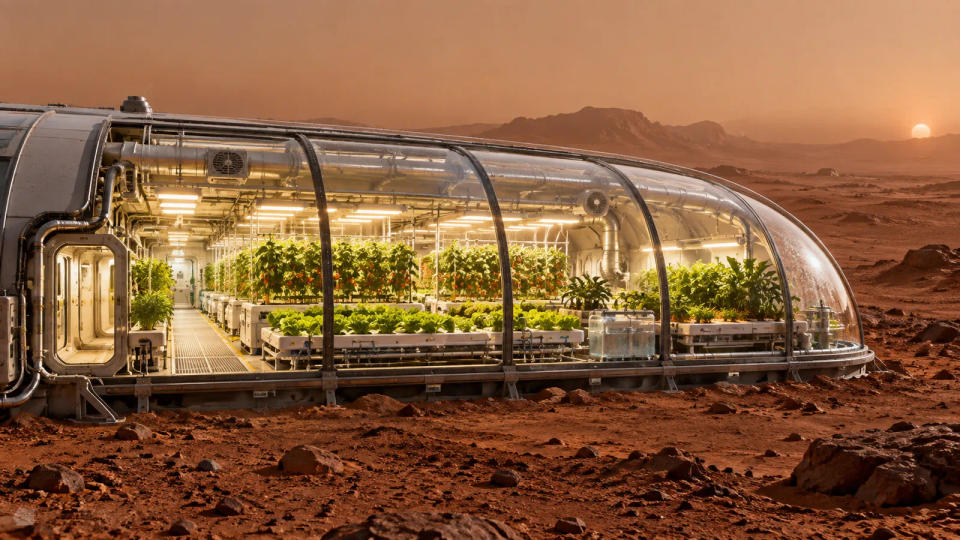
NASA has studied this idea for decades under “bioregenerative life support.” Controlled-environment tests suggest that roughly 20 to 25 square meters of continuously cultivated crops, given strong light and careful management, could supply the oxygen needs of one person. A four-person crew would therefore need on the order of 80 to 100 square meters of productive crop area just to match breathing demand under those test assumptions.
That number is surprisingly modest. It is roughly the footprint of a small apartment spread across growing trays. Vertical racks could reduce the floor area, although not the total leaf area that must be illuminated.
The bigger challenge is reliability. A mechanical oxygen generator can be designed around pumps, filters, power, and spare parts. Plants are living systems. Their output changes with crop age, light, temperature, nutrient balance, disease, and even how much edible biomass is harvested. A Mars base would almost certainly keep backup chemical or electrochemical oxygen systems even if plants carried much of the daily load.
Why you could not simply plant a forest outside
Mars is not a chilly version of Earth waiting for seeds. Its atmosphere is less than one percent as thick as Earth’s and is mostly carbon dioxide. Liquid water is not stable for long on most of the surface, and temperatures can plunge far below freezing. The thin atmosphere also provides limited shielding from harmful space radiation.
That makes an open Martian field impossible for familiar crops. Plants need a protected environment with enough pressure to keep water in their tissues, temperatures in a workable range, accessible liquid water, and protection from radiation and damaging ultraviolet light.
NASA greenhouse research has shown that plants can tolerate atmospheres much thinner than Earth’s. Early low-pressure experiments reported plant survival and growth above about 76 millibars, and other studies suggested normal plant function may be possible around 100 millibars or somewhat below. But even those low-pressure greenhouse conditions are still far above the natural pressure at the Martian surface.
In other words, future Martian farming would begin with buildings, not soil. A greenhouse might use filtered sunlight, artificial lighting, hydroponics, recycled water, and a carefully controlled mix of gases. The crops would be part farm, part air-recycling machine.
The oxygen math gets harder when you scale from a habitat to a planet
Keeping four astronauts alive and changing an entire atmosphere are completely different engineering problems.
A habitat contains only a limited volume of air. If its crops produce roughly as much oxygen as the crew consumes, the system can approach a closed cycle. Add algae or cyanobacteria, recycle nutrients and water, and the biological loop becomes even more useful.
Terraforming Mars would require accumulating oxygen across the whole planet. And oxygen production is not enough by itself. The carbon left behind by photosynthesis must also stay locked away. If dead leaves, roots, microbes, or stored food eventually decompose and react with oxygen, much of that oxygen is consumed again.
Earth’s oxygen-rich atmosphere became possible because a small fraction of biologically fixed carbon was buried or otherwise kept from immediately recombining with oxygen over immense periods of time. A Martian terraforming project would need some comparable long-term carbon sequestration—or an industrial process that separates oxygen without letting the carbon simply reverse the chemistry.
Pressure is another problem. Even a high oxygen percentage would not automatically make Mars breathable if the total atmospheric pressure remained extremely low. Humans need an adequate oxygen partial pressure, not just oxygen molecules mixed into a near-vacuum.
Greenhouses may work better with algae and machines
Higher plants are attractive because they can provide fresh food, psychological benefits, humidity control, and oxygen all at once. But they may not be the most efficient oxygen producers for every part of a Mars base.
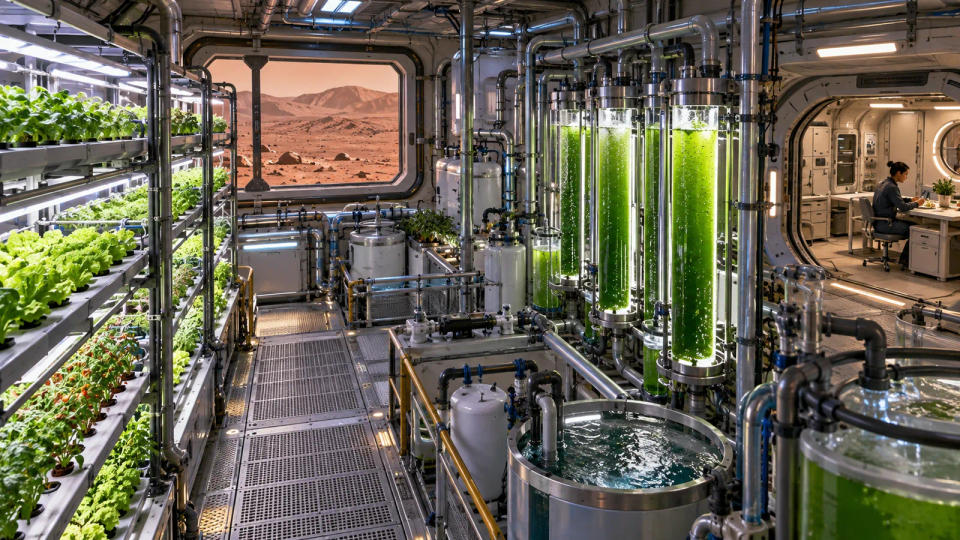
ESA’s MELiSSA program, for example, studies a closed life-support loop that combines microorganisms, algae, higher plants, waste processing, and water recycling. Photosynthetic microbes can grow in compact photobioreactors, where light, nutrients, gas flow, and harvesting are easier to control than in a field of crops.
There is also a non-biological option. NASA’s MOXIE experiment aboard Perseverance proved that oxygen can be extracted directly from Mars’ carbon dioxide atmosphere using high-temperature electrochemistry. Across 16 runs, MOXIE produced a total of 122 grams of oxygen and reached rates as high as 12 grams per hour at 98 percent purity or better.
That does not mean future Mars bases will choose machines instead of plants. More likely, they will mix technologies. Electrochemical systems could provide dependable baseline oxygen and large quantities for rocket propellant. Crops could supply food while recycling carbon dioxide. Algae could act as a fast, adjustable biological buffer.
The safest life-support system may look less like a forest and more like a carefully balanced ecosystem wired to an industrial plant.
Could plants ever help terraform Mars?
In a very distant future, perhaps—but only after other problems are solved first.
Plants cannot create a warm, thick atmosphere if they cannot survive in the existing one. Mars would first need much higher pressure, stable liquid water, manageable temperatures, radiation protection, and a reliable nutrient cycle. A 2018 NASA-sponsored analysis concluded that Mars does not have enough easily accessible carbon dioxide to create the needed warming and pressure with present-day technology.
So plants are unlikely to be the first step in terraforming. They would be a later step, introduced after engineers had already transformed the environment enough for biology to function on large scales.
That still makes them important. The first convincing demonstration may happen inside a greenhouse only a few dozen meters across, where every breath, liter of water, photon of light, and gram of biomass is measured. If humans ever learn to build long-lived settlements on Mars, plants may become one of the technologies that turn a fragile outpost into something closer to an ecosystem.
The answer, then, is yes on the scale of a habitat and no, for now, on the scale of a planet. Plants could one day make a meaningful share of the oxygen astronauts breathe on Mars. Turning Mars itself into a world where people can walk outside and breathe freely would require far more than planting enough greenery.
Sources & Further Reading
- NASA Technical Reports Server — Bioregenerative Life Support for Humans in Space
- NASA Science — Mars: Facts
- NASA Technical Reports Server — Low Pressure Greenhouse Concepts for Mars
- ESA — Life Support and MELiSSA
- NASA — MOXIE Completes Mars Mission
- NASA — Mars Terraforming Not Possible Using Present-Day Technology
Post a Comment