
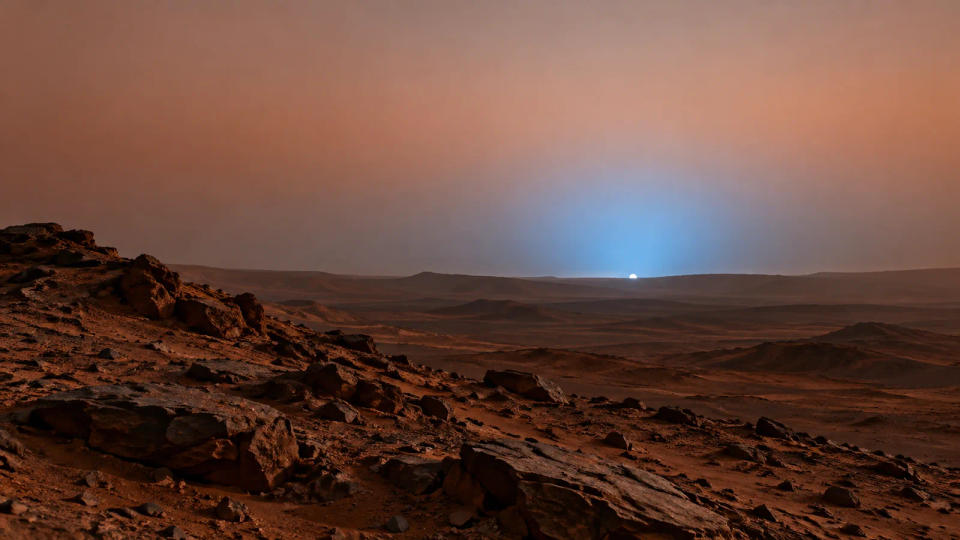
Imagine standing on two planets at the same moment of sunset. On Earth, the low Sun can glow through a red and orange sky. On Mars, the sky closest to the setting Sun can shine blue. Why does the same sunlight produce such different colors? The answer is not a blue Martian Sun or a special kind of alien daylight. It is the way each planet’s atmosphere redirects the colors in sunlight.
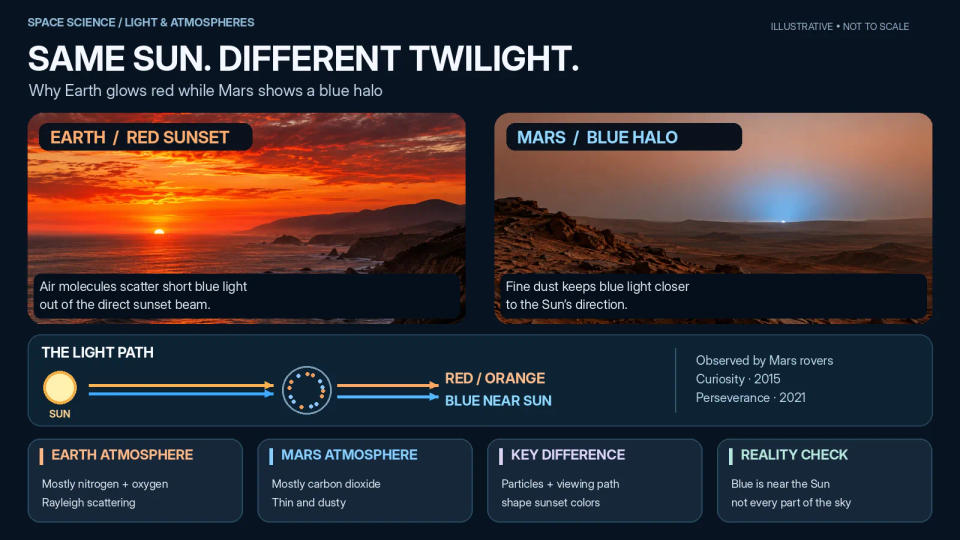
On Earth, air molecules scatter short blue wavelengths out of the direct beam, leaving more red and orange light to reach an observer looking toward sunset. On Mars, fine airborne dust affects different wavelengths and directions of scattering: blue light remains concentrated nearer the Sun while yellow and red light spread across more of the sky. NASA rovers have photographed the result. But the famous blue glow is a localized twilight effect—not proof that every Martian sunset fills the entire sky with blue.
Why Earth’s Sunsets Turn Red
Sunlight looks white, but it contains a mixture of visible colors. Its blue light has a shorter wavelength than its red light. When sunlight enters Earth’s atmosphere, it encounters countless nitrogen and oxygen molecules. Those molecules scatter shorter wavelengths far more strongly than longer ones. This process is called Rayleigh scattering, and it helps explain why a clear daytime sky looks blue.
Picture a crowd passing colored balls down a long hallway. Some colors are knocked sideways more often than others. That comparison is imperfect—the real process is an interaction between electromagnetic waves and particles—but it captures an important result: the light continuing toward you does not keep exactly the same mix of colors that left the Sun.
When the Sun is high, sunlight follows a comparatively short route through air. At sunset the path becomes much longer because the light arrives almost horizontally. Much of the blue and violet light has already been scattered away from the direct line between the Sun and your eyes. Red, orange and yellow wavelengths become more conspicuous. The disk of the Sun and clouds illuminated by that light can take on the familiar warm tones.
Not every terrestrial sunset is brilliant red. Weather, cloud height, smoke, pollution and other aerosols change the balance of light. A low cloud can catch reddish illumination even when another region of sky looks gray. The simple rule about Rayleigh scattering is a foundation, not a promise that all Earth sunsets will look identical. The key is that the longer atmospheric path leaves the sunlight arriving directly from the horizon richer in the warm colors.
Why Martian Dust Paints a Blue Halo
Mars has a very different atmosphere. It is extremely thin, made mostly of carbon dioxide, and often contains airborne mineral dust. The dust grains are much larger than individual gas molecules. Their interaction with sunlight is not just a weaker copy of the Earth effect; the grain size changes both which colors pass through more efficiently and how light is scattered across the sky.
NASA explains that the fine Martian dust allows blue light to penetrate the atmosphere somewhat more efficiently than longer-wavelength light. Crucially, the blue light scattered by that dust tends to remain nearer the Sun’s direction. Red and yellow light, meanwhile, is distributed more widely. During ordinary daylight, the airborne dust makes much of the sky look dusty yellow, orange or reddish. Close to sunset, the longer path through the dusty air makes the blue region surrounding the Sun especially noticeable.
This distinction matters because descriptions such as “Mars has blue sunsets” can sound as though the whole horizon turns a uniform sapphire color. Rover images actually show a blue or blue-gray glow near the Sun, often surrounded by more subdued, warmer or grayish tones. The Sun itself is not changing color at its source. The atmospheric particles are filtering and redirecting the white sunlight along the path toward a camera or an observer.
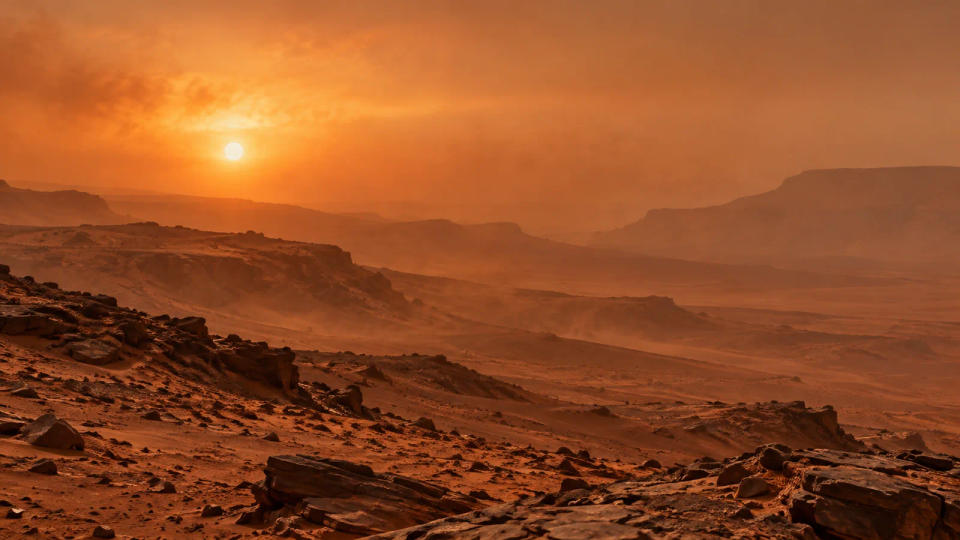
A useful surprise is that a thin atmosphere can still produce a striking optical display. You do not need Earth-like atmospheric pressure to scatter sunlight visibly; enough suspended dust along a long slanting line of sight can change the colors you see. Mars also has a much longer twilight than many people might expect. NASA reports that high-altitude dust can scatter sunlight toward the planet’s night side, with a faint glow sometimes persisting for as long as two hours before sunrise or after sunset.
That does not mean the blue will always look equally vivid. The quantity and vertical distribution of dust vary with place, season and weather. Less dust can produce more muted colors. The Martian atmosphere is not a permanently fixed color filter, just as an Earth sunset changes with local conditions.
What the Mars Rovers Actually Observed
The explanation rests on real measurements and images, not only laboratory reasoning. NASA’s Curiosity rover photographed a sunset in Gale Crater on April 15, 2015, during mission sol 956. Four images in a published sequence were captured over six minutes and 51 seconds. The rover’s Mastcam instrument recorded a blue glow near the descending Sun. NASA says the pictures were calibrated and white-balanced to reduce camera artifacts, and that the camera’s color response is similar to that of the human eye.
That last detail is important. Space images can be processed in different ways, and a dramatic color in a picture should not automatically be treated as an unprocessed view from a human eye. For the Curiosity sunset sequence, NASA explicitly documents the color calibration. It remains sensible to remember that displays, lighting and imaging choices affect how a photograph appears on a screen.
A second rover supplied an instructive comparison. On November 9, 2021, Perseverance captured a sunset in Jezero Crater with its Mastcam-Z camera. NASA noted that the picture showed a less intense blue color than is typical because there was less dust in the atmosphere. The result is valuable precisely because it is not an idealized postcard: changing conditions alter the actual Martian light show.
Scientists also use such images for more than their beauty. Observations of twilight, dust and clouds help investigators understand how high particles extend and how they transport light. The colors provide clues about the atmosphere through which sunlight has traveled. It is a reminder that a camera pointed at the horizon can teach planetary scientists something about the air above the landscape.
Conclusion
Earth’s red sunset and Mars’s blue sunset are not opposites caused by different Suns. They are different outcomes of the same sunlight interacting with different atmospheres. Earth’s gas molecules preferentially scatter blue light out of a long sunset path, leaving red and orange light prominent. On dusty Mars, blue light remains concentrated near the Sun while warmer colors are scattered more broadly.
The next time you see a crimson sunset from Earth, imagine an observer beside a Martian rover looking toward a small, pale Sun surrounded by cool blue light. Both views are genuine possibilities in our Solar System—and both begin with particles too small to notice individually, redirecting a dazzling mixture of colors.
Sources & Further Reading
- NASA Science — What Do Sunrises and Sunsets Look Like on Mars?
- NASA Science — Sunset at Mars’ Gale Crater (Curiosity)
- NASA Science — Mastcam-Z’s First Martian Sunset
- NASA Space Place — Why Is the Sky Blue?
- NOAA NESDIS — Why Is the Sky Blue?
Post a Comment