

NASA’s Lucy has entered the Trojan asteroid region. Discover what its 2027 flybys could reveal about the early solar system.
NASA’s Lucy has reached the region occupied by Jupiter’s Trojan asteroids, opening a new stage of its journey toward ancient planetary building blocks. The milestone, announced on October 28, 2026, is an arrival in a broad region of space; its first close encounter with a Trojan asteroid is still ahead, in August 2027. Lucy will investigate how these bodies differ, what their surfaces contain, and what they reveal about the solar system’s early history.
The mission’s promise lies in comparison. Examining several objects with different characteristics could help scientists test explanations for how the outer planets formed and how smaller bodies were redistributed. Those answers will require encounter data: entering the region does not mean Lucy has already resolved its targets’ landscapes.
Image: NASA’s Scientific Visualization Studio/Kel Elkins. Computer visualization of the trajectory, rather than a spacecraft photograph of the asteroid swarms.
What has Lucy actually reached?
The Jupiter Trojans travel around the Sun in two broad groups associated with the L4 and L5 Lagrange points. One group leads Jupiter around its orbit; the other follows. They are not moons circling the planet. Their stable orbital arrangement involves the gravity of both Jupiter and the Sun, and the groups occupy extensive regions rather than sharply bounded destinations.
NASA’s new announcement says Lucy has traveled more than 2.2 billion miles since its October 2021 launch. Engineers establish its location through radio tracking and images of background stars. Reaching this region is therefore a navigation milestone, even though there is no visible boundary for the spacecraft to cross.
The name “Jupiter Trojans” can also create the wrong mental picture. These asteroids are far from Jupiter itself. Lucy’s route is designed to meet selected small bodies along their solar orbits, rather than explore the giant planet at close range. A diagram helps explain that geometry much better than an imagined crowded field of nearby rocks.
What could the asteroids reveal about planetary origins?
Lucy’s science program treats the Trojans as surviving evidence from planet formation. Their diversity may reflect different birthplaces and later transport as the planets evolved. Comparing their properties can constrain that history, although a particular origin remains an interpretation to be tested rather than an established biography for every target.
Surface geology is one line of evidence. Maps of shapes, craters, reflectivity and geological units will help researchers compare impact histories and identify different terrains. Fractures, excavated material and exposed layers may offer clues to material below the immediate surface. These observations are ways to investigate interiors indirectly, rather than photographs through solid rock.
Composition provides another test. Lucy will map surface color and look for signatures of minerals, ices and organic materials. Such searches do not guarantee detections, and organic compounds by themselves would not demonstrate life. Scientists also plan to investigate masses and densities and search for additional satellites or rings. Taken together, these measurements can reveal differences that a distant point of light conceals.
Eurybates is especially interesting because it belongs to a collisional family and has a comparatively neutral-colored spectrum. The mission’s FAQ notes that its collision history might have exposed material from an earlier body’s interior. Comparing it with other Trojans gives researchers a chance to examine that possibility.
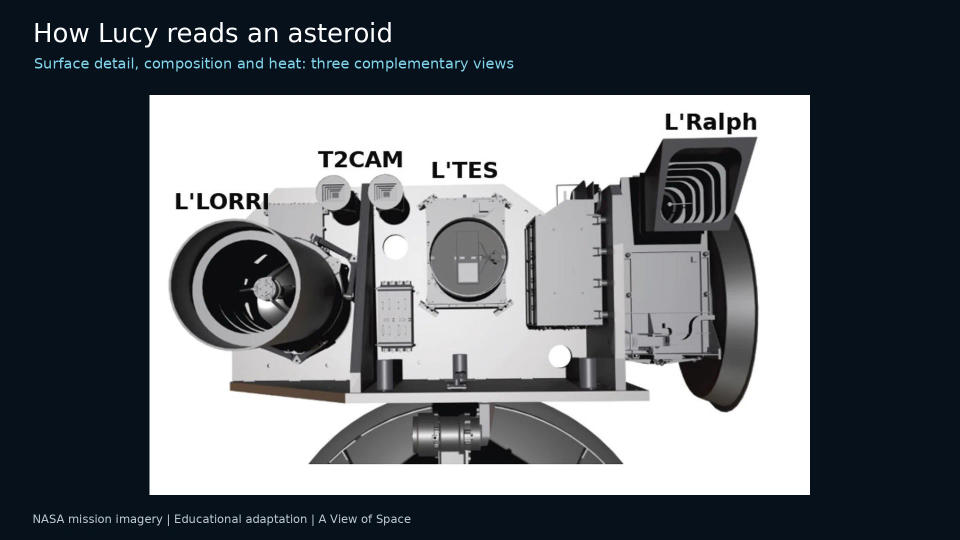
Image: NASA. Instrument-platform rendering, fitted to a 16:9 canvas with explanatory headings; hardware proportions are preserved.
How will Lucy turn brief flybys into useful measurements?
Lucy carries complementary instruments because no single picture answers every scientific question. L’LORRI is a sensitive black-and-white telescope camera that will reveal fine surface structure. Its images will support geological interpretation and searches for small companions. Shapes, shadows and crater patterns will be more useful together than an attractive close-up alone.
L’Ralph combines a color imager with an infrared imaging spectrometer. By separating reflected light into wavelength information, it can help identify surface materials and differences across an asteroid. L’TES measures thermal emission to investigate temperature and surface thermal properties. Radio tracking adds another kind of measurement by examining changes in the spacecraft’s signal during encounters.
These observations need careful preparation. In spring 2026, Lucy observed Eurybates, Polymele, Leucus and Orus with L’LORRI; NASA reported the processed results in August. The targets still appeared as small points. Their importance was operational: views from Lucy help the team choose camera settings for illumination conditions different from those normally available to Earth-based observers.
During the eventual flybys, partly shadowed terrain will make exposure choices important. Bright streaks and arcs visible in the early montage include scattered-light artifacts, not giant structures attached to the asteroids. Keeping that distinction clear prevents a camera effect from becoming a false scientific discovery.
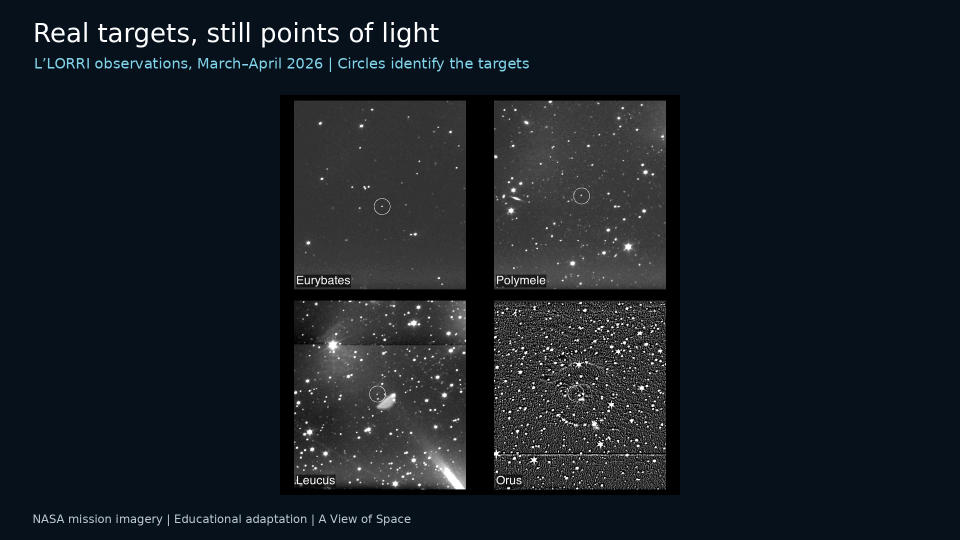
Image: NASA/Goddard/Southwest Research Institute/JHU-APL. One frame from the March–April 2026 observation montage, with headings added; target circles are from the source.
NASA’s current schedule lists Eurybates and its moon Queta first in August 2027, followed by Polymele and its moon in September. Leucus and Orus follow in 2028. After another Earth gravity assist in 2030, Lucy is scheduled to investigate the Patroclus–Menoetius binary in March 2033. These are planned encounters, and later mission updates should be checked before treating a date as final.
Conclusion
Lucy’s arrival makes the Trojan population a spacecraft destination, while the detailed discoveries remain ahead. The central question is how much these survivors can tell us about the materials and movements that shaped the planets. Images, spectra, thermal measurements and radio science will let researchers compare that evidence across multiple targets. For now, the clearest distinction is between entering the Trojan region in 2026 and beginning close Trojan exploration in 2027.
Sources & Further Reading
- NASA’s Lucy Reaches Trojan Asteroid Region 5 Years After Launch
- Lucy Mission: Frequently Asked Questions
- Lucy Science Goals
- The Lucy Spacecraft
- NASA’s Lucy Begins Camera Tests Ahead of 2027 Trojan Flybys
- Lucy: Mission Overview and Encounter Schedule
Post a Comment