
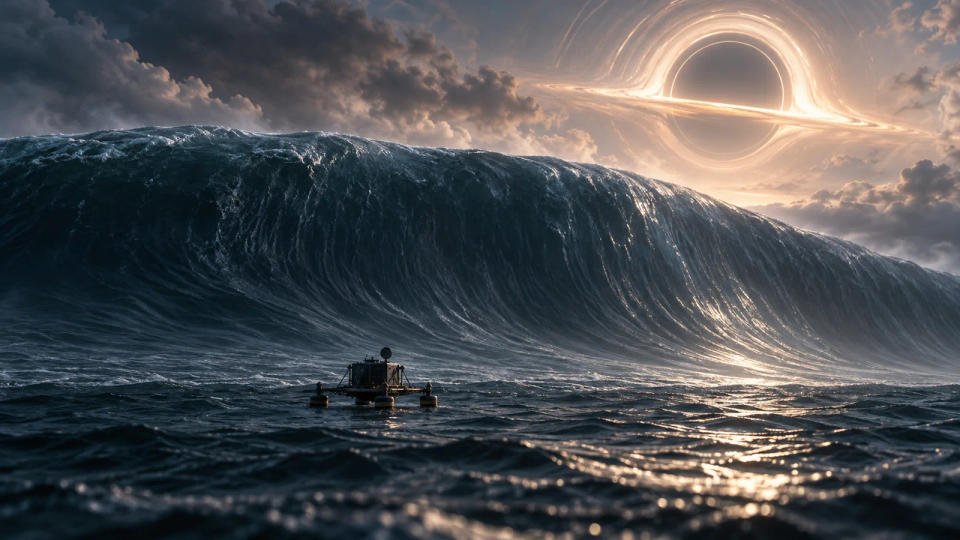
Imagine stepping out of a spacecraft into ankle-deep water. The horizon looks flat. Then the horizon itself starts rising, and you realize you are looking at a wall of water taller than a skyscraper.
That is the terrifying surprise waiting on Miller’s planet in Interstellar. But could the black hole Gargantua really cause waves like those?
Possibly, at least in a carefully imagined situation. A black hole can create enormous tides, and those tides might set an ocean in motion. The important catch is that a high tide is not automatically a traveling wave. To understand the movie, we need both parts of the story.
How Can Gravity Make a Wave at All?
Start with something familiar: the Moon causes tides on Earth. The ocean rises and falls because the Moon’s gravity does not pull equally on every part of our planet.
The side facing the Moon is a little closer, so it feels a stronger pull. The far side feels a weaker pull. That difference helps stretch the oceans into two broad bulges. On Earth, the changes usually look like water slowly moving up and down a beach rather than a monster wave.
Now replace the Moon with Gargantua, a black hole, and imagine putting a planet extraordinarily close to it. The difference in gravity from one side of the planet to the other becomes much more dramatic. Scientists call this difference a tidal force.
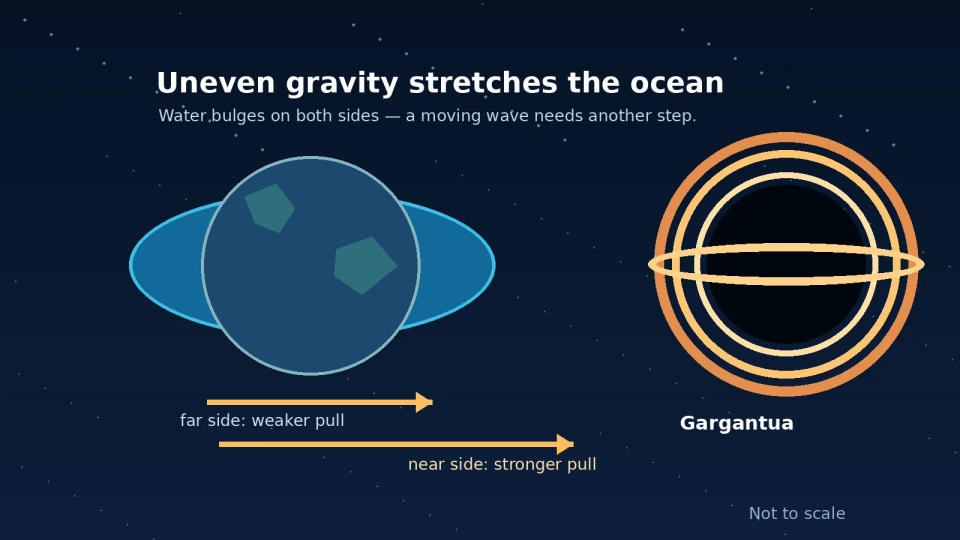
Think of two people pulling on different parts of a stretchy toy. If one end is tugged harder, the toy changes shape. Gravity can do something similar to an entire planet, although rocks are obviously much tougher than a toy.
It is the difference in gravity that matters here, not just how powerful gravity feels in one spot. NASA uses the same basic idea to explain ordinary tides on Earth.
Why Would Miller’s Planet Survive So Close to Gargantua?
You might wonder why such extreme gravity does not simply tear the planet apart. That is a good question, because it could.
The movie’s scientific adviser, physicist Kip Thorne, chose an unusually massive black hole for Gargantua: roughly 100 million times the mass of the Sun in his calculations. This is not a measurement of a real black hole called Gargantua. It is a number chosen for a fictional setting.
Here is the surprising part: for a planet orbiting very close to a black hole’s edge, a more massive black hole can actually be less destructive in terms of stretching forces than a smaller one. Bigger black holes have much larger horizons, so the change in gravity across a planet can be less extreme at comparable positions near the horizon.
Thorne also needed Gargantua to spin extraordinarily fast. Those conditions help his fictional planet occupy an orbit close enough for the movie’s extreme time difference without immediately breaking apart.
None of this means every planet near a black hole could safely hold an ocean. The film uses a very special arrangement, not an everyday kind of planetary system.
Why Would the Ocean Form Moving Walls of Water?
Here is the key twist: if Gargantua simply made a permanent ocean bulge, the water would not necessarily charge across the landscape like the waves in the movie.
Picture a bathtub that you hold perfectly still. The water settles into its usual shape. Now rock the bathtub gently from side to side. Suddenly the water sloshes, sometimes piling up at one end and then rushing toward the other.
Thorne proposed something similar for Miller’s planet. He imagined it was almost tidally locked to Gargantua. That means the planet would keep nearly the same face toward the black hole, rather like our Moon keeps nearly the same face toward Earth.
But the planet might not yet have settled perfectly into that position. If it rocked a little back and forth, Gargantua’s powerful tidal pull could keep shifting the ocean. Water would surge across the surface instead of remaining in a fixed bulge.
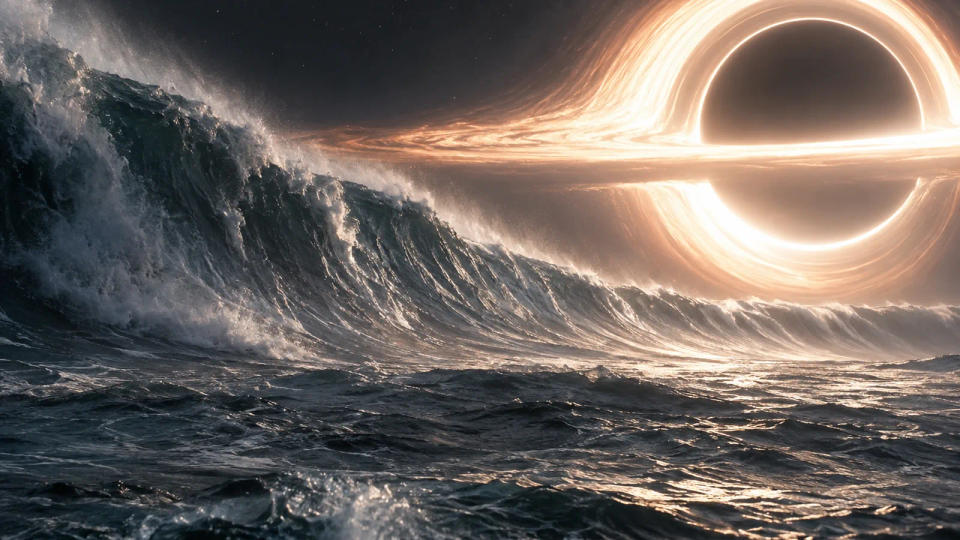
On Earth, a rough comparison is a tidal bore, when an incoming tide sends a moving wall of water up a river. That does not mean the film’s waves are ordinary river waves multiplied by a magic number. It simply shows how a tide can turn into a traveling front of water under the right conditions.
Thorne also suggested a second possible route: the same rhythmic squeezing might deform the planet’s crust and trigger enormous earthquakes, which could generate tsunamis. Both are proposed explanations for the movie, not proven descriptions of any real exoplanet.
Could the Waves Really Be More Than a Kilometer High?
The giant waves in the film are about 1.2 kilometers (roughly three-quarters of a mile) tall in Thorne’s discussion. That is an almost unimaginable mountain of moving water.
Height is only part of the problem. Ocean depth, seafloor shape, wave speed, and whether the water breaks all matter. A huge tide does not guarantee a smooth, steep wall that arrives on cue exactly where astronauts happen to land.
Thorne considered wave shapes resembling very large solitary waves—long traveling humps of water that can hold together for some distance without immediately curling over and crashing. In his interpretation, water moving from deeper toward shallower regions might help produce the unusual appearance.
There is one remarkable detail: the movie says the waves arrive roughly an hour apart. In Thorne’s model, the planet’s back-and-forth rocking could also take about an hour. That agreement is intriguing, but it does not prove the waves would happen in nature.
So Is This Real Science or Just Movie Magic?
The gravitational principle is real; the exact ocean spectacle is speculative. Gravity differences really do create tides. Black holes really can stretch nearby objects. And a rocking planet could, in principle, disturb its ocean.
What we have not done is discover Miller’s planet, observe waves beside a black hole, or test Thorne’s complete imagined setup in a real ocean. The story depends on unusual details: a vast rapidly spinning black hole, a surviving water-covered planet, a favorable orbit, and a particular pattern of planetary rocking.
That is what makes the scene interesting rather than merely impossible or perfectly realistic. The movie stretches the circumstances while leaning on actual physical laws.
Conclusion
Gargantua would not need to blow on the ocean or push it with some mysterious energy. Its uneven gravitational pull could reshape the sea, and a wobbling planet might turn those tides into enormous traveling waves. Whether nature could produce Miller’s exact water walls remains an open—and wonderfully strange—question.
Sources & Further Reading
- Kip Thorne, “One Hundred Years of Relativity” (Caltech-hosted PDF) — his explanation of the planet’s tidal stretching and rocking.
- Scientific American interview with Kip Thorne — why he compared the waves with tidal bores and solitary waves.
- NASA Science: Tides — how the Moon causes ocean bulges on Earth.
- NASA Science: Five Things to Know About the Moon — a simple explanation of tidal locking.
- NASA Science: New Black Hole Visualization — how black hole size affects tidal stretching.
Post a Comment