
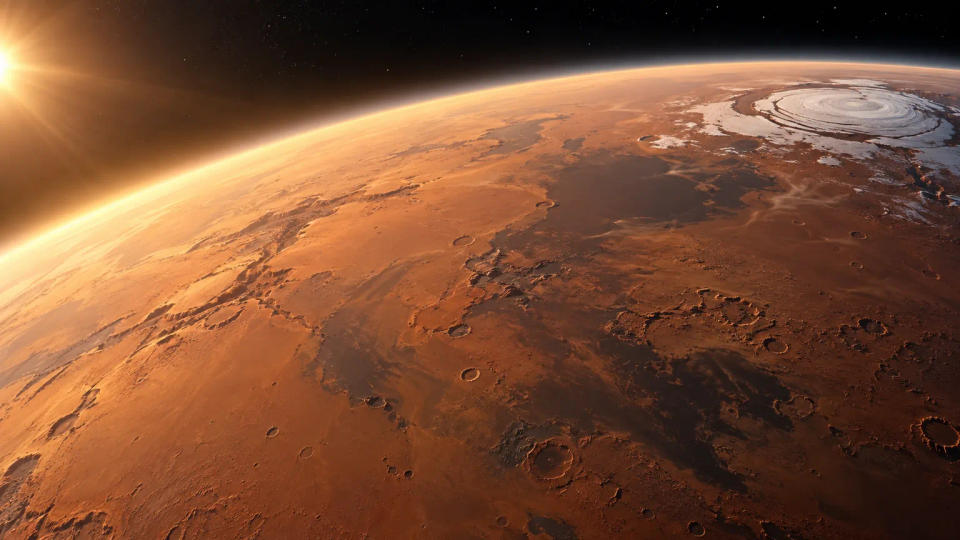
Mars looks deceptively familiar. It has mountains, valleys, polar ice, seasons, and a day only a little longer than ours. But step onto its surface and the resemblance ends quickly: the planet is so cold and its air is so thin that liquid water is unstable across most of the surface.
So if people ever tried to terraform Mars, warming it would be the first major climate problem to solve. The basic idea sounds simple—trap more heat or add more sunlight—but turning that idea into a planetary engineering project is extraordinarily difficult. Recent studies suggest some approaches may be more efficient than scientists once thought, while also making clear that warming alone would not create a second Earth.
Why Mars Loses Heat So Quickly
Mars receives only about 43% as much sunlight as Earth because it orbits farther from the Sun. Its atmosphere is also extremely thin, with surface pressure below 1% of Earth's. Although that atmosphere is mostly carbon dioxide, there simply is not enough of it to produce a strong greenhouse blanket.
NASA gives typical Martian temperatures in the minus-60s Celsius range, although conditions swing dramatically with location, season, and time of day. Antarctica can become colder at its most extreme interior sites, but Mars lives in that deep-freeze regime on a planetary scale. The thin air also allows heat absorbed during the day to escape rapidly after sunset.
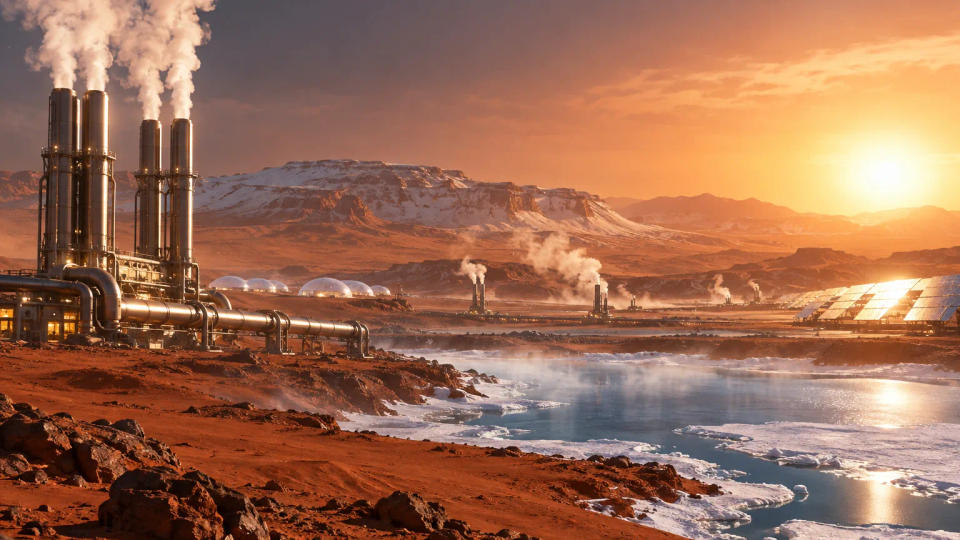
That means warming Mars is not like heating a sealed room. Engineers would have to alter the planet's energy balance continuously: either make the surface absorb more solar energy, reduce the amount of infrared heat escaping to space, or do both.
Why Releasing Martian CO2 Is Not Enough
The classic terraforming idea is to warm the poles and soil so that frozen or chemically trapped carbon dioxide enters the atmosphere. More CO2 would increase pressure and strengthen the greenhouse effect. If that warming released still more CO2 and water vapor, the process might seem capable of feeding on itself.
The problem is inventory. A NASA-sponsored analysis published in 2018 concluded that Mars does not have enough readily accessible carbon dioxide to create anything close to an Earth-like atmosphere with present-day technology. A newer 2026 system-level analysis reached a similar practical conclusion: accessible native CO2 is best thought of as a resource measured in tens of millibars, not the vast atmospheric mass needed for an open, human-friendly environment.
Releasing that CO2 could still warm Mars somewhat. But “somewhat warmer” is very different from “warm enough for stable oceans.” It also would not provide oxygen, a protective atmosphere, or comfortable pressure. The old image of simply vaporizing the polar caps and watching Mars transform itself is therefore too optimistic.
Engineered Particles Could Change the Equation
One of the most intriguing newer ideas is to manufacture tiny engineered particles from materials available on Mars and release them into the atmosphere. A 2024 Science Advances study examined conductive nanorods roughly nine micrometers long. Their shape was chosen to interact strongly with infrared radiation escaping from the surface while still allowing much of the incoming sunlight to reach the ground.
In the study's climate models, these particles were more than 5,000 times more effective at warming per unit mass in the atmosphere than the best previously studied greenhouse gases. Under one modeled scenario, sustained release at about 30 liters of particle material per second, assuming a ten-year atmospheric lifetime, produced global warming of at least 30 kelvin—enough to begin melting some near-surface ice.
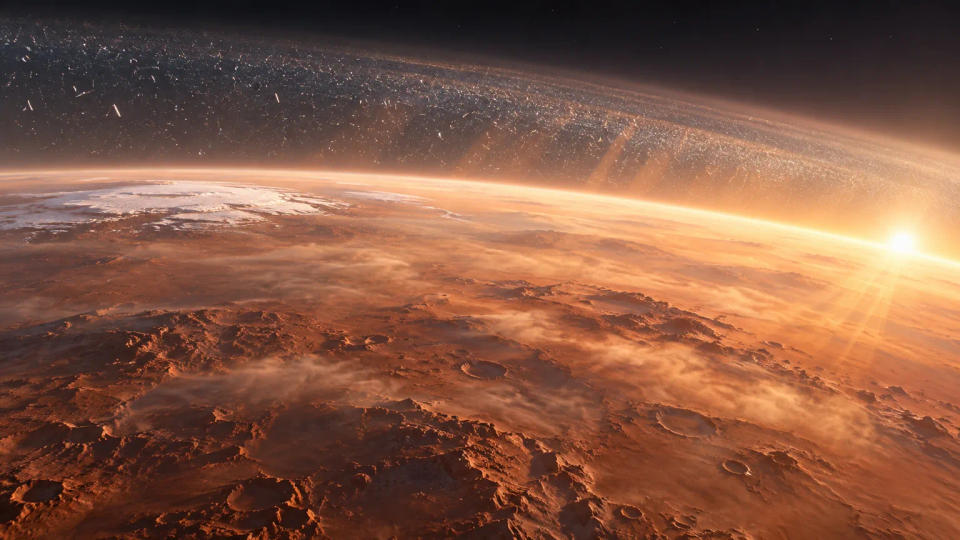
That result is not a blueprint for terraforming. It is a model-based feasibility study with major uncertainties, including how particles would clump, settle, interact with the water cycle, and affect the environment. But a 2026 follow-up study using a three-dimensional Martian climate model found that radiatively active particles released from a local source could self-loft and spread widely, with the modeled global particle abundance approaching a steady state within a few Martian years.
The important shift is conceptual. Instead of trying to manufacture an enormous mass of conventional greenhouse gas, a future civilization might try to engineer the optical properties of a much smaller amount of material already available on Mars.
Mirrors and Local Greenhouses May Come First
Another route is to add sunlight directly. Large orbital reflectors could redirect extra solar energy toward selected regions, perhaps warming a settlement, an ice-rich site, or a carbon-dioxide reservoir. The physics is straightforward, but the scale is intimidating. A 2026 analysis estimated that raising average Martian temperatures toward the range associated with widespread melting by direct solar forcing could require reflector areas on the order of tens of trillions of square meters.
That is why local warming may be more realistic before global warming. Researchers have proposed solid-state greenhouse materials, including transparent insulating layers that allow sunlight in while slowing heat loss from the ground beneath them. Such systems could create warm patches for water extraction, biology experiments, or agriculture without changing the entire planet.
This staged approach matters because it would let engineers test Martian climate interventions at small scales. A regional greenhouse, reflector, or aerosol experiment could reveal unexpected effects before anyone attempted something that altered weather across a hemisphere.
Warming Mars Is Only the Beginning
Suppose we eventually found a reliable way to raise Mars by several tens of degrees. That would be a remarkable achievement, but it would solve only one part of terraforming. Mars would still have a low-pressure atmosphere, almost no breathable oxygen, intense surface radiation, chemically challenging soil, and a water cycle very different from Earth's.
Even a warmer Mars could therefore remain a place where humans need pressure habitats and life-support systems. The 2026 system analysis found that the atmospheric mass required for an open, human-relevant atmosphere would be enormous—far beyond simply releasing the gases Mars already stores near the surface.
The most plausible path may not be a sudden transformation from red desert to blue planet. It may be a progression: warm protected areas first, learn how the atmosphere responds, expand regions that can support liquid water, and only then ask whether planet-scale warming is technically, environmentally, and ethically worth pursuing.
That makes the question “How could we warm Mars?” more interesting than a simple terraforming fantasy. Scientists are beginning to identify mechanisms that could genuinely change the Red Planet's climate. The bigger challenge is whether any of them can be scaled safely from an experiment to an entire world.
Sources & Further Reading
- NASA Science — Mars: Facts
- NASA — Mars Terraforming Not Possible Using Present-Day Technology
- Science Advances (2024) — Feasibility of Keeping Mars Warm With Nanoparticles
- Geophysical Research Letters (2026) — Atmospheric Dynamics of IR-Active Particles Released From Mars' Surface
- APS Open Science (2026) — Terraforming Mars: Mass, Forcing, and Industrial Throughput Constraints
Post a Comment