

Imagine that someone, somewhere in the Milky Way, is looking at the night sky and wondering whether anybody else is out there. Could there be thousands of such societies—or just one?
One widely discussed scientific estimate points to about 36 currently communicating civilizations in our galaxy. That does not mean astronomers have found 36 alien worlds with radio transmitters. It is the result of a model published in 2020, built around a bold question: what if technological life elsewhere takes roughly as long to develop as it did on Earth?
The idea is called the Astrobiological Copernican Limit. Understanding it is a useful way to see both what astronomy can estimate and what remains completely unknown.
What Does the Astrobiological Copernican Limit Mean?
Start with a familiar thought: Earth is probably not the center of everything. The broader Copernican approach suggests we should be cautious about treating our planet as an extraordinary exception without evidence.
In a 2020 study, researchers Tom Westby and Christopher Conselice used that reasoning to explore the number of communicating extraterrestrial intelligent civilizations in the Milky Way. Here, “communicating” means a society producing technology that might leave detectable signals, not necessarily one deliberately trying to talk to us.
They asked what would happen if the development of such societies followed a timescale resembling Earth's. Our Sun and Earth formed around 4.6 billion years ago, while radio technology emerged only recently. In this approach, that long wait becomes a condition to test against the galaxy's population of stars and planets.

Crucially, this is not a universal law of life. The term “limit” describes the boundaries created by the researchers' chosen assumptions. It is not an observed cap on how many civilizations can exist, and it is not proof that intelligence inevitably appears after a certain number of years.
How Did Scientists Arrive at the Number 36?
Think of a huge orchard. If you want to estimate how many trees currently have ripe fruit, you need to know how many trees there are, which ones are old enough, and how long the fruit stays ripe. Counting technological civilizations is similar, except we know far less about the final step.
The researchers combined information about the Milky Way's star formation, the abundance of elements heavier than helium, and the expected frequency of roughly Earth-like planets in habitable zones. A habitable zone is a region where surface liquid water could exist under suitable conditions; it does not guarantee life.
They then tested two versions of their idea. Under the Weak Astrobiological Copernican condition, a communicating civilization can appear after about five billion years. Under the more restrictive Strong condition, its emergence is confined to approximately 4.5–5.5 billion years after a star system forms, broadly matching Earth's story.
For the Strong condition, assuming a civilization remains detectable for an average of 100 years, their model produced a central estimate of 36 civilizations, with a broad statistical range of roughly 4 to 211. The authors described 36 as a conditional lower-limit estimate in that framework—not a confirmed minimum for the real galaxy.
That final assumption matters enormously. If technological societies commonly transmit detectable signals for a thousand years rather than a hundred, many more could overlap in time. If that detectable phase usually ends quickly, the number could shrink dramatically.
Why Could 36 Civilizations Still Be Impossible to Contact?
Thirty-six sounds like a lively neighborhood until you remember the scale of the Milky Way. Its stars are scattered across a disk roughly 100,000 light-years wide. Even if dozens of civilizations existed simultaneously, they would not necessarily be anywhere near us.
Under the study's simplified spatial assumptions, the estimated separation to our nearest communicating neighbor was on the order of 17,000 light-years, with substantial uncertainty. That figure is a model result, not the location of an actual detected civilization.
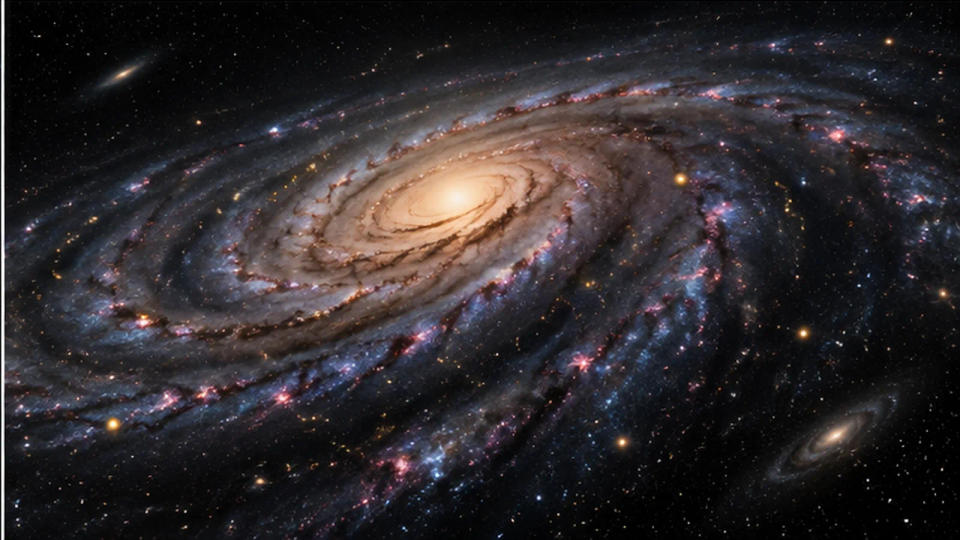
Suppose a message left such a world today and traveled toward Earth at the speed of light. It would arrive about 17,000 years later. A reply would need another 17,000 years to return. Even a perfectly successful exchange would span roughly 34,000 years, assuming the same distance and no other delays.
There is a second problem: signals weaken as they spread. An ordinary radio transmission that is easy to receive nearby may be extraordinarily hard to distinguish from background noise across thousands of light-years. A civilization could be out there, broadcasting, while our instruments simply cannot hear it.
What If Earth Is a Terrible Example?
The biggest weakness of the model is also what makes it interesting: Earth is our only confirmed example of life, let alone a technological civilization. We have no way to know whether our evolutionary journey is typical, unusually slow, or an extraordinary accident.
Microbial life appeared on Earth long before humans. Yet complex organisms, intelligence, and radio engineering required many additional steps. Other planets might develop simple life without ever producing technology. On some worlds, intelligence might emerge faster. On others, it might never appear.
The model also assumes conditions involving stellar age, planet types, and chemical enrichment. It predicted that many potential hosts could be small, long-lived red dwarf stars. But whether their environments can remain friendly to life for billions of years is an open question.
And civilizations need not remain detectable in the same way forever. Perhaps they use communication methods we do not recognize. Perhaps their radio-bright era lasts a century, or ten thousand years, or disappears as their technology changes. A society could continue living long after it stops producing signals we could identify from Earth.
For all these reasons, 36 is a scenario-dependent estimate, not a census. The true number of communicating civilizations in the Milky Way could be zero beyond our own, or much higher than this particular calculation suggests.
How Can Astronomers Test These Ideas?
We cannot currently count alien civilizations directly, but we can improve the ingredients. As astronomers discover and study more exoplanets, they learn how often different kinds of worlds form and which environments might support liquid water.
Scientists also search for technosignatures: potential evidence of technology rather than biology alone. Possibilities include unusually narrow radio signals, brief laser flashes, certain artificial atmospheric chemicals, or patterns of light and heat that would need careful investigation.
None of these possibilities should be mistaken for a confirmed discovery. Natural astrophysical processes and human-made interference can imitate suspicious signals. A convincing detection would require repeated observations, independent checks, and explanations that rule out more ordinary causes.
Even a long stretch of silence can help refine future searches, provided researchers understand which stars, frequencies, and signal strengths their surveys were actually sensitive to. Not finding a signal is not the same thing as proving nobody exists.
Conclusion: The Astrobiological Copernican Limit turns our one known example—Earth—into a way of asking better questions about the galaxy. The memorable figure of 36 is not the answer to whether we are alone. It is a reminder that the age of a world, the lifetime of its technology, and the distance between stars may matter just as much as the number of planets.
Sources & Further Reading
- Westby & Conselice (2020), The Astrobiological Copernican Weak and Strong Limits for Intelligent Life, The Astrophysical Journal
- Authors' open-access manuscript and model summary
- University of Nottingham (2020), research announcement
- NASA, Searching for Signs of Intelligent Life: Technosignatures
- NASA, What Is a Biosignature?
Post a Comment