
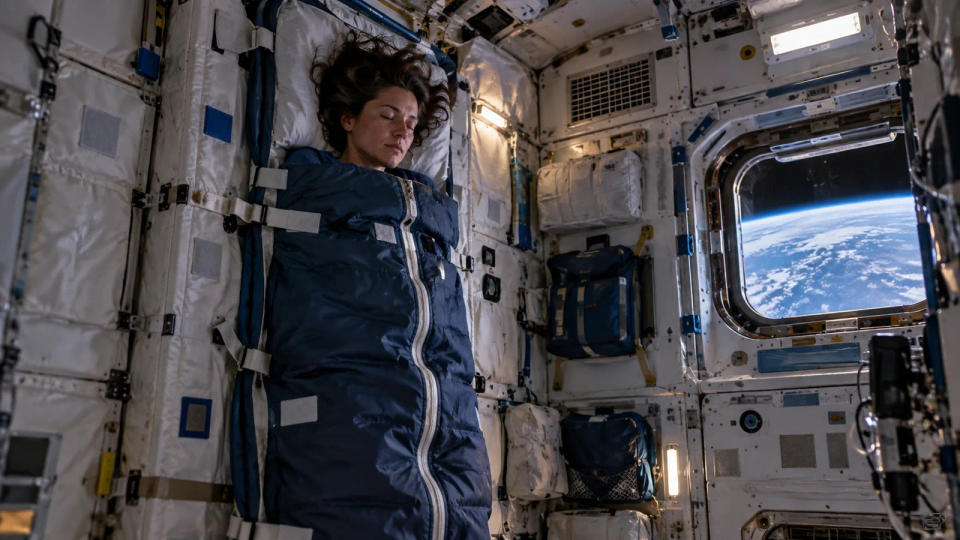
Imagine going to bed without a mattress, pillow, floor, or even a reliable sense of which way is up. That is normal for astronauts in orbit. In microgravity, they can sleep facing almost any direction because their bodies are not being pressed into a bed by gravity.
The trick is not finding a comfortable “down.” It is creating a small, quiet, ventilated place where the body can relax without drifting into equipment. On the International Space Station, that usually means a personal crew cabin, a sleeping bag attached to a wall, carefully managed airflow, and a strict schedule that tells the brain when night has begun.
Why There Is No Up or Down in Orbit
Astronauts on the International Space Station are not floating because Earth’s gravity has disappeared. The station, the crew, and everything inside are all falling around Earth together. The spacecraft moves sideways fast enough that as gravity pulls it downward, Earth’s curved surface keeps falling away beneath it. That continuous free fall creates the experience we call microgravity.
Because an astronaut and the cabin are accelerating together, the astronaut does not feel body weight pressing against a floor. A wall can function as a floor, another wall can feel like a ceiling, and a sleeping astronaut can be positioned vertically, horizontally, or upside down relative to another crew member. Those labels matter much less when nothing is naturally pulling the body toward one surface.
That sounds disorienting, but the human brain adapts. Instead of gravity deciding orientation, astronauts rely more on visual cues, handrails, equipment layouts, and habit. When it is time to sleep, they do not need to lie flat. They only need a stable place to stay.
A Sleeping Bag Becomes the Bed
Most astronauts sleep in a sleeping bag secured inside a small crew compartment. The bag is attached so the sleeper does not slowly drift across the module, bump into hardware, or wake up somewhere unexpected. The restraint is gentle; it is not meant to pin the body down as tightly as a seat belt.
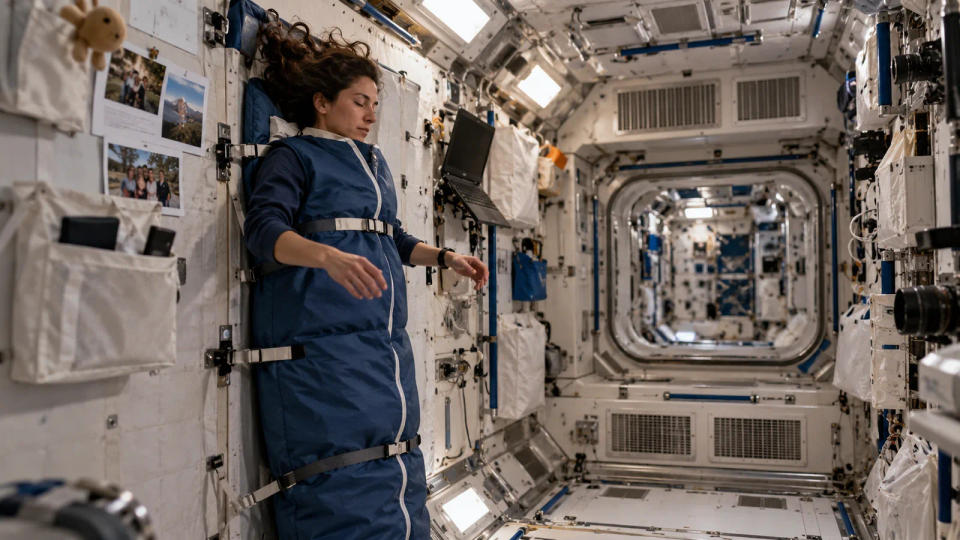
Without gravity, a conventional mattress would offer little benefit. There is no body weight to distribute across foam or springs, and a loose blanket would simply float away. A sleeping bag keeps the astronaut, clothing, and bedding together while still allowing a relaxed posture.
Arms can naturally float forward if they are not tucked into the bag, and astronauts may adopt a slightly curled posture. Some like the feeling of light contact around the body because it provides a familiar physical reference. Others enjoy the sensation of floating. Personal preference still matters, even when “bed position” no longer does.
The crew quarters also serve as tiny private rooms. They may contain a laptop, family photos, personal items, and storage pockets. Privacy is valuable on a station where people work and live together for months in a confined environment.
Airflow Is a Bigger Deal Than a Mattress
One of the strangest differences between sleeping on Earth and sleeping in orbit is that warm exhaled air does not simply rise away from the face. In microgravity, natural convection is greatly reduced. Without good ventilation, exhaled carbon dioxide can collect around a sleeping astronaut’s head.
That is why airflow is essential inside a sleeping compartment. Fans keep cabin air circulating so fresh air continuously replaces the air around the face. The same ventilation system that makes sleep safer also creates noise, which is one reason earplugs and other sleep-environment controls can be useful.
Temperature, light, vibration, privacy, and noise all matter too. NASA’s human-spaceflight standards treat sleep accommodation as a real engineering requirement, not a comfort upgrade. A crew member who sleeps poorly may be less alert when operating equipment, conducting experiments, or responding to an emergency.
Sixteen Sunrises Can Confuse the Body Clock
The lack of a mattress is not necessarily the hardest part of sleeping in space. The bigger challenge can be convincing the body that it is nighttime. The International Space Station circles Earth roughly every 90 minutes, so the crew can experience about 16 sunrises and sunsets during a 24-hour day.
Human circadian rhythms evolved around a much slower pattern: one day and one night. To protect that rhythm, astronauts follow a planned work-and-rest schedule rather than using the view outside the window as a clock. NASA’s current operational guidance recommends an 8.5-hour sleep period, and recent ISS sleep research has examined schedules with a regular bedtime around 21:30 and wake time around 06:00 Greenwich Mean Time.
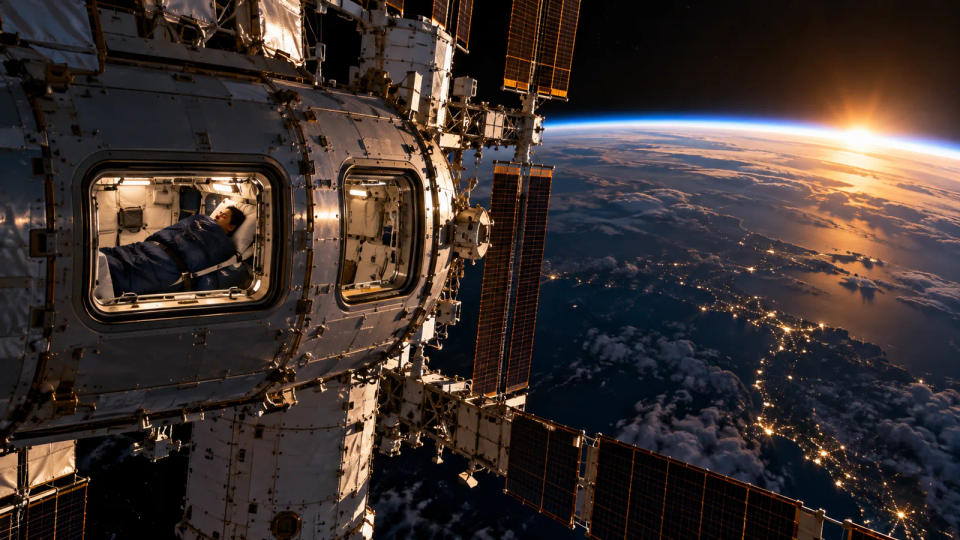
Lighting is another tool. Modern station lighting can be adjusted to support wakefulness at the right time and reduce disruption before sleep. Researchers have also studied how schedule shifts, visiting spacecraft, workload, and unusual mission events affect sleep duration and quality.
Historically, astronauts have often slept only about six hours per night in space, less than their scheduled sleep opportunity. More stable schedules and better sleeping environments appear to help, but spaceflight can still interrupt normal sleep. In other words, astronauts may be able to sleep in any physical orientation, yet their biological clocks remain very Earth-like.
What Space Sleep Teaches Us About Longer Missions
Sleep becomes even more important as missions move farther from Earth. A tired crew on the ISS can receive extensive support from flight controllers, and the station is only a few hours away by spacecraft under favorable conditions. A crew traveling to the Moon or Mars will operate with greater independence and, in the case of Mars, increasing communication delays.
That makes sleep a mission-safety issue. Alertness affects reaction time, judgment, memory, teamwork, and the ability to handle unexpected problems. Future spacecraft and surface habitats therefore need more than bunks. They need lighting systems that support circadian rhythms, effective ventilation, noise control, comfortable restraints, and schedules designed around human biology.
There is also a useful lesson for Earth. Shift workers, pilots, medical staff, and people who travel across time zones face some of the same basic problems: light at the wrong time, irregular schedules, and insufficient sleep. Spaceflight pushes those problems to an extreme, giving researchers a demanding environment in which to test ways of protecting sleep and performance.
Conclusion: Astronauts do not solve sleep in space by choosing which direction is “down.” They make direction almost irrelevant. A wall-mounted sleeping bag keeps the body from drifting, airflow keeps the breathing zone safe, and carefully timed light and schedules give the brain a substitute for Earth’s day-night cycle. In orbit, the bed is simple. The real challenge is helping an Earth-adapted body know when it is time to sleep.
Sources & Further Reading
- NASA — What Is Microgravity?
- NASA — Medical Operations: Circadian Shifting and Fatigue Management
- NASA — Risk from Inadequate Sleep and Irregular Schedules
- NASA Technical Reports Server — Impact of Sleep Shifting Strategies on the International Space Station
- ESA — Astronaut Selection FAQs: Sleeping in Space
Post a Comment