

Imagine opening an umbrella beneath a blue alien sky—and discovering that the rain might be made of glass. On the exoplanet HD 189733 b, astronomers have strong evidence for a fiercely heated, blue atmosphere, and they have proposed that silicate particles could form glass-like droplets. The crucial distinction is that scientists have not watched shards of glass fall there. The notorious sideways glass rain is a plausible interpretation, not an eyewitness weather report.
This is a much stranger story than an ordinary storm. The world is a gas giant, not an Earth with a dangerous beach; it travels around its star in only 2.2 Earth days. To understand why it became the poster child for terrifying alien weather, we need to follow the clues carried by light.
Why Would Glass Form in a Blue Alien Sky?
HD 189733 b is a hot Jupiter: a large gas planet orbiting extremely close to its parent star. NASA's catalog lists a radius about 1.13 times Jupiter's and an orbital distance of roughly 0.031 astronomical units. An astronomical unit is the average distance between Earth and the Sun; this planet receives intense heating because it circles so much nearer to its own star.
NASA and ESA reported in 2013 that Hubble observations established its deep-blue visible-light color. Researchers watched the system as the planet disappeared behind the star, comparing the light with and without the planet's small contribution. The blue part of the combined light diminished, providing evidence that the missing planet had reflected more blue light.
On Earth, we instinctively associate blue with seas and a gentle atmosphere. But here the proposed explanation is a high-altitude haze of silicates, materials made from silicon and oxygen that are common in rocks and glass. Tiny particles can scatter shorter blue wavelengths efficiently. If conditions allow these silicates to condense, they may become minute liquid or glassy droplets. That is where the dramatic phrase “glass rain” comes from.

Notice the boundary between a detection and an interpretation. The color is supported by observation; the precise material, droplet formation, and actual precipitation are not directly confirmed. Images showing large razor-sharp shards are visual metaphors, not photographs. On a gaseous planet, there is also no ordinary solid surface for a visitor to stand on while the rain strikes.
How Hot, Windy and Dangerous Is HD 189733 b?
Hubble's 2013 discussion described daytime atmospheric temperatures near 2,000 degrees Fahrenheit, approximately 1,100 degrees Celsius. Under such conditions, the familiar water cycle does not explain the exotic haze. Materials that form solid minerals on Earth can instead be present in very different atmospheric states. Whether and where silicate particles actually rain out depends on altitude, pressure and the planet's temperature profile.
The winds deserve their own caution. A 2015 investigation of sodium absorption during transits reported winds above 5,400 miles per hour, about 8,690 kilometers per hour. It used the Doppler effect: moving gas shifts the wavelengths of the light it absorbs, much as an approaching siren changes its pitch. Earlier NASA and ESA descriptions quoted other multi-thousand-kilometer-per-hour estimates.
However, atmospheric wind speed is not a single number engraved on the planet. Different measurements sample different parts of its atmosphere, and the models used to separate wind, rotation and stellar effects matter. In 2024, a peer-reviewed analysis of new sodium data reported a quieter interpretation, with a suggested dayside-to-nightside flow around 0.7 kilometers per second and an additional superrotating component of about 3–4 kilometers per second, conditional on the signal really being planetary. It explicitly challenged the strongest previous claims.
Even with that uncertainty, the environment is extreme. The planet is thought to be tidally locked, presenting approximately the same face to its star. Air heated on the dayside can circulate toward the nightside, transferring energy across vast distances. But the popular image of a precise universal wind blowing glass blades horizontally everywhere goes beyond what current observations establish.
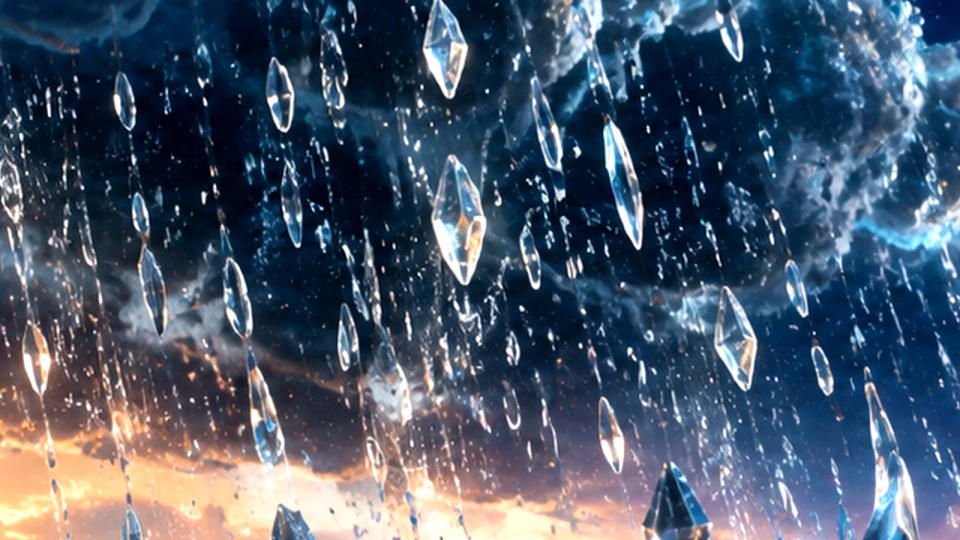
A useful thought experiment is to picture an unmanned probe passing through an upper cloud layer. It might encounter intense turbulence, radiation from the nearby star and unfamiliar suspended particles. Whether it would literally be pelted by glass droplets at a particular location is still unknown. This imagined flight helps visualize the science; it is not a forecast for a spacecraft that has visited the planet.
What Have Telescopes Actually Learned—and What Remains a Mystery?
HD 189733 b sits around 63 light-years away in the direction of Vulpecula. A light-year measures distance, not time: it is how far light travels in one year. Nobody has taken a close-up photo of a shower there. Instead, astronomers use light filtered or blocked by the planet to reveal conditions that no spacecraft has sampled directly.
Spitzer provided another clue in 2007 by building an infrared temperature map. The telescope found a warmer dayside, a cooler nightside and a hot spot shifted away from the point directly beneath the star. That displacement offered evidence for circulation moving heat around the globe. Infrared mapping reveals differences in emitted heat; it does not identify individual raindrops.
The story developed further when the James Webb Space Telescope examined starlight transmitted through the planet's atmosphere. A 2024 Nature study reported significant detections of water vapor, carbon dioxide, carbon monoxide and hydrogen sulfide. The investigators inferred an atmospheric abundance of heavy elements around three to five times the host star's value. These are chemical clues about how the planet formed, not a measurement of glass precipitation.
Hydrogen sulfide often prompts jokes about rotten eggs. Yet it would be misleading to imagine standing close enough to smell this air: the world is a scorching gas giant and a thoroughly unsuitable destination for humans. The discovery matters because sulfur chemistry can help scientists reconstruct the ingredients incorporated during planet formation.
One remarkable lesson is methodological. A tiny change in blue light revealed the planet's color, a shifted spectral line suggested atmospheric motion, infrared variations mapped heat, and Webb's infrared spectrum identified molecules. None of those observations looks like the sweeping artist illustrations in a science magazine, but together they support a far richer picture.
Conclusion
So what if it rained glass instead of water? HD 189733 b shows why that phrase is compelling: a verified deep-blue world, blistering atmospheric heat, evidence for powerful circulation and a physically plausible silicate-cloud scenario. But it is more scientifically exciting to know where the evidence stops than to mistake a striking illustration for direct proof.
This distant planet is not a second Earth with dangerous weather. It is a natural laboratory where telescopes test how clouds, winds, heat and chemistry behave under conditions far beyond our everyday experience. The next chapter will be written by measurements sharp enough to separate the possible glass rain from the glass-rain legend.
Sources & Further Reading
- NASA — NASA's Hubble Finds a True Blue Planet (2013)
- NASA — 5,400 mph Winds Discovered Hurtling Around Planet Outside Solar System (2015)
- NASA — Spitzer Maps an Exoplanet (2007)
- NASA Exoplanet Catalog — HD 189733 b
- Fu et al., Nature — Hydrogen sulfide and metal-enriched atmosphere for a Jupiter-mass exoplanet (2024)
- Keles et al., MNRAS — New Na D transmission spectra indicate a quieter atmosphere on HD 189733b (2024)
Post a Comment