
GJ 367 b circles its star every 7.7 hours, completing more than three years during a single Earth day.
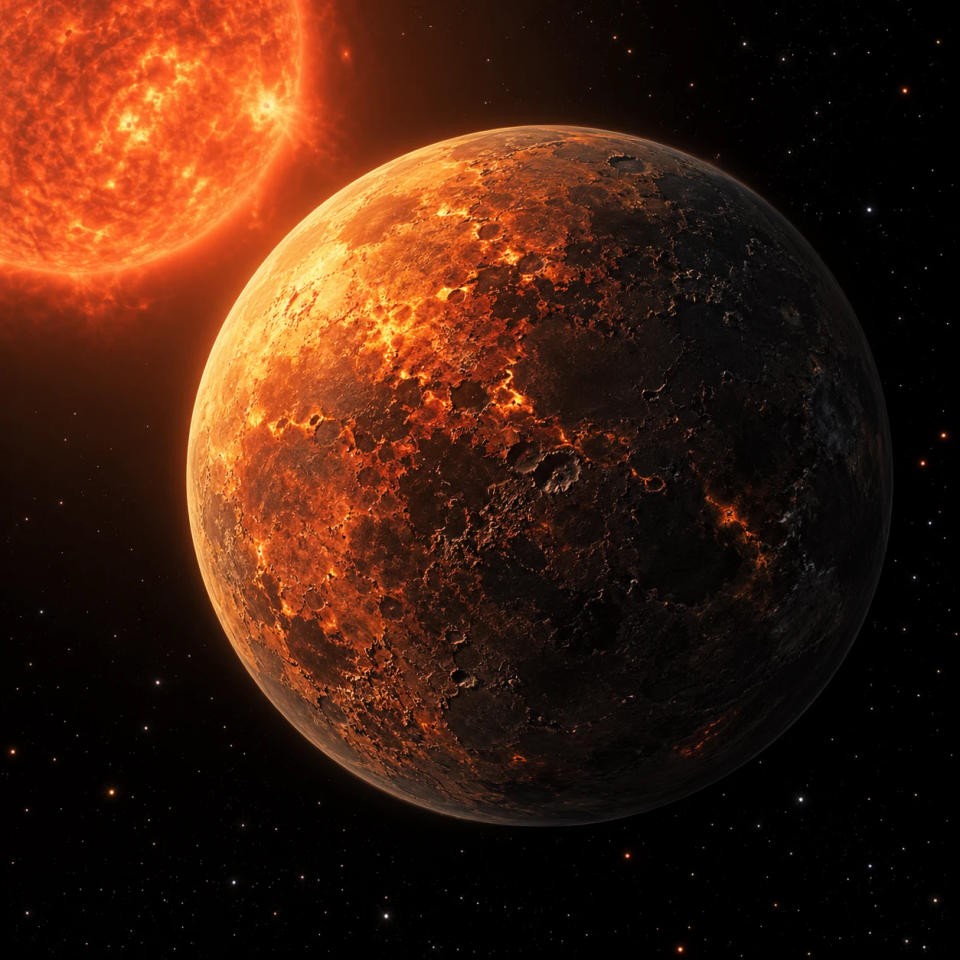
A year on GJ 367 b lasts less than a typical working day. This small rocky exoplanet races around a red dwarf so closely that its orbital period is measured in hours. The headline is real, but it describes the time needed to circle the star, not a clock running faster or a human aging at a different rate.
The planet also tells a more complicated story about what distant worlds contain. Early studies suggested an extraordinarily iron-rich interior. A 2026 reanalysis reduced that estimate, showing why the discovery is fascinating even when the most dramatic description changes. Its short year remains secure; its exact internal composition is a scientific inference that researchers continue to refine.
How can a year last only 7.7 hours?
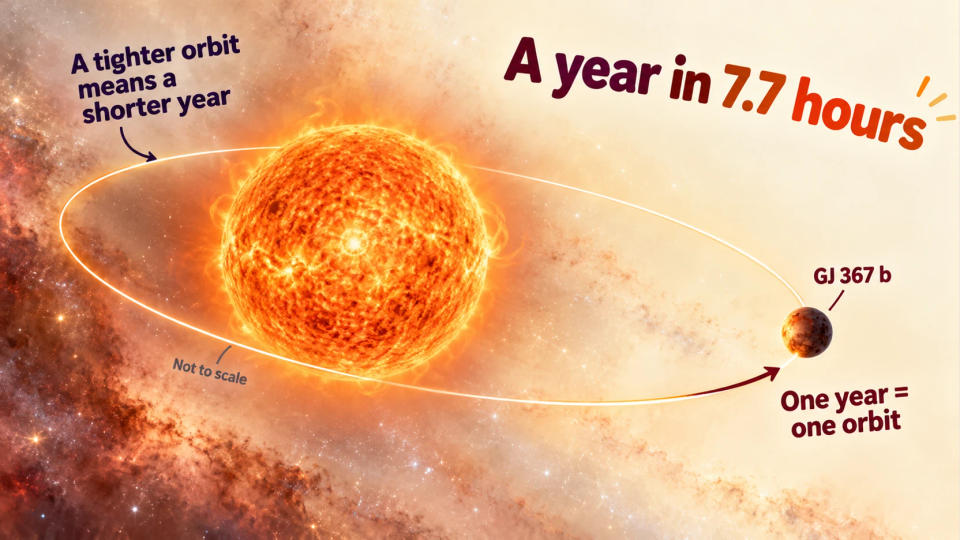
A planetary year is one complete orbit around the host star. GJ 367 b belongs to the ultra-short-period category: planets that circle their stars in less than a day. The 2021 discovery paper reported its approximately 7.7-hour period, and subsequent studies retained this striking property.
For a fixed stellar mass, closer orbits have shorter periods. The planet travels a smaller orbital circuit while moving faster under the star's stronger gravitational pull. Both effects contribute. It is not necessary to invent unusual physics or a mysterious source of propulsion to explain the rapid return.
Dividing 24 Earth hours by 7.7 gives about 3.1 orbits. That is why saying the planet completes more than three years in an Earth day is a useful comparison. It is simply arithmetic using the rounded orbital period, rather than an observation of inhabitants celebrating repeated birthdays.
A year must also be distinguished from a day. The orbital period does not, by itself, measure the planet's rotation or the interval between local sunrises. Close-in planets can experience strong tidal effects, but a short year should never automatically be presented as a measured sequence of rapidly alternating daylight and darkness.
The schematic orbit in the illustration is not drawn to scale. It explains the relationship between a compact orbit and a short period, rather than reconstructing a telescope image of the system. Astronomers do not see this small planet as a detailed globe traveling around a resolved stellar disk.
How did astronomers find such a small world?
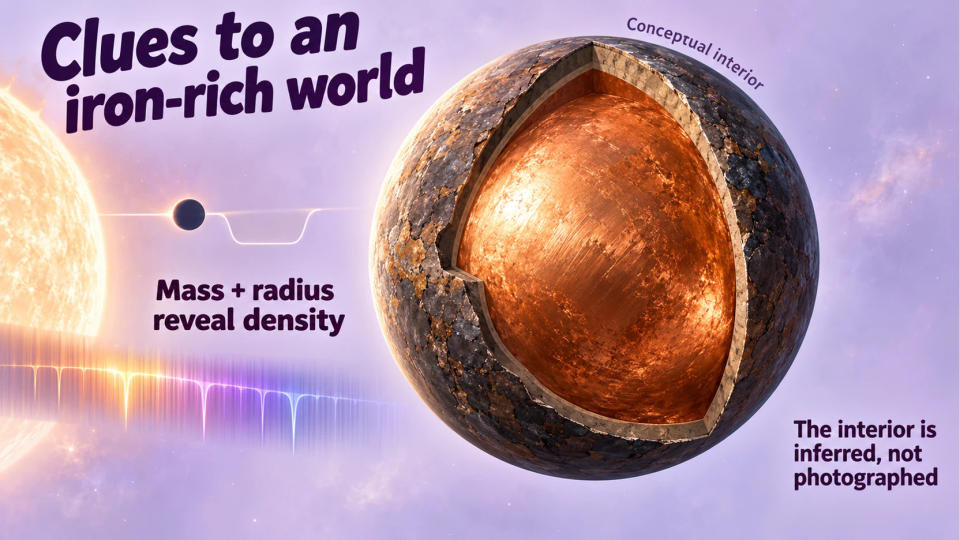
The discovery combined two complementary methods. TESS observed transits: small, repeated decreases in the star's brightness when the planet passed in front of it from our viewpoint. The spacing between those dips revealed the orbital period. Their depth helped constrain the planet's size relative to its star.
Ground-based spectroscopy supplied another clue. A planet and its star orbit their shared center of mass, so the star moves slightly toward and away from us. These radial-velocity changes shift features in the stellar spectrum. Measuring the repeating signal helps estimate the planet's mass when combined with the system's geometry.
Size and mass answer different questions. A transit does not weigh a planet, and a radial-velocity signal does not directly show its surface. Together, the measurements allow researchers to calculate bulk density and test which combinations of rock and metal could plausibly fit the data.
Follow-up work also revealed a larger planetary family. The 2023 study identified two additional non-transiting companions with periods near 11.5 and 34 days. Their presence makes GJ 367 b part of a multiplanet system, rather than an isolated curiosity with no wider architectural context.
The ability to observe many inner-planet orbits is valuable. Repetition helps test whether a signal stays consistent, although stellar activity and instrumental limitations still require care. A spectacularly short period makes the system accessible to repeated monitoring, not automatically free from measurement uncertainty.
Is GJ 367 b really almost pure iron?
That description needs updating. In 2023, researchers estimated a mass of 0.633 Earth masses and a radius of 0.699 Earth radii. Those measurements implied a very high bulk density and supported models with an unusually large iron core. Such results motivated comparisons with an extreme version of Mercury.
A study submitted in June 2026 revisited the system with newer TESS observations and VLT/ESPRESSO radial velocities. It reported a radius of 0.736 ± 0.035 Earth radii and a mass of 0.503 ± 0.078 Earth masses. Those revised values imply less extreme density than the earlier analysis.
The team's interior modeling favored an iron mass fraction around 50–70%, depending on assumptions about composition and shape. That is broadly Mercury-like, rather than compelling evidence for an almost pure iron planet. It remains a small, metal-rich candidate, but the details should be attached to the study and its uncertainties.
This distinction matters because volume changes with the cube of radius. A modest revision to size can noticeably affect inferred density. The researchers also considered stellar activity, dilution of the transit signal, and tidal distortion. Density is a calculated constraint, and interior composition requires an additional layer of modeling.
Conditions so close to the star are also harsh. A 2024 study used the host's X-ray emission to assess atmospheric escape and concluded that a surviving atmosphere was very unlikely under its models. That is evidence-based interpretation, not a photograph proving every possible gas is absent. Illustrations of a scorched rocky surface should likewise be understood as visualizations, not mapped geography.
Conclusion
GJ 367 b really does complete an orbit in about 7.7 hours. Its year is short because it circles close to its red dwarf, while transit timing and stellar motion let astronomers investigate a world far too small and distant to inspect directly.
The richer lesson is that a robust orbital discovery can coexist with changing estimates of mass, size, and composition. GJ 367 b remains extraordinary without treating its interior as settled. Its rapid orbit invites attention; the evolving evidence shows how scientists turn that attention into a more accurate planetary story.
Sources & Further Reading
- GJ 367b: A dense ultra-short period sub-Earth planet transiting a nearby red dwarf star
- Company for the ultra-high density, ultra-short period sub-Earth GJ 367 b: discovery of two additional low-mass planets at 11.5 and 34 days
- Revisiting the Exo-Mercury Candidate GJ 367 b with ESPRESSO and a Self-Consistent Tidal Distortion Model
- The high-energy environment of the heavy sub-Earth GJ 367 b indicates likely complete evaporation of its atmosphere
Post a Comment