
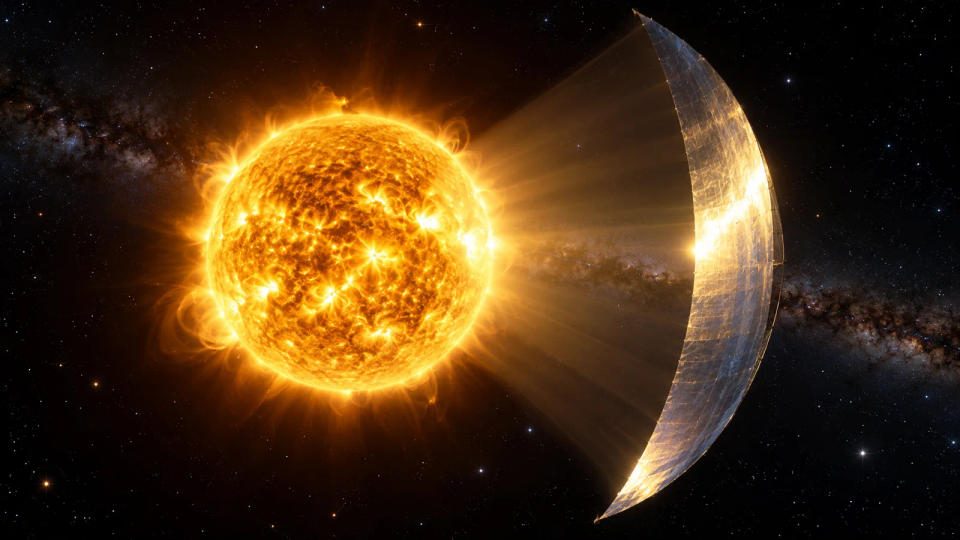
Could a mirror bigger than a planet alter the future of the entire solar system? In principle, yes: an extraordinarily large reflector placed on one side of the Sun could help change the Sun’s path through the Milky Way over immense stretches of time. But it could not switch off the Sun, stop nuclear fusion, or prevent our star from growing old.
The idea is called a Shkadov thruster, after a concept proposed in 1987. It sounds like science fiction because the machine would be larger than anything humanity has built by a staggering margin. Yet the force behind it—sunlight pushing on reflective material—is a real, measured effect. The surprising part is that even the Sun might respond, very slowly, if an advanced civilization learned to arrange that force on a truly stellar scale.
How Could a Mirror Push the Sun?
Sunlight carries energy, but it also carries momentum, the property that lets a moving object deliver a push. A photon has no rest mass, yet when light hits a surface it transfers a tiny amount of momentum. Reflecting that light changes the momentum transfer. NASA’s solar-sail research uses this principle: large, thin reflective sheets can receive a gentle but persistent push without burning rocket fuel.
Now enlarge the sail beyond ordinary engineering imagination. A classic Shkadov design places a huge curved reflector on just one side of a star. It is not a complete shell around the Sun. A symmetrical shell that redirected sunlight evenly would not provide the same preferred direction for propulsion.
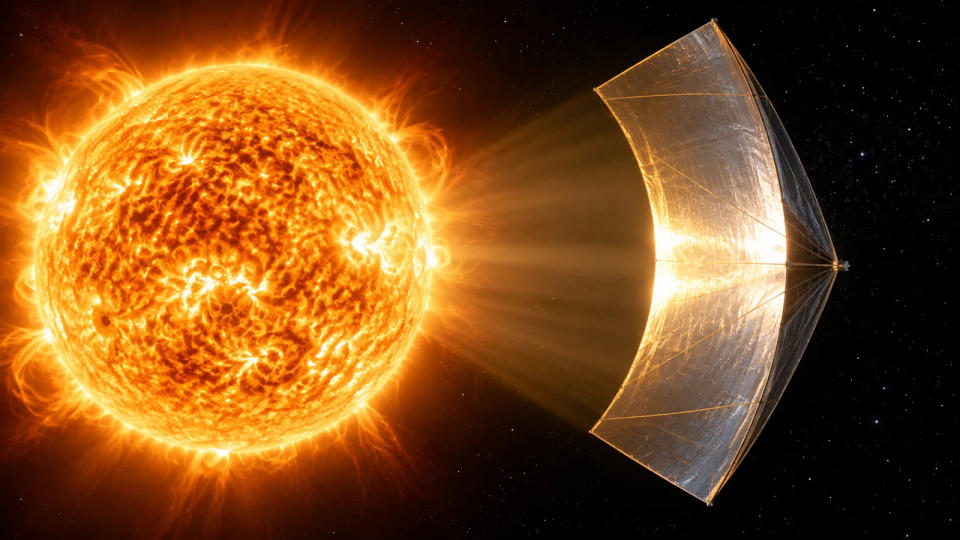
The structure would need an unusual balance: sunlight pushes the reflector outward while the Sun’s gravity pulls it inward. The hypothetical configuration is often called a statite, meaning an object that maintains a position using forces other than ordinary orbital motion. Its gravity pulls on the Sun, while the escaping redirected light carries momentum away. Taken together, the system can acquire a tiny net acceleration in one direction.
Think of holding a very light sail in a continuous breeze, except the breeze is made of photons. The analogy helps explain the pressure, but it cannot convey the scale. A solar sail on a spacecraft and a curved mirror intended to affect a star are separated by an almost unimaginable gulf in size, mass, stability, and manufacturing requirements.
Could It Really Move the Entire Solar System?
Our solar system is already traveling around the center of the Milky Way. NASA estimates that one galactic orbit takes roughly 230 million years. A stellar engine would not need to lift the Sun out of a stationary location; it would gradually modify an existing galactic trajectory, a little like adding the faintest possible steering correction to a moving ship.
In a 2019 paper in Acta Astronautica, astrophysicist Matthew Caplan examined passive reflective stellar engines and more powerful active alternatives. His analysis treated such devices as mathematical engineering concepts, not as technology that currently exists. Published estimates for passive engines are extraordinarily small—of roughly trillionths of a meter per second squared, depending on the design. A 2021 technical comment corrected an equation in the earlier passive-mirror treatment, a reminder that exact numbers depend on the geometry and assumptions.
That acceleration would be hopelessly weak for dodging a threat that appeared next week or next century. Over millions or billions of years, however, a sustained correction could accumulate into a meaningful change in direction. The 2019 study discusses potential changes to a star’s galactic orbit, while stressing the enormous timescales involved. That is why a stellar engine makes more sense as an idea about distant civilizations than as a practical plan for present-day Earth.
Would the planets be left behind? Not automatically. The Sun contains about 99.8 percent of the solar system’s mass, and the planets remain gravitationally bound to it. Under a sufficiently slow, smooth change in the Sun’s motion, many planetary orbits could accompany it. Still, engineers would need to model the altered gravitational environment and long-term orbital stability; "move the Sun" does not mean the planets are guaranteed to behave perfectly.
Could Mirrors Save Earth From the Sun’s Future?
Here the distinction between steering sunlight and changing the Sun itself becomes crucial. A reflector can block or redirect some incoming sunlight, at least in principle. Positioning smaller structures to shade a planet or redirect energy toward colder locations is another speculative form of solar engineering. But those arrangements are not equivalent to the asymmetric reflector intended to move a star.
Earth’s long-term problem is not that our Sun is heading toward the wrong neighborhood. As the Sun ages, its output gradually changes. NASA explains that in about five billion years it will enter the red-giant stage, expanding so dramatically that the inner solar system faces extreme conditions. Some planetary outcomes—including precisely what happens to Earth’s orbit and physical remains—depend on stellar-evolution models, but Earth will lose its present habitability long before the story ends.
A shade might reduce the radiation reaching a world for some period; an enormous mirror system might also make conditions worse if it directed concentrated light toward the wrong place. Neither approach replenishes hydrogen in the Sun’s core. Mirrors cannot halt the chain of stellar changes that eventually leaves behind a white dwarf.
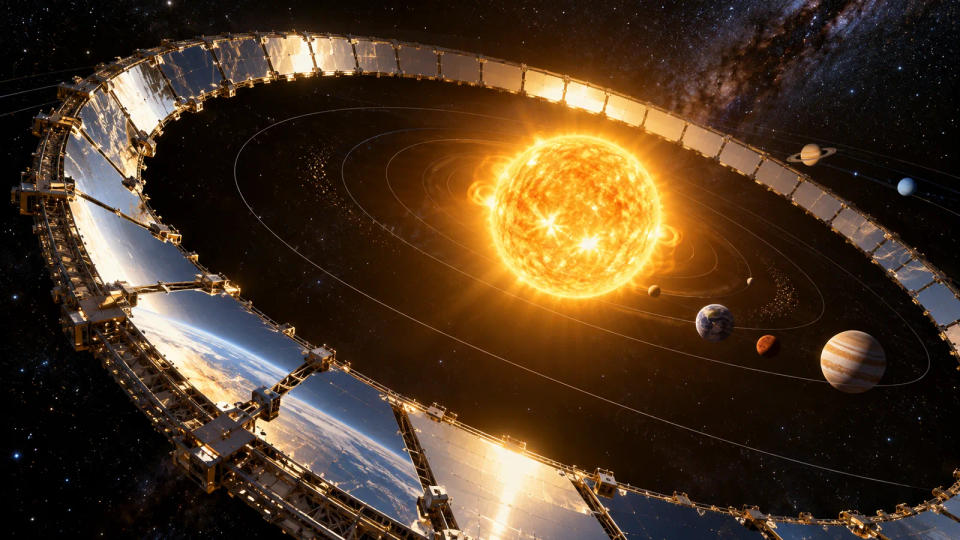
There is also a conceptual trap in the phrase "mirror around the Sun." A Dyson swarm, sometimes imagined as numerous collectors arranged around a star, is primarily an energy-harvesting concept. A Shkadov thruster is primarily a momentum-redirecting concept. They could both involve immense reflective surfaces, but their geometry, goals, and unintended effects would be very different. An evenly distributed ring or shell in an illustration should not be mistaken for a tested stellar-engine blueprint.
Even if a civilization had the resources to build such structures, huge questions would remain. Where would the raw materials come from? How could large, extremely thin components resist damage and maintain orientation for ages? How would the construction avoid disrupting useful sunlight reaching inhabited planets? No published demonstration has answered those questions for a star-sized device.
Conclusion
A giant solar mirror could, according to theoretical physics, do something extraordinary: turn the Sun’s own light into a slow steering mechanism for the Sun and the gravitationally connected planetary system. The basic photon pressure is real; the stellar-scale structure is hypothetical. Its usefulness would emerge on immense timescales, not as a quick rescue device.
That would change one kind of fate—the route our star takes through the galaxy—without changing another. The Sun would still age, brighten, expand, and eventually become a white dwarf. The deeper lesson is that directing the motion of a solar system and preserving life on a planet are two profoundly different engineering challenges.
Sources & Further Reading
- Caplan (2019), Stellar Engines: Design Considerations for Maximizing Acceleration — Acta Astronautica
- Svoronos and Caplan (2021), Comments on Stellar Engines — Acta Astronautica
- NASA — Diffractive Lightsails
- NASA Science — Sun: Facts
- NASA Science — Life and Death of a Planetary System, Chapter 6
Post a Comment