
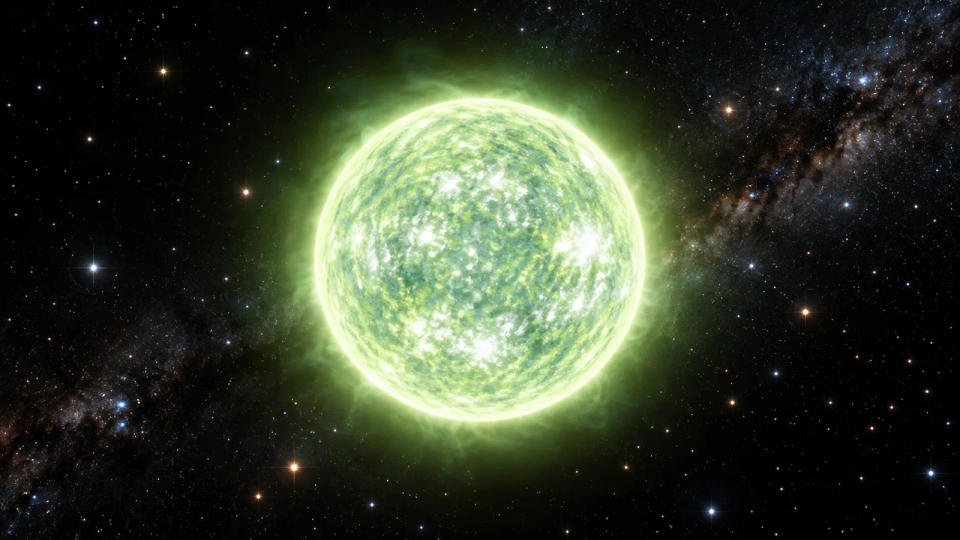
Astronomers have finally found compelling evidence for a green star—but not the sort of green Sun that science fiction usually imagines. In research published on October 15, 2026, scientists identified a white dwarf called WD J1330+6435 whose measured spectrum and atmospheric models predict a pale chartreuse appearance. It is a remarkable exception to the familiar rule that stars are red, white, or blue rather than green.
The important distinction is how the color was established. Nobody has photographed a resolved, lime-green stellar disk from Earth. Researchers calculated what human eyes would perceive if the tiny, faint stellar remnant could be viewed close enough, using its observed light and models of an unusually dense atmosphere.
Why Astronomers Used to Say Green Stars Do Not Exist
A normal star glows across a broad rainbow of wavelengths, not in a single narrow color. Its temperature largely determines the balance of that light. Cooler stars look orange or red, while hotter stars tend toward white or blue. Intermediate temperatures do not normally make a luminous green ball because red and blue wavelengths are emitted alongside green and mix in our visual system.
The Sun is an excellent example. Its spectrum is strong around the visible green-yellow region, yet sunlight seen from space is essentially white. The apparent contradiction disappears once we distinguish the wavelength where a spectrum peaks from the perceived color of the whole spectrum. Human vision combines responses from three types of cone cells; it does not simply report the brightest wavelength.
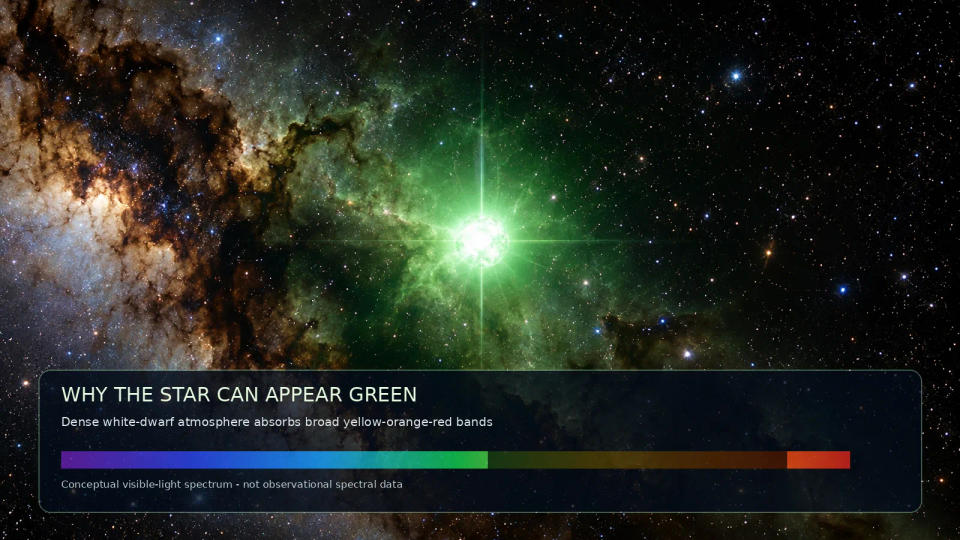
For decades, this explanation supported the popular phrase “there are no green stars.” That statement worked well for ordinary stellar atmospheres, which approximately follow a blackbody spectrum. It was never proof that every possible star must behave like a clean blackbody. A star whose atmosphere removes selected wavelengths could look different—and white dwarfs provide the extreme conditions needed.
The Green White Dwarf WD J1330+6435
WD J1330+6435 is a white dwarf: the dense leftover core of a star that has ended its ordinary nuclear-burning lifetime. Instead of being a young, unusually hot green star, it is an old stellar remnant with a complicated chemical history. The Warwick research team reports a temperature of roughly 4,000 degrees Celsius and evidence that rocky debris from its former planetary system has entered its atmosphere.
That material introduced elements including sodium, calcium, and lithium. Sodium is especially important to the surprising hue. In an ordinary setting, sodium absorbs light at characteristic wavelengths near the yellow-orange part of the visible spectrum. Inside a dense white dwarf atmosphere, pressure broadens the absorption enormously, reducing a much wider range of yellow, orange, and red light.
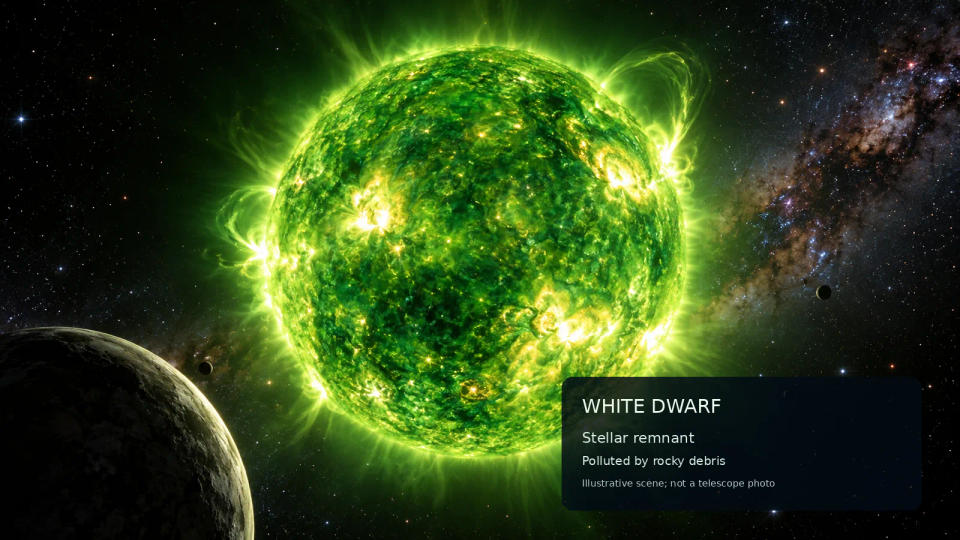
The result is not a pure green laser beam. It is a reshaped, broad spectrum whose mixture of surviving wavelengths is predicted to appear chartreuse to human observers. Researchers used observational spectroscopy along with atmosphere and color-perception models to estimate that appearance. Their paper also notes that some measurements for this particular star are noisy, so the exact shade has uncertainty, although earlier models produced a similar greenish result.
This matters because the unusual atmosphere records the fate of rocky planetary material. Rather than merely adding a new color to a star chart, the spectrum links a dead star to the chemical remains of objects that once orbited it.
How Starlight Reveals Colors We Cannot Photograph
Astronomers read starlight by separating it into wavelengths using spectroscopy. Imagine spreading white sunlight through a prism: a smooth rainbow is interrupted by dark regions where atoms or molecules have absorbed specific colors. Those missing pieces are chemical fingerprints. NASA explains that comparing absorption features with physical models can reveal which substances lie in a star’s outer layers.
White dwarf atmospheres can be far denser than those of familiar main-sequence stars. In such conditions, absorption features cease to be thin lines and may expand into wide troughs. Computer models then calculate how much light reaches the eye at each wavelength. Researchers convert those predicted spectra into standard color coordinates to estimate what a resolved stellar disk would look like.
The new study did not discover a nearby giant emerald sphere that amateur telescopes can show in full color. White dwarfs are too small and distant for their disks to be seen directly as detailed colored circles. The images released with the research are artistic or computed visualizations, not ordinary spacecraft photographs. Screen settings, surrounding illumination, and human eyesight also affect how subtle colors appear.
The most reliable statement, therefore, is precise: WD J1330+6435 is an observed white dwarf whose spectrum, interpreted with atmospheric physics, supports a distinctly green appearance under hypothetical close-up viewing conditions.
The same 2026 investigation found that green is not the only unexpected option. Certain white dwarfs containing carbon can appear pink or purple because molecules absorb so much blue and green light. A particularly striking example is WD J1011+2845, described by the researchers as a salmon-pink object with carbon brought upward by convection. Other modeled atmospheres can look yellow or cyan.
These examples reveal a larger lesson: a star’s perceived color depends on more than surface temperature. Chemical composition and the pressure and density of its atmosphere can reorganize the visible spectrum. However, spectacular exceptions are not the norm. In a nearby volume-limited sample examined by the researchers, the typical white dwarf still came out approximately white.
There is another reason to be cautious about pictures circulating online. A nebula colored green in an astronomy image may use assigned colors to represent narrow emission bands or invisible wavelengths. That is not equivalent to claiming that a stellar photosphere would look green to a human eye. The new white dwarf finding is specifically about modeled human-visible color, not an arbitrary color palette.
Conclusion
So, have astronomers discovered a green star? Yes, with an important scientific qualification. WD J1330+6435 is a real white dwarf, and its observed spectrum gives researchers a strong basis for predicting a greenish, chartreuse appearance. It does not overturn the physics of normal stars; instead, it exposes a fascinating exception created by chemical absorption under extraordinary pressure.
The discovery turns a familiar astronomy trivia question into a lesson about spectroscopy, planetary debris, and the limits of everyday color intuition. Green stars may still be extraordinarily rare, but the universe has found a physically plausible way to make one.
Sources & Further Reading
- Original peer-reviewed study: Any colour you like (2026)
- University of Warwick: Astronomers reveal the true colours of white dwarfs
- NASA: Spectroscopy 101 – Types of Spectra and Spectroscopy
- NASA: The Sun’s Spectrum with Its Missing Colors
- Reuters: Newly identified green star leaves astronomers amazed
Post a Comment