
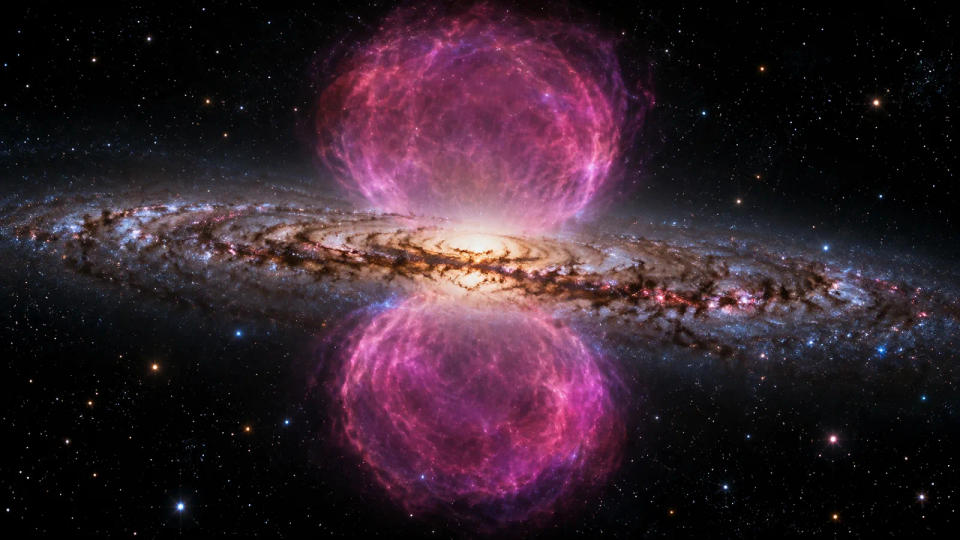
Why do two enormous, invisible structures rise from the center of our Milky Way? They are called the Fermi bubbles: twin regions of gamma-ray emission extending roughly 25,000 light-years above and below the galactic plane, about 50,000 light-years end to end. Their energy probably traces an enormous outflow from the Milky Way’s center, but astronomers are still testing exactly what powered it.
The name “bubbles” may suggest glowing soap bubbles floating among stars. In reality, they are not visible to human eyes. Their boundaries were reconstructed from high-energy radiation detected by an orbiting telescope. The dramatic colored pictures commonly used to show them are visualizations or false-color maps, not ordinary photographs of glowing purple gas.
How Did Astronomers Find the Fermi Bubbles?
NASA’s Fermi Gamma-ray Space Telescope launched in 2008. Its Large Area Telescope detects gamma rays, the most energetic kind of electromagnetic radiation. When scientists analyzed the first two years of observations, they uncovered an unexpectedly symmetrical pair of enormous lobes, announced in 2010. Each appears to extend roughly 50 degrees away from the galactic plane as seen from Earth.
Finding them required more than pointing a camera toward the middle of the sky. The Milky Way already produces diffuse gamma-ray emission because energetic particles encounter gas and starlight. Astronomers modeled that broad foreground glow, accounted for bright individual sources, and examined what remained. Out of the background emerged two lobes with surprisingly defined edges and an unusually high-energy spectrum.
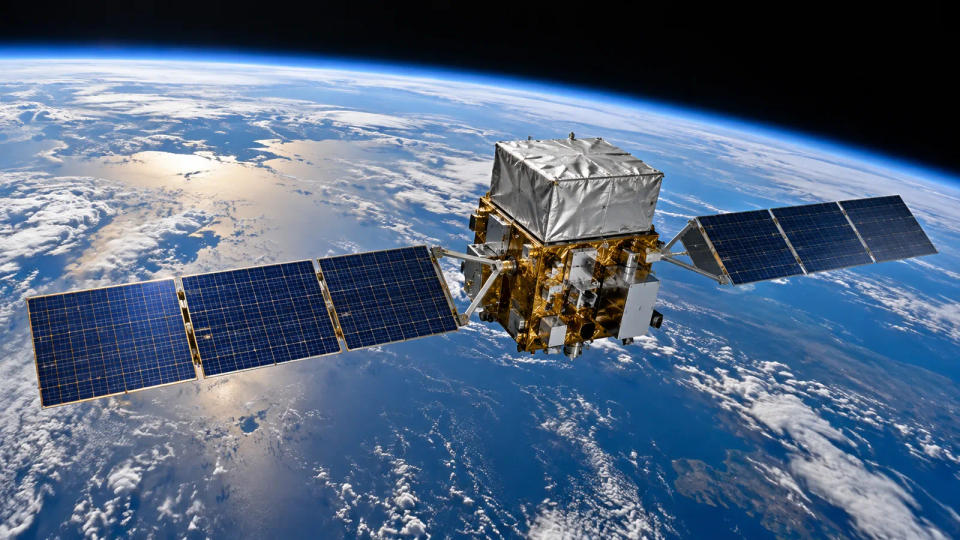
Think of listening for a deep drumbeat in a crowded orchestra. The sound is there, but first you must understand and subtract the other instruments. Fermi’s analysis worked in a similar way: removing expected emission patterns revealed a large structure that had been hiding in the data. The satellite image here is an illustrative view of the observing technology, not a photograph of the gamma rays themselves.
The discovery was striking for its geometry. The lobes lie on opposite sides of the central disk, broadly aligned with the galactic center. Their roughly paired shape makes a central energy source plausible. Still, the images represent our reconstruction from one position inside the Milky Way, rather than an external photograph showing the whole galaxy.
What Could Have Blown Such Enormous Bubbles?
The strongest ideas involve a period when the heart of our galaxy released far more energy than it does today. At that center is Sagittarius A*, a supermassive black hole. Black holes do not need to swallow their surroundings violently all the time: when gas falls toward them, accretion can energize surrounding matter and sometimes drive powerful jets or winds. Astronomers observe these processes in other galaxies.
One proposed explanation is that Sagittarius A* once experienced a substantially more active phase, sending energy and particles toward the galactic poles. As the outflow moved through gas above and below the disk, it could have inflated large regions containing energetic particles. This is a model of the galaxy’s past activity, not evidence that a spectacular jet is operating there now.
A different possibility is collective activity from massive stars in the galactic center. When many stars form in a relatively short period, stellar winds and supernova explosions inject energy into surrounding gas. Under suitable conditions their combined effect can create a large-scale galactic wind. The stars need not create two literal hollow balloons: what matters is the distribution and motion of hot gas and energetic particles.
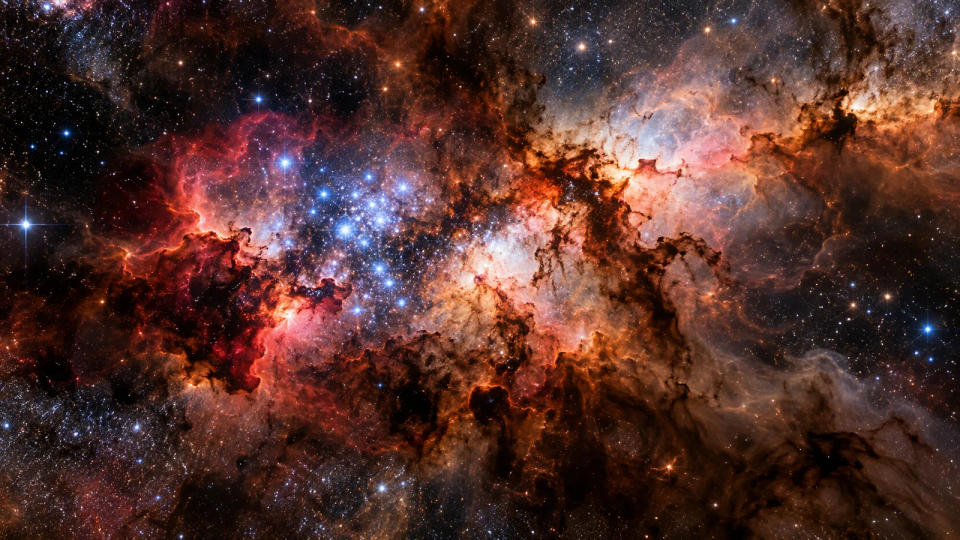
The star-forming scene above illustrates one possible class of energy source, not a verified photograph of the specific event that produced the Fermi bubbles. Researchers compare these possibilities with the lobes’ shapes, gamma-ray energy spectra, gas motions and related emissions at other wavelengths. A central black-hole outburst is compelling, especially in some simulation studies, but the details are not settled by one image or observation.
The gamma rays themselves also carry clues. A fast electron can transfer energy to a lower-energy photon through inverse Compton scattering, boosting it into the gamma-ray range. Interactions involving very energetic protons can contribute gamma rays by a different route. Scientists examine the spectrum and associated signals to learn which particle populations and physical processes are responsible.
What Do X-Rays and Other Signals Reveal?
The Fermi bubbles are part of a broader, multiwavelength mystery. Earlier X-ray observations had hinted at related large structures. Then, in 2020, researchers using the eROSITA X-ray telescope reported enormous soft-X-ray bubbles extending about 14 kiloparsecs, roughly 46,000 light-years, above and below the galactic center. These X-ray structures are larger than the gamma-ray Fermi bubbles and should not be confused with the original 50,000-light-year measurement.
The X-ray observations trace hot gas and boundaries consistent with shocks propagating into the Milky Way’s halo. In contrast, the Fermi map emphasizes high-energy gamma-ray radiation. The two maps do not simply show the same gas in different colors; they reveal different physical components of an energetic galactic environment.
There is also a microwave haze associated with the inner galaxy, giving scientists another view of energetic electrons and magnetic fields. Putting gamma rays, X-rays and microwaves together lets astronomers test whether a shared outflow could explain several distinct signals. It also helps reveal how energy travels from the crowded central region into the thin gas surrounding the galactic disk.
A 2022 Nature Astronomy study used numerical simulations to demonstrate how one episode of past jet activity from the central supermassive black hole could reproduce several features of the Fermi bubbles, eROSITA bubbles and microwave haze. That result makes a common origin scientifically plausible. It is not an observation of the original eruption, and alternative histories remain under investigation.
How old are these structures? The often-cited timescale is several million years, but a single precise birthday cannot be read directly from the maps. Age estimates depend on assumptions about how quickly the outflows expanded, how particles lost energy and what conditions existed in the galactic halo. A strikingly sharp boundary can indicate a powerful past event without providing a unique timeline.
Conclusion
The Milky Way’s two giant Fermi bubbles are real gamma-ray structures, not visible purple clouds. Their approximately 50,000-light-year combined extent is evidence that our galaxy’s center has shaped its surroundings on an enormous scale. An ancient episode involving Sagittarius A* is a major explanation, while strong star formation remains an important alternative to test. Observations across multiple wavelengths are helping astronomers reconstruct that history without pretending its details are already certain.
Sources & Further Reading
- NASA — Fermi Telescope Finds Giant Structure in Our Galaxy
- NASA Science — Blowing Bubbles in the Gamma-ray Sky
- Predehl et al. (2020) — Detection of Large-scale X-ray Bubbles in the Milky Way Halo
- Yang et al. (2022) — Fermi and eROSITA Bubbles as Relics of Past Black Hole Activity
- NASA — Galactic Haze Seen by Planck and Bubbles Seen by Fermi
Post a Comment