
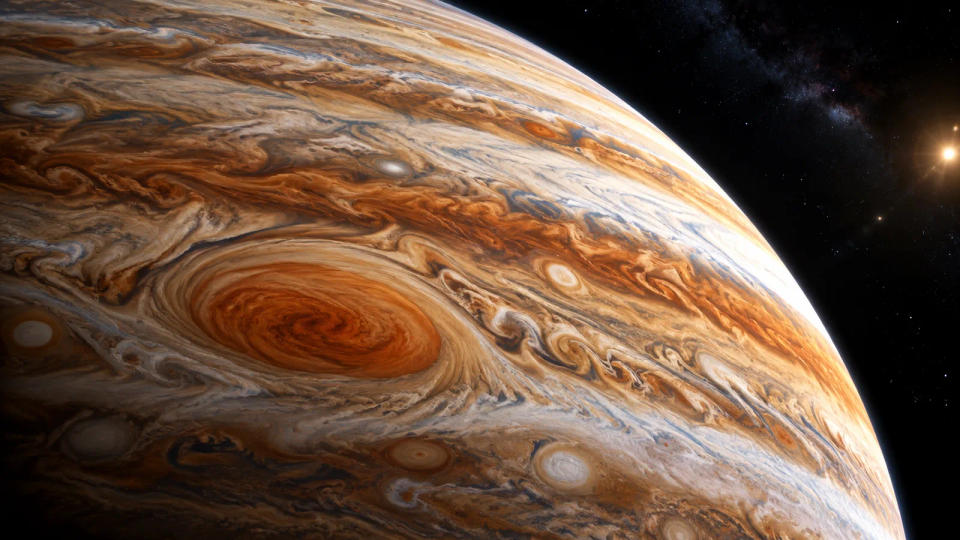
Suppose you stepped off a spacecraft above Jupiter. Would you hit something, float forever, or disappear into the planet? Jupiter has no ordinary ground to land on: the visible planet is its atmosphere, and a descent would carry you toward increasingly dense, hot, high-pressure material. An unprotected human could not survive even the early stages.
The question is more interesting than a simple ‘you would be crushed’ answer, because the clouds are only the beginning. NASA has sent an instrumented probe into Jupiter, while the Juno spacecraft has measured clues about the world hidden below those clouds. Their evidence lets us separate a real physical picture from a dramatic imaginary fall.
Crossing a Boundary That Is Not Ground
From a distance, Jupiter looks like a giant marble with a striped surface. Those stripes are not continents or painted rock. They are clouds and broad belts of moving atmosphere, primarily hydrogen and helium. High clouds include ammonia ice; farther down, scientists expect other cloud-forming materials, including ammonium hydrosulfide and water. The visible bands and storms are weather, not landscapes.
For a rocky planet, reaching the surface means finding the place where air ends and ground begins. Jupiter offers no equivalent moment. Planetary scientists commonly use the atmospheric level at a pressure of one bar as a reference height. One bar is close to air pressure at sea level on Earth, but the line is a measurement convention, not a hidden platform beneath the clouds.
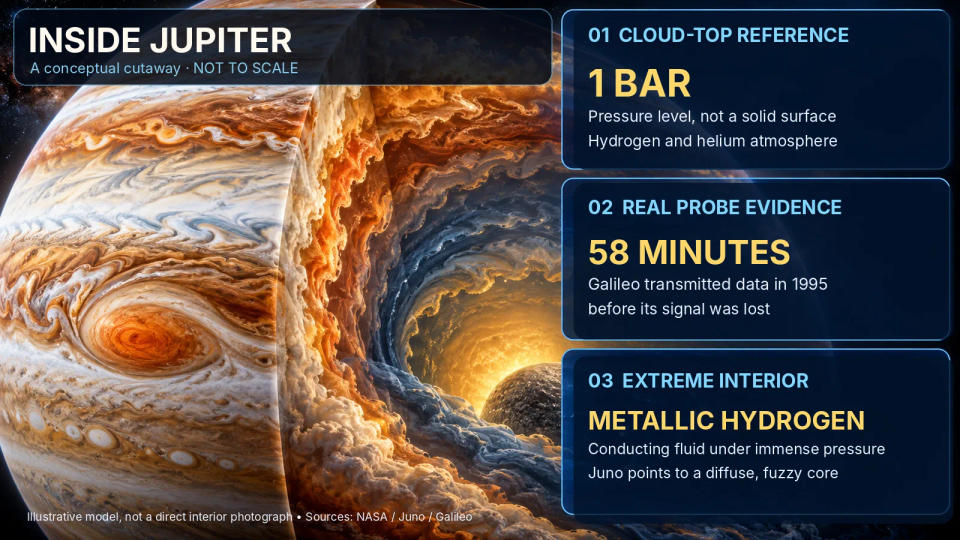
Imagine walking into fog that slowly thickens without ever becoming a sidewalk. That is closer to the right mental model, though real Jupiter is vastly stranger. Gravity pulls material inward, and the growing weight of the atmosphere compresses the layers below. Deeper down, the hydrogen becomes a dense fluid. There is no universally fixed altitude at which a visitor could say, ‘Now I have landed.’
Your exact fate would depend on how you arrived. Dropping toward Jupiter from a fast spacecraft could produce a violent atmospheric entry and enormous heating. Descending slowly in a hypothetical protected craft would avoid some entry heating, but it would not create breathable air or a solid destination. Jupiter's hydrogen-rich atmosphere contains essentially none of the oxygen a human needs to breathe, and its environment is far beyond ordinary life-support systems.
The striking lesson of the infographic is that our familiar word ‘surface’ stops being useful here. It illustrates a plausible change from cloud-bearing gas to high-pressure fluid, rather than a literal photograph or a precisely scaled map of Jupiter's interior.
The Probe That Actually Fell Into Jupiter
On December 7, 1995, the Galileo atmospheric probe did something no human has done: it entered Jupiter's atmosphere and measured the conditions directly. It arrived with a heat shield and then descended on a parachute. The instrument package sent scientific measurements back to the Galileo orbiter for about 58 minutes. Its radio signal was eventually lost as it sank into a hostile environment.
Galileo was not a person in a spacesuit and was not simply dropped from rest. During its fiery entry, the probe endured a reported peak deceleration of 228 times Earth's gravity, and the entry-heating environment reached extraordinary temperatures. Those numbers describe the spacecraft's entry conditions, not the everyday temperature of the surrounding clouds or a rule for every possible descent.
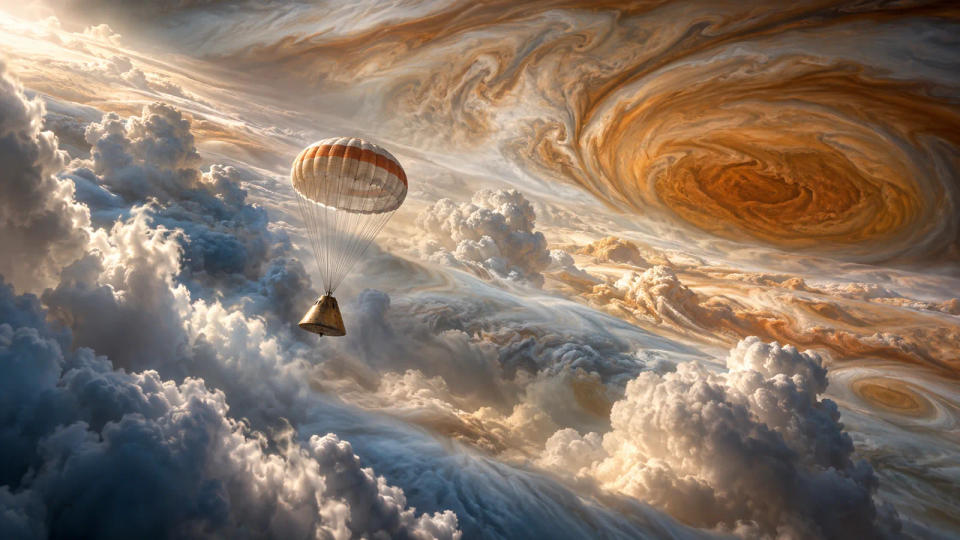
The mission ended after the probe encountered pressures of roughly 23 times standard Earth atmospheric pressure. NASA reports that it descended to a region around 180 kilometers below its initial atmospheric entry level before its transmitter stopped functioning. That provides a powerful reality check: even purpose-built equipment has difficulty enduring Jupiter's deeper atmosphere.
The probe found unexpected features, too. Its measurements indicated much less water vapor than scientists anticipated along that entry path, so its local sample did not represent every region of the giant planet. Its observations of winds and atmospheric composition remain invaluable precisely because they were measurements rather than guesses.
Galileo also teaches us to be cautious with storytelling. We cannot honestly give a precise number of seconds an imaginary human would last without specifying an entry speed, protective equipment, trajectory and survival assumptions. A burning meteor-like entry and a controlled parachute descent are very different scenarios, although neither offers a safe landing.
What Lies Deeper Than the Clouds?
Juno, an orbiting spacecraft rather than a descent probe, supplies the next part of the picture. By measuring Jupiter's gravity and magnetic field, it revealed that the familiar colored belts are linked to winds extending about 3,000 kilometers beneath the cloud tops. What looks like a thin layer of weather is connected to astonishingly deep circulation.
Deeper still, immense pressure changes how hydrogen behaves. Under ordinary conditions, hydrogen is a gas. Compressed strongly enough, it becomes a fluid; under still more extreme conditions, it can behave as metallic hydrogen, conducting electricity. This does not mean there is a shiny metal floor you could stand on. It describes a state of matter within a planet-sized pressure cooker.
Older cutaway pictures often showed Jupiter as a neat series of shells surrounding a small, sharply bounded rocky core. Juno's results challenge that tidy picture. NASA describes the central region as diffuse or ‘fuzzy,’ with heavier material mixed into surrounding hydrogen rather than separated by a simple, solid boundary. The detailed composition and structure of the deepest region are still being investigated.
For a fictional indestructible observer, the journey would therefore be a passage into denser material, not an endless free fall through empty air. Drag and buoyancy would matter as density grew, and any final resting depth would depend on the object's physical properties. A real human, meanwhile, would be overcome long before the hypothetical interior questions became relevant.
There is another surprise: the brightest planet in a backyard telescope is not the place where we know least. By combining Galileo's short direct sampling with Juno's remote measurements, researchers can infer how the atmosphere connects to deep fluid layers. They still cannot send a camera to photograph an actual internal cutaway. Every illustration of Jupiter's central layers remains a model informed by evidence.
Conclusion
If you fell into Jupiter, you would not splash onto a global ocean or crash into a familiar surface. You would enter a cold, restless atmosphere that becomes hotter and denser with depth, with rising pressure and extreme conditions making survival impossible. A high-speed entry could be especially destructive even before the deeper layers were reached.
The deeper mystery is not whether Jupiter hides a secret landing spot. It is how gases, fluids, and heavy elements arrange themselves under pressures that Earth's surface can never reproduce. Galileo showed how dangerous the descent is; Juno is showing why there may be no clean line between atmosphere and interior at all.
Sources & Further Reading
- NASA Science — Jupiter Facts
- NASA Science — Galileo Jupiter Atmospheric Probe
- NASA Science — Juno Mission
- NASA Science — A Deep Dive Into Jupiter’s Great Red Spot
- NASA Science — Temperatures Across Our Solar System
Post a Comment