

Yes—Europa probably does have more liquid water than Earth, despite being only about 90% the diameter of our Moon. NASA estimates that Europa’s buried global ocean could hold more than twice as much water as all of Earth’s oceans combined.
The trick is not surface area. It is depth. Earth’s oceans spread across about 71% of our planet but average only around 4 kilometers deep. Europa’s ocean appears to wrap around the entire moon beneath ice and may be roughly 60 to 150 kilometers deep. That makes this small Jovian moon one of the largest known reservoirs of liquid water in the solar system.
There is an important caveat: no spacecraft has drilled through Europa’s ice or directly measured the full ocean. The volume is an estimate based on multiple lines of evidence and models of the moon’s interior.
How Can Europa Hold More Water Than Earth?
At first, the comparison sounds impossible. Earth is more than four times wider than Europa and vastly more massive. But an ocean’s total volume depends on how much of a world it covers and how deep it goes.
NASA’s Europa comparison gives Earth’s ocean volume at about 1.4 billion cubic kilometers. Europa’s suspected ocean is estimated at roughly 2.87 billion cubic kilometers. In other words, a moon with a diameter of only about 3,120 kilometers may hold about twice the liquid-water volume found in Earth’s global ocean.
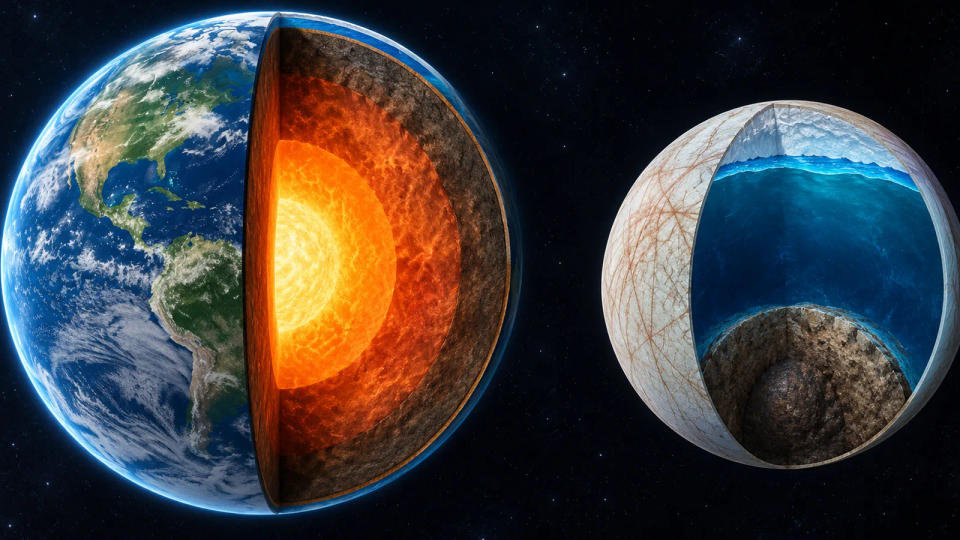
Europa can do this because its water layer is not a collection of relatively shallow basins sitting on the surface. Scientists think the moon has a global shell of water: solid ice at the top, a deep liquid ocean below, and a rocky interior underneath that.
The ice shell itself is thought to be about 15 to 25 kilometers thick, although some estimates vary. Below that ice, the ocean may extend another 60 to 150 kilometers downward. If those estimates are broadly correct, Europa is less like a small icy rock with an underground lake and more like an ocean world whose sea happens to be hidden beneath a frozen roof.
How Do We Know an Ocean Is Under the Ice?
We have not seen Europa’s ocean directly, so why are scientists so confident it exists?
One of the strongest clues came from NASA’s Galileo spacecraft, which made 12 close flybys of Europa while orbiting Jupiter. Galileo measured how Jupiter’s powerful magnetic field was disturbed around the moon. The pattern is best explained if an electrically conductive layer exists beneath Europa’s surface. A large, salty ocean is the leading explanation because salty water conducts electricity.
Europa’s surface provides another clue. Images show a bright crust crossed by long ridges, fractures, bands, pits, and regions where blocks of ice appear to have shifted or broken apart. The surface also has relatively few large impact craters, suggesting it is geologically young and has been resurfaced.
Those features do not prove every detail of the ocean model, but together they point toward an active icy shell above liquid water rather than a moon frozen solid from surface to core.
Scientists have also reported evidence for water vapor above Europa, including a 2019 ground-based detection. Possible plume activity is still treated cautiously, however, and a plume is not required for the global-ocean case. The magnetic evidence and geology remain central.
What Keeps Europa’s Ocean From Freezing Solid?
Europa orbits far beyond the traditional region where sunlight could keep surface water liquid. At Jupiter’s distance from the Sun, Europa’s surface is brutally cold, so its exposed water is frozen into hard ice.
The hidden ocean may survive because Europa has another source of heat: tides.
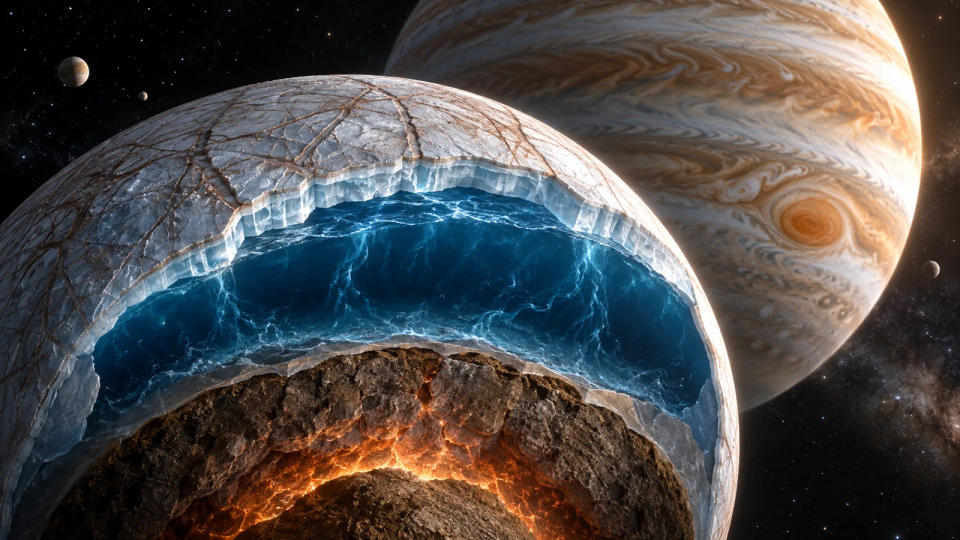
Europa travels around Jupiter on a slightly eccentric orbit. As its distance from the giant planet changes, Jupiter’s gravity stretches and relaxes the moon. This repeated flexing creates friction and heat inside Europa. NASA models indicate that this tidal flexing is likely strong enough to help maintain the subsurface ocean in a liquid state.
The process is similar in principle to bending a metal paper clip back and forth until it warms, although the actual physics inside a moon is far more complex. Europa is being continually “kneaded” by gravity.
That heating is especially interesting because Europa’s ocean is believed to rest on a rocky seafloor. If water interacts with warm rock, chemical reactions could supply minerals and energy sources. Scientists do not yet know how active Europa’s seafloor is, and hydrothermal vents remain a possibility rather than a confirmed observation.
Does More Water Make Europa More Habitable?
Having enormous amounts of liquid water makes Europa scientifically exciting, but water alone does not mean life exists there.
Life as we know it needs more than a solvent. It also needs suitable chemistry, usable energy, and an environment stable enough for biological processes to persist. Europa may have several of those ingredients. Its ocean has probably existed for a very long time, its rocky interior could provide chemical materials, and radiation striking the surface can create reactive compounds that might eventually be transported downward.
But major unknowns remain. Scientists still need better measurements of the ice shell’s thickness, the ocean’s depth and salinity, the chemistry of surface materials, and how efficiently material moves between the surface, ocean, and rocky interior.
That is why NASA’s Europa Clipper matters. The spacecraft launched on October 14, 2024, and is scheduled to reach Jupiter in April 2030. It will orbit Jupiter and make 49 close flybys of Europa, using instruments to study the ice shell, composition, geology, and the ocean below.
Europa Clipper is not designed to detect life directly. Its main goal is to determine whether Europa has environments that could be suitable for life. That distinction matters: proving habitability is not the same as finding organisms.
Conclusion
So, could Europa have more water than Earth? Based on today’s best evidence, yes—its hidden global ocean may contain more than twice the water in all of Earth’s oceans combined.
The most surprising part is not simply the number. It is how a small moon can hide such an enormous sea beneath a shell of ice, kept liquid by the gravitational pull of a planet hundreds of thousands of kilometers away. Europa turns the familiar idea of an “ocean world” inside out: instead of blue water under an open sky, its ocean is sealed in darkness beneath frozen crust.
Whether that ocean is habitable is still an open question. Europa Clipper is designed to give us a much clearer answer about the environment—and, eventually, about how common life-friendly oceans may be beyond Earth.
Sources & Further Reading
- NASA Science — Europa Facts
- NASA/JPL — Europa In Depth
- NASA Science — Why Europa: Evidence for an Ocean
- NASA Science — Why Europa: Ingredients for Life
- NASA Science — Europa Clipper Mission
Post a Comment