
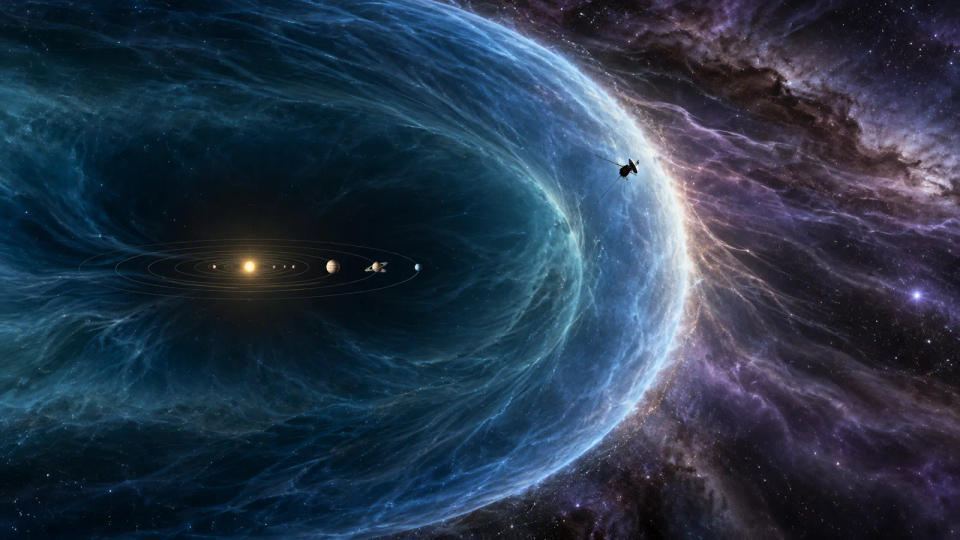
Imagine sailing away from Earth, past Neptune, past Pluto, and into darkness. At what point could you look back and say you had finally left the solar system?
Surprisingly, there is no single line everyone agrees on. NASA's Voyager probes have already crossed the boundary of the Sun's solar-wind bubble and entered interstellar space. But if you count the distant icy objects still held by the Sun's gravity, the true outskirts lie vastly farther away. The answer depends on which kind of edge you mean.
Does the solar system end just beyond Neptune?
Neptune, orbiting roughly 30 astronomical units (AU) from the Sun, is our outermost planet. One AU is the average distance between Earth and the Sun, about 150 million kilometers (93 million miles). That makes Neptune a useful landmark, not an exit sign.
Beyond Neptune is the Kuiper Belt, a broad region of icy bodies that includes Pluto. Its main population extends approximately from 30 to 50 AU. Even at that distance, those objects are orbiting the Sun just as Earth does. Planetary territory fades out, but the solar system itself keeps going.
There is another way to define the boundary. The Sun constantly blows a stream of electrically charged particles into space. This solar wind carries the Sun's magnetic field outward and inflates an enormous region called the heliosphere. Its outer boundary is the heliopause.
Think of the Sun as a fan blowing into a room where another breeze is already moving. The fan's air dominates nearby; farther out, the surrounding air pushes back. In space, the solar wind and material between the stars create a much larger, more complicated version of that meeting place.
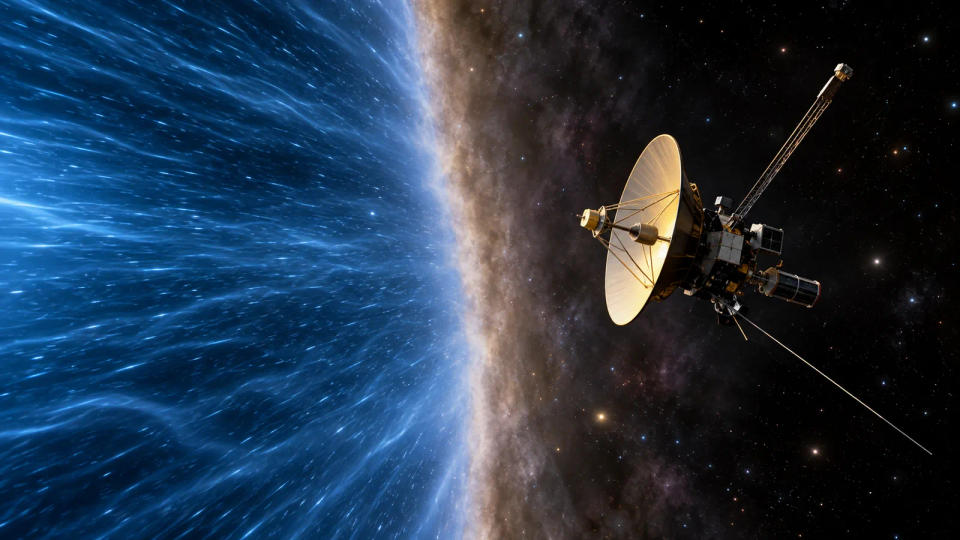
Artist's concept: a Voyager-like probe near the heliopause. The glowing boundary is a visualization, not a wall visible to a spacecraft camera.
What boundary did Voyager 1 and Voyager 2 cross?
The Voyager spacecraft were launched in 1977, primarily to study the outer planets. Their journeys eventually became an extraordinary experiment in finding the Sun's invisible frontier.
Before reaching the heliopause, each craft crossed the termination shock, where the solar wind suddenly slows. Farther outward lies a turbulent zone called the heliosheath. Only beyond that is the heliopause, where the solar wind no longer dominates the surrounding space.
Voyager 1 crossed the heliopause on August 25, 2012, at approximately 122 AU from the Sun. Voyager 2 crossed a different part of that boundary on November 5, 2018. Those dates mark the first two human-made spacecraft entering interstellar space.
How did scientists know? They did not see a luminous line through a window. Instruments detected changes in the particles and magnetic environment. Particles associated with the Sun dropped off, while particles from the galaxy became more prominent. Voyager 2's working plasma instrument provided especially valuable direct measurements of the changing plasma environment.
There is an important twist: the heliopause is not a rigid sphere with a permanent radius. Its location can shift as solar activity changes, and the surrounding interstellar material presses on it unevenly. That is one reason the Voyagers encountered it at different distances along different routes.
Why does reaching interstellar space not mean leaving the solar system?
Here is the apparent contradiction. Voyager 1 and Voyager 2 are in interstellar space, yet NASA also says they have not fully left the solar system. Both statements can be true.
Interstellar space, in the Voyager mission's definition, begins outside the heliopause. But the Sun's gravity extends far past its solar-wind bubble. Objects can travel through interstellar material and still remain gravitationally bound to our star.
Consider a satellite high above Earth. It may be outside Earth's atmosphere while still orbiting Earth. Leaving one kind of environment does not automatically mean escaping the larger gravitational system. The same distinction applies here, though on an almost unimaginable scale.
Beyond the heliopause, the Voyagers continue outward into an area that could still contain objects belonging to the Sun's distant comet reservoir. The probes themselves are on escape trajectories, but they have not passed through the region usually treated as the solar system's farthest extent.
So the clearest answer to the question is: we have crossed the solar wind's edge, but not the outermost gravitational outskirts of the solar system.
How far away is the Oort Cloud?
The most distant proposed region of the solar system is the Oort Cloud, an enormous, roughly spherical reservoir of icy objects thought to surround the planetary system. Its existence is inferred mainly from the behavior of long-period comets; no spacecraft has visited it, and we do not have a direct photograph of the cloud as a whole.
NASA estimates that its inner region may begin somewhere around 2,000 to 5,000 AU, while its outer edge could be roughly 10,000 to 100,000 AU away. These are broad estimates, not surveyed borders. At 100,000 AU, the distance is about 1.6 light-years—an astonishing reach for a system centered on a single star.
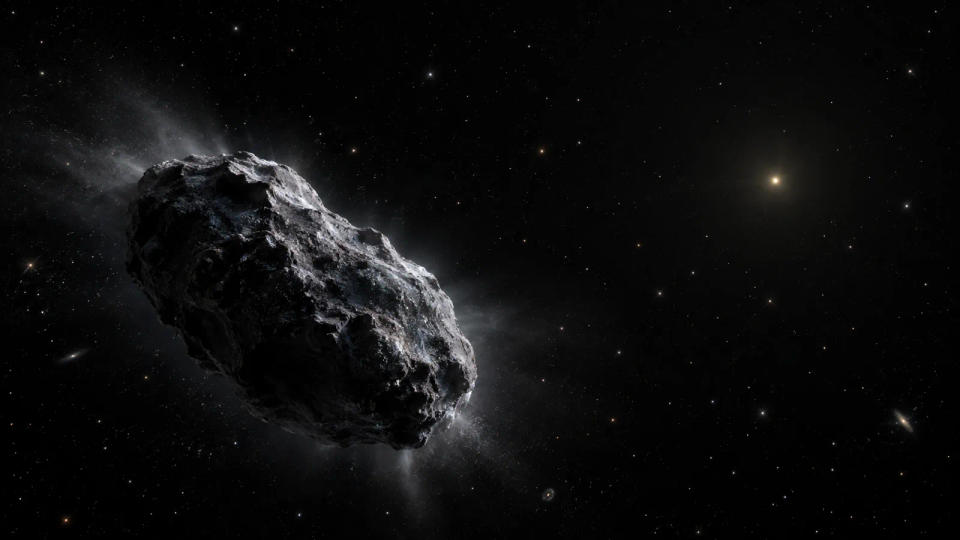
Conceptual visualization of a distant icy body. The Oort Cloud is inferred from comet orbits; this is not an observed image of an Oort Cloud object.
If those numbers feel abstract, try a travel-time comparison. At its present speed, Voyager 1 is expected to take roughly another 300 years to reach the Oort Cloud's inner reaches. Passing through the vast cloud could take on the order of 30,000 years. The probe's radio signal will almost certainly fall silent long before that journey is complete.
Even the Oort Cloud's far edge is not a perfectly sharp gravitational finish line. Nearby stars and the Milky Way's gravitational field also affect distant objects. Astronomers therefore describe an estimated outer region where the Sun's hold becomes increasingly vulnerable to those outside influences.
How are scientists mapping an edge they can barely visit?
Two trajectories through the heliopause tell us a great deal, but they cannot reveal the shape of an entire three-dimensional bubble. It would be like driving through a coastline at two points and trying to draw a complete map of the continent.
Scientists can also study the heliosphere from much closer to home. When charged particles exchange electrons with neutral atoms near the boundary, they can produce energetic neutral atoms. Unlike charged particles, these atoms can travel long distances without being steered by magnetic fields. Detectors can use them to build indirect maps of distant regions.
NASA's Interstellar Mapping and Acceleration Probe (IMAP), launched in September 2025, reached its observing location near the Sun–Earth L1 point in January 2026. From there it is designed to investigate particles and map the Sun's interaction with interstellar space. It does not need to travel to the heliopause to help scientists understand it.
Such measurements matter beyond settling a geographical question. The heliosphere helps shield the planets from much of the galaxy's energetic cosmic radiation. Understanding its shape and behavior tells us more about the environment through which Earth and the rest of the solar system move.
Conclusion: The Voyagers have given humanity its first direct passage into interstellar space. Yet the solar system's deeper edge, marked by the hypothesized Oort Cloud, remains thousands of AU beyond them. We have reached an edge—just not the last one.
Sources & Further Reading
- NASA — Where Is the Edge of the Solar System?
- NASA — Voyager Interstellar Mission
- NASA/JPL — Voyager 2 Enters Interstellar Space
- NASA — Oort Cloud Facts
- NASA — IMAP Mission Overview
Post a Comment