
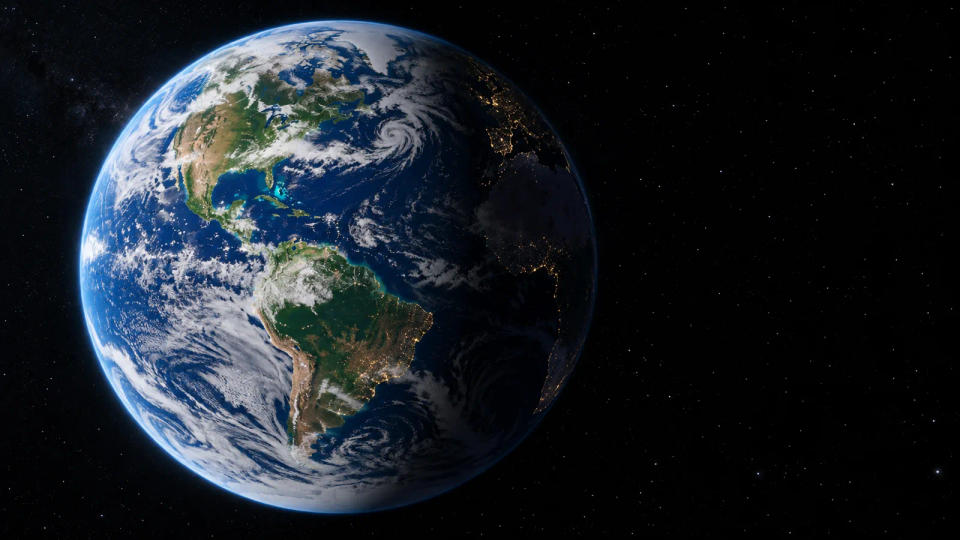
Imagine stepping outside tonight and finding an empty space where the Moon should be. No familiar silver disk, no moonrise over the rooftops, and no full-Moon glow across the sea. Would that make Earth a more dangerous place to live?
Potentially, yes—but not because the planet would immediately fall apart. The Moon helps shape ocean tides, influences the pace of Earth's rotation, and makes its axial tilt more stable over long periods. Without it, some environments would change quickly, while the biggest climate uncertainties would unfold over thousands to millions of years.
There is an important difference between the Moon suddenly disappearing today and Earth having formed without one. In the first case, we keep our present 24-hour day and existing climate at the moment of disappearance. In the second, billions of years of planetary history could have taken another path entirely. Let's start with the change that could matter most for the distant future.
Could Earth's seasons become dangerously unpredictable?
Earth's seasons come from its tilted rotation axis, not from being much closer to the Sun in summer. Our axis currently leans about 23.4 degrees relative to a line perpendicular to the orbital plane. That lean changes how directly sunlight reaches each hemisphere throughout the year.
Think of Earth as a spinning top. Other planets and the Sun tug gravitationally on its slightly flattened shape, slowly changing the direction and, to a lesser extent, the angle of its spin axis. The Moon's gravitational influence changes this motion in a way that helps prevent large swings in the tilt.
Without that influence, Earth's tilt could wander more widely. A smaller tilt would generally make seasonal differences milder; a much larger tilt could give high latitudes more intense summer sunlight and darker, colder winters. Ice sheets, rain belts, ocean circulation, and habitats might have to adjust to changing patterns of sunlight.
But the dramatic version of this story needs a qualification. An early mathematical study showed that a moonless Earth's tilt could access a very wide range under certain conditions. Later numerical simulations by Jack Lissauer, Jason Barnes, and John Chambers found that many hypothetical moonless Earths remained within more limited tilt ranges for hundreds of millions of years, even while varying more than our real planet.
So the Moon acts more like a stabilizer than a magical switch keeping catastrophe away. Losing it would increase the potential for long-term climatic variation, but it would not guarantee an immediate runaway tilt, an instant ice age, or an uninhabitable Earth.
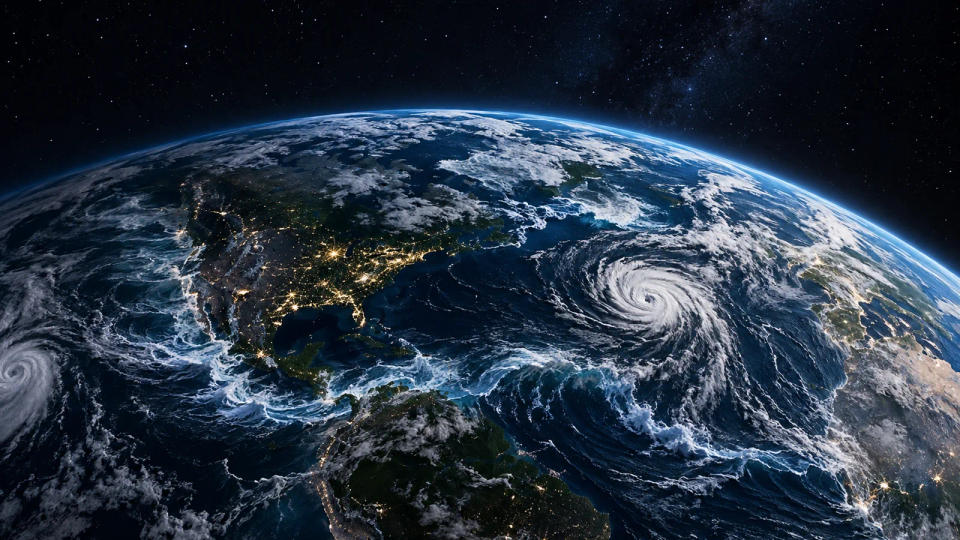
Would the oceans lose their tides?
Not completely. The Moon is the strongest driver of Earth's tides, but the Sun also produces tides through gravity. NASA explains that the Sun's tide-generating force is a little less than half the Moon's. Remove the Moon and the solar tide remains.
Picture a beach where the tide normally exposes broad stretches of wet sand before the water returns. On a moonless Earth, many shores would still experience rising and falling water, but the rhythm and typical tidal ranges would change substantially. The familiar cycle of stronger spring tides and weaker neap tides, created by the shifting alignment of the Sun and Moon, would disappear.
There is no single percentage by which every coastline's tide would shrink. Real tides depend on the shape of ocean basins, water depth, the coastline, and resonances that can amplify or reduce water movement. Some places would change more than others.
That matters for more than beach walks. Tides regularly flood and expose coastal wetlands and rocky shores, exchange water in estuaries, and influence where organisms can feed or reproduce. With much weaker lunar-driven motion, coastal ecosystems would need to adapt to a different pattern of flooding, currents, and nutrient exchange.
It would not mean the oceans stop moving. Wind-driven waves, currents, storms, and solar tides would still exist. Nor would a vanished Moon somehow pull all the seawater off Earth. Gravity would continue holding the oceans to our planet.
What would happen to animals on darker nights?
The change you would notice first might be the sky. With no moonlight, clear rural nights would be much darker, apart from stars, planets, airglow, and any artificial lighting. Solar eclipses caused by the Moon would also become a thing of the past.
For wildlife, however, moonlight is not just scenery. It is a repeating environmental signal. Some animals use changes in nighttime brightness to time activity, avoid predators, or coordinate reproduction. Removing that signal could change the balance between hunters and prey.
Coral reefs offer a striking example. Many reef-building corals release eggs and sperm in synchronized events connected to seasonal conditions and the lunar cycle. NOAA notes that moon phase helps determine the day of spawning for many species. If individuals lose a reliable timing cue, coordination could become harder, although the actual response would differ among species.
Researchers studying coral-reef food webs also find that changing moonlight affects the movements of small marine animals and the conditions faced by young reef organisms. A permanent absence of moonlight would not simply turn every night into a harmless new moon: it would remove the monthly progression from bright nights to dark ones.
Some species might benefit from darker nights. Others might lose an important signal or feeding advantage. The outcome would be ecological reshuffling, not a credible prediction that all nocturnal life would disappear.
Would days change, and could Earth become less safe?
The Moon has helped slow Earth's rotation over immense spans of time. Its gravity raises tides, and the energy dissipated by tidal movement gradually reduces Earth's spin. NASA identifies lunar tidal friction as a major contributor to the lengthening of Earth's day over billions of years.
If the Moon suddenly vanished, tomorrow would not become a six-hour day. Earth would keep almost the same rotation rate it had just before the event. What would change is its future history: with lunar tidal braking gone, the long-term slowing would be different, although solar tides and other processes would still affect the rotation.
If Earth had never possessed a Moon, the length of its day today could be very different. But a specific number cannot be stated confidently, because the planet's starting spin, interior, oceans, and evolutionary history would also matter.
What about a popular idea that the Moon protects us by intercepting dangerous asteroids? The Moon does sometimes get hit, as its craters show, but it is not a protective umbrella over the entire Earth. Its disappearance would not automatically send asteroids raining down or switch off Earth's magnetic field.
And Earth would remain in orbit around the Sun. The Moon is important to our planet's behavior, but the Sun—not the Moon—is what primarily holds Earth in its yearly orbit. The greater concerns are altered tides, disrupted biological rhythms, and the possibility of less predictable climate over very long periods.
Conclusion: A different Earth, not an instant disaster
Without the Moon, Earth would still have oceans, air, sunlight, gravity, and the potential to support life. Yet its coastlines would feel different, its nights would lose a vital natural rhythm, and its long-term climate could be less steady. The Moon's greatest gift may be subtle: it has helped make Earth's environmental changes more predictable while life evolved.
Sources & Further Reading
- NASA Science — Tides
- Carnegie Science — Obliquity Variations of a Moonless Earth (Lissauer, Barnes & Chambers)
- NASA Science — Milankovitch Cycles and Earth's Climate
- NASA — Research on Changes in Earth's Rotation
- NOAA Ocean Service — What Is Coral Spawning?
- Peer-reviewed review — How Moonlight Shapes Coral-Reef Ecology
Post a Comment