
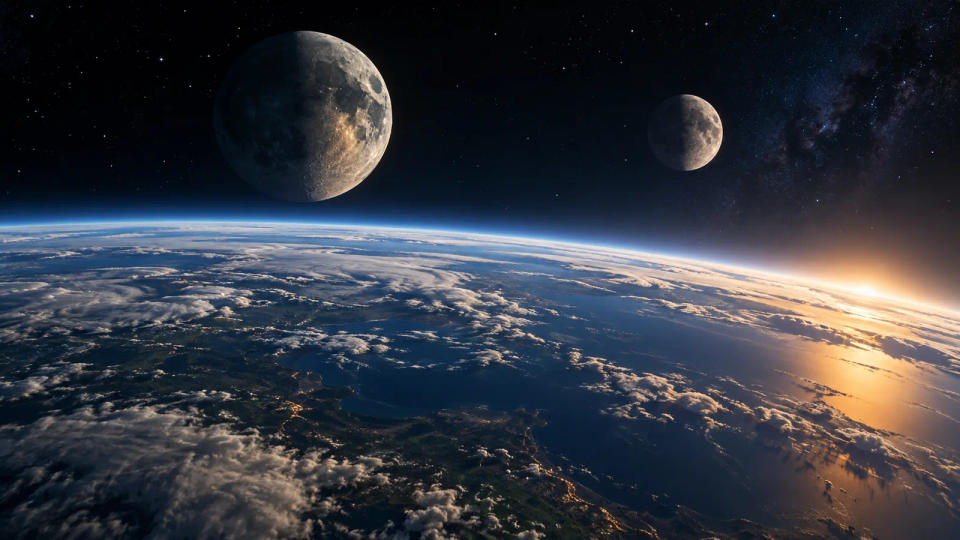
Imagine stepping outside on a clear night and seeing two moons crossing the sky instead of one. Earth would not automatically become uninhabitable, but the planet’s tides, night brightness, eclipse patterns, rotation, and long-term orbital evolution would all become more complicated.
The exact outcome would depend on the second moon’s mass, distance, and orbital tilt. For a useful thought experiment, assume Earth formed with two large rocky moons on separate, long-lived orbits rather than suddenly capturing a new Moon-sized body today.
The Biggest Change Would Be the Tides
Our Moon is the main driver of Earth’s ocean tides. Its gravity does not pull equally on every part of Earth: the near side feels a slightly stronger pull than the planet’s center, while the far side feels a slightly weaker one. That difference creates the familiar tidal bulges.
A second moon would add another tide-raising force. The important point is that tidal strength depends very strongly on distance—approximately on mass divided by distance cubed. A smaller moon close to Earth could therefore matter more than a larger moon much farther away.
If the second moon were roughly Moon-sized and orbited at a comparable distance, some alignments could produce stronger-than-normal tides when the Sun and both moons pulled in similar directions. Other configurations could partially cancel one another, producing weaker tides. The result would not simply be “twice the tides.” Coastal timing would follow overlapping cycles, much like several waves adding together and then drifting out of phase.
That would matter for estuaries, tidal flats, coral reefs, coastal erosion, navigation, and animals that use lunar or tidal rhythms. On an Earth that had always possessed two moons, however, ecosystems would have evolved with those patterns from the beginning rather than being suddenly disrupted by them.
Nights Would Follow Two Lunar Clocks
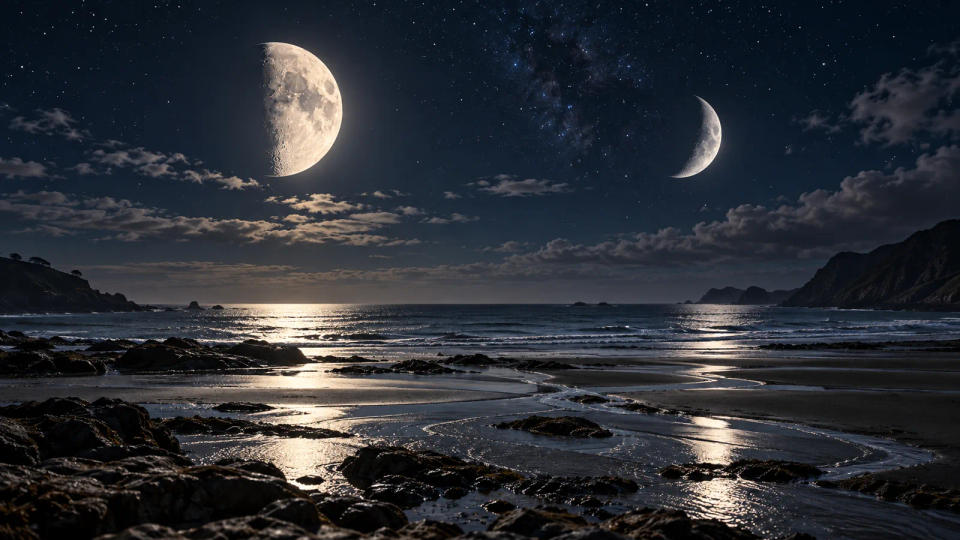
Two moons would make the sky more varied, but not every night would be dramatically brighter. Moonlight is reflected sunlight, so each moon would pass through its own sequence of phases. Some nights might show two bright gibbous moons; others could have one crescent and one nearly new moon, or both below the horizon.
Calendars would also be more complicated. Our familiar month is tied historically to the Moon’s changing phases. With two orbital periods, people could track two “months” at once, creating repeating patterns that might take many cycles to line up again.
Eclipses could become more common, too, although not guaranteed every month. A solar eclipse requires a moon to pass directly between Earth and the Sun, while a lunar eclipse requires it to enter Earth’s shadow. The frequency would depend on the orbital tilts of both moons. If their orbital planes were tilted differently, they would create two separate eclipse seasons.
Earth’s Rotation and Climate Would Evolve Differently
The Moon does more than move ocean water. Tidal friction transfers angular momentum from Earth’s rotation into the Moon’s orbit, gradually slowing Earth’s spin while the Moon moves outward. NASA measurements show that our Moon is currently receding by about 4 centimeters per year.
With two substantial moons, that angular-momentum exchange would become a three-body problem. Both moons could raise tides on Earth, both could exchange energy with Earth’s spin, and they could also perturb each other. Earth might still slow over time, but there is no simple rule saying the slowdown would be exactly twice as fast.
Earth’s axial tilt would also have a different history. The present Moon helps stabilize Earth’s obliquity, limiting large chaotic changes in the planet’s tilt. A second moon could add another stabilizing torque in some orbital arrangements, but in others its gravitational interactions could introduce new resonances. That means “two moons equals a more stable climate” is not a safe assumption; the result would depend on the architecture of the system.
Could Two Large Moons Stay in Stable Orbits?
Yes—at least in principle. The giant planets already show that multiple moons can coexist, although packing large moons around a small rocky planet is harder because the available stable region is much tighter.
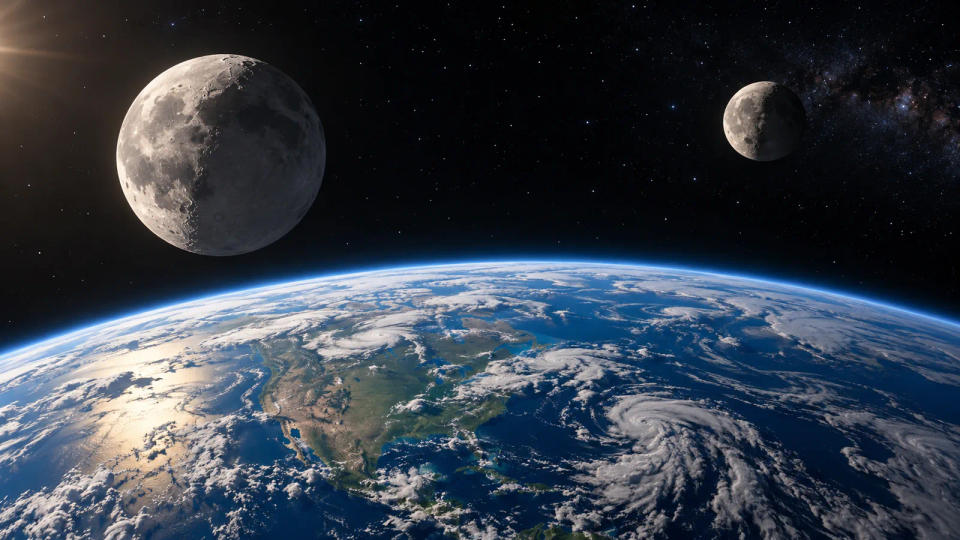
Numerical studies have tested this directly. A 2022 Monthly Notices of the Royal Astronomical Society study found stable arrangements containing several Luna-mass moons around an Earth-mass planet when the moons began on carefully spaced, nearly circular orbits. But those simulations also noted that tidal migration could later change the picture.
A newer 2026 study in The Astrophysical Journal included tidal evolution and found that an Earth-mass planet could sustain two Luna-mass moons in some configurations. With Earth-like tidal dissipation, however, long-lived solutions occupied relatively narrow ranges of orbital spacing, and billion-year survival generally favored weaker tides than those in the present Earth–Moon system.
So a two-moon Earth is not forbidden by physics, but the moons could not be placed anywhere at random. If their orbits were too close together, resonances and close encounters could pump up their eccentricities, leading eventually to a collision, an ejection, or one moon falling inward or moving outward into an unstable region.
Would Earth Still Be Habitable?
If Earth had formed with two stable moons and retained them for billions of years, it could still be a habitable planet. Life would simply have developed under different tidal schedules, darker and brighter combinations of lunar phases, and a somewhat different rotational history.
For humans, the most obvious changes would be cultural as well as physical. Navigation, calendars, mythology, coastal engineering, astronomy, and even the meaning of a “month” would have grown around two repeating lunar cycles.
The dramatic version of the scenario is a second Moon-sized object suddenly appearing today. That would be far more dangerous because placing such a massive body into a stable Earth orbit would require an enormous energy exchange, and a poorly chosen orbit could strongly disturb the existing Moon. But an alternate Earth that had always possessed two well-spaced moons is scientifically plausible—and would be less a doomed planet than a familiar world running on two celestial clocks.
Sources & Further Reading
- NASA Science — The Moon and Tides
- NASA Science — Compare Earth and the Moon
- NASA Science — Tidal Locking
- Laskar, Joutel & Robutel (1993) — Stabilization of the Earth’s Obliquity by the Moon
- Satyal, Quarles & Rosario-Franco (2022) — Moon Packing Around an Earth-Mass Planet
- Briseño, Quarles & Rosario-Franco (2026) — Tidal Evolution of Packed Moon Systems Around an Earth-Mass Planet
Post a Comment