
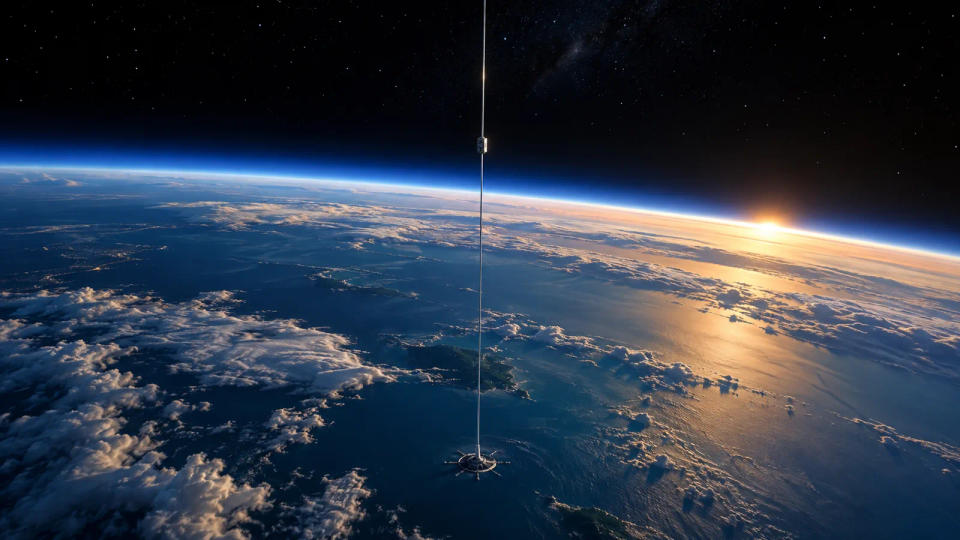
Imagine stepping into a vehicle at sea level and climbing into space without a rocket launch. That is the basic promise of a space elevator: not a gigantic rigid tower, but an incredibly long tether held taut by Earth’s rotation, with electrically driven climbers carrying cargo and possibly people upward.
In principle, the physics works. The hard part is building a tether strong, light, durable, and long enough to survive from the atmosphere to far beyond geostationary orbit. That turns a simple-sounding elevator into one of the most demanding engineering projects ever proposed.
How Would a Space Elevator Actually Work?
A practical Earth space elevator would most likely be anchored near the equator, where a point on the surface moves fastest because of Earth’s rotation. From that anchor, a tether would stretch upward through the atmosphere and continue far beyond the altitude of geostationary orbit.
Geostationary orbit is about 35,786 kilometers above Earth’s equator. A satellite there circles Earth once per sidereal day, so it appears to hover over the same longitude. A space-elevator tether would rotate with Earth in the same way, keeping the lower end above its equatorial anchor.
The crucial point is that the tether would not stand up by itself. It would be under tension. The portion below geostationary orbit is pulled inward by gravity, while the portion extending above it experiences a stronger outward effect in the rotating system. A counterweight or simply enough extra tether beyond geostationary altitude can keep the whole structure stretched tight.
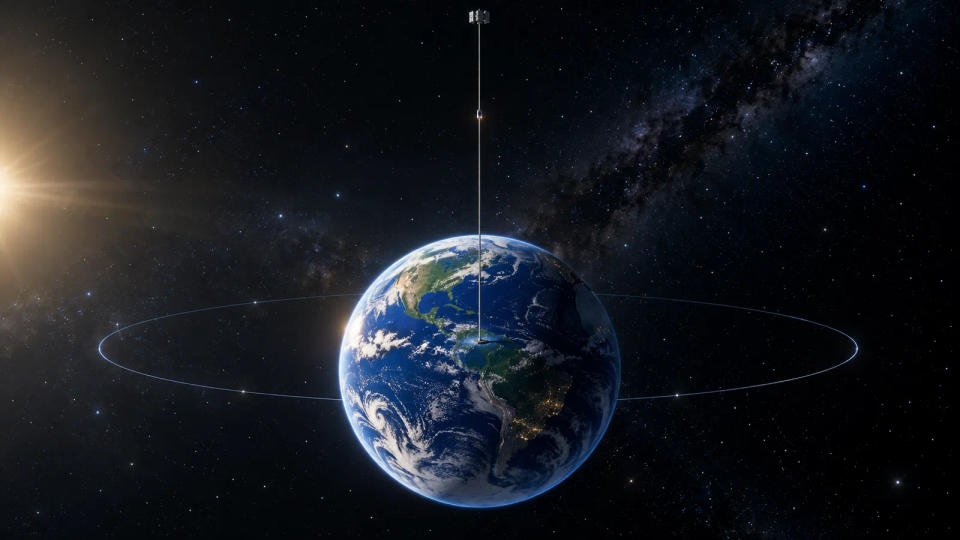
That is why familiar drawings of a cable that ends at a space station are misleading. The elevator needs an upper extension to provide the balancing tension. Some classic concepts describe a total tether length of roughly 100,000 kilometers, although the exact design would depend on the tether material, payloads, safety margins, and counterweight.
Why Must the Tether Reach Beyond Geostationary Orbit?
If the cable stopped at geostationary altitude, gravity acting on the enormous mass below would tend to pull it down. Extending the tether farther outward changes the balance. The upper part is moving around Earth once per day at a radius much larger than geostationary orbit, so maintaining that rotation creates the outward tension needed to support the lower sections.
This gives the elevator another interesting feature: every climber would already be moving sideways with Earth as it rose. At geostationary altitude, a payload released from the tether would already have the correct rotational speed to remain in geostationary orbit. It would not need a rocket burn to accelerate from zero horizontal speed.
Climb even farther, and the tether’s rotational motion can give a released payload more orbital energy. In some designs, the upper end acts almost like a slow-motion sling, potentially helping send spacecraft toward higher orbits or even interplanetary trajectories. That does not make rockets unnecessary, but it could shift much of the energy needed for routine transport from onboard propellant to reusable ground or space-based power systems.
What Would the Ride Into Space Be Like?
It would be much slower than a rocket. A rocket reaches orbit in minutes because it accelerates to several kilometers per second. A space-elevator climber would instead crawl along the tether for days.
A 2023 engineering study examined a representative 20-ton climber with about 4 megawatts of mechanical power and a maximum speed near 200 kilometers per hour. Under those assumptions, the trip from the surface to geostationary altitude would take about eight days. Other designs could be faster or slower, so this is a study result rather than a fixed travel time.
The changing view would be extraordinary. During the first part of the trip, gravity would still feel strong and the vehicle would pass through weather and the upper atmosphere. Higher up, Earth would shrink beneath the climber as the effective downward force gradually decreased. Near geostationary orbit, passengers and objects would experience near-weightlessness relative to the rotating elevator.
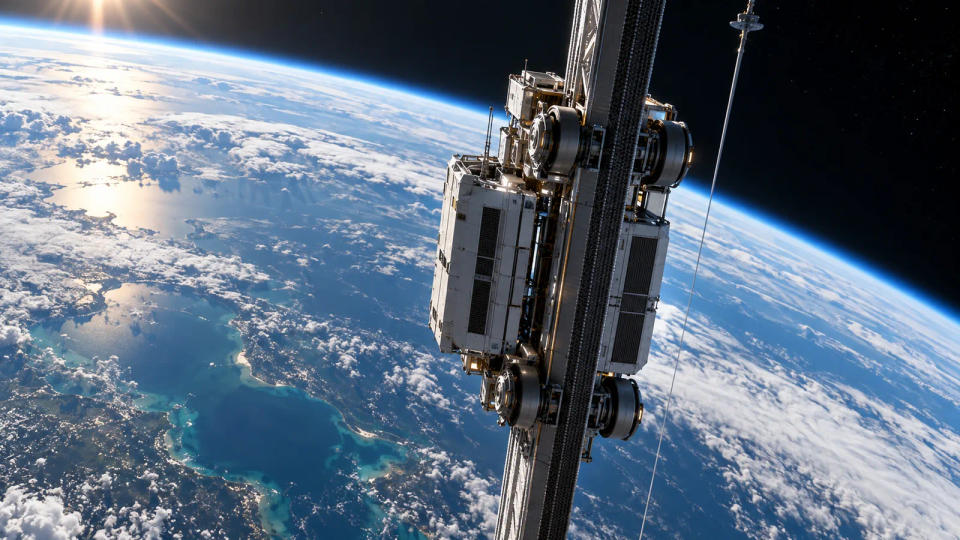
Human travel would introduce extra problems. A slow climb spends far longer in the space radiation environment than a rocket launch does, including passage through the Van Allen radiation belts. Crewed climbers would therefore need shielding, life support, emergency capability, and a plan for what happens if the vehicle stops tens of thousands of kilometers above Earth.
What Could Break a 100,000-Kilometer Tether?
The material problem comes first. Ordinary steel is far too heavy for an Earth space elevator because a cable tens of thousands of kilometers long must support not only payloads but also its own mass. The useful measure is not strength alone, but strength compared with density.
Carbon nanotubes became famous as a possible solution because individual nanotubes can have extraordinary tensile strength at very low mass. More recent research has also examined graphene and hexagonal boron nitride. Laboratory-scale materials can show impressive properties, but making defect-free or reliably joined material with the required strength over kilometer-scale segments—and eventually a tether on the order of 100,000 kilometers—remains a fundamentally different manufacturing challenge.
Even a perfect material would face a hostile route. The lower tether must deal with winds, moisture, lightning, and atmospheric loading. Higher sections encounter atomic oxygen, ultraviolet radiation, charged particles, micrometeoroids, and orbital debris. Moving climbers can also excite vibrations and change the tension distribution along the tether.
That means the elevator could not simply be built and forgotten. It would need constant tracking, inspection, repair, active control of oscillations, and probably some ability to move or reel the lower anchor to avoid dangerous conditions. Reliability would have to be treated more like a global transportation network than a single spacecraft mission.
Would a Space Elevator Replace Rockets?
Probably not. Rockets would still be essential for many missions, especially during construction. The first deployment hardware, tether material, assembly equipment, and counterweight would have to reach space somehow. Rockets can also launch from many latitudes, reach different orbital planes directly, and respond quickly in ways a fixed equatorial elevator cannot.
Where an elevator could be transformative is repeated heavy transport. Once operating, a climber would not need to carry all the propellant required for a conventional launch. Cargo could move upward gradually using electrical power, and the system could be reused again and again. That is why the concept remains scientifically attractive despite the enormous engineering barriers.
For now, the space elevator sits in an unusual category: its basic orbital mechanics do not violate known physics, but the necessary material and system reliability have not been demonstrated at anything close to full scale. Building one would require advances in materials, manufacturing, power delivery, debris protection, control systems, and long-duration operations all at once.
If those problems were ever solved, reaching space might stop feeling like an explosion-driven departure and start feeling more like a very long train ride—one that ends 35,786 kilometers above the equator and can continue much farther.
Sources & Further Reading
- NASA Technical Reports Server — Space Elevators: Building a Permanent Bridge for Space Exploration and Economic Development
- NASA Technical Reports Server — Critical Technologies for the Development of Future Space Elevator Systems
- Acta Astronautica — Space elevator tether materials: An overview of the current candidates
- Acta Astronautica — Conditions at the interface between the space elevator tether and its climber
- European Space Agency — The space elevator
Post a Comment