
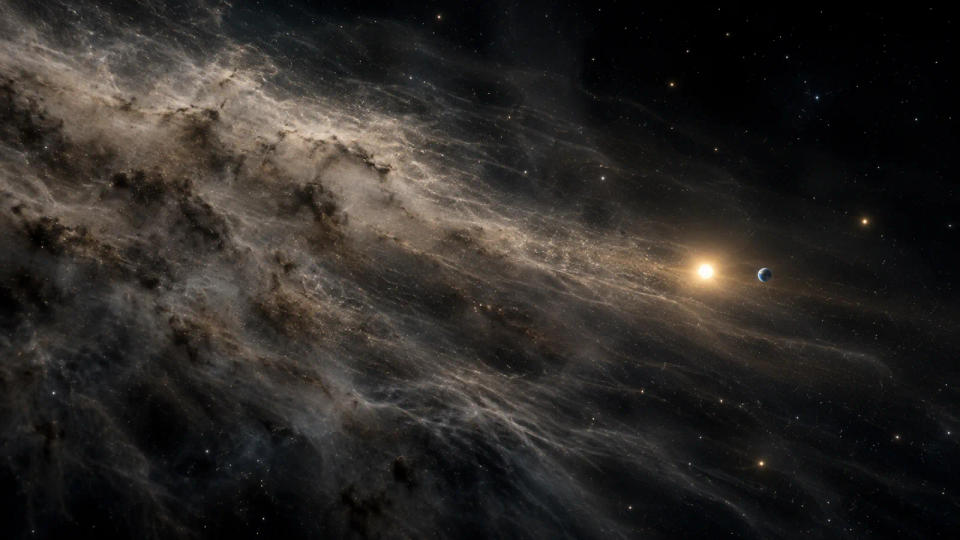
What if Earth entered a dense cloud of interstellar dust? The greatest concern would probably not be a dramatic shower of rocks or a suddenly black sky. A sufficiently dense cloud of gas and dust could instead squeeze the Sun's protective heliosphere, letting a different mixture of particles reach Earth's space environment and upper atmosphere.
This is a scientifically motivated what-if, not an approaching disaster. Astronomers have evidence that interstellar dust already crosses the Solar System, while recent models suggest that much denser clouds may have affected our neighborhood millions of years ago. What those encounters did to Earth's climate remains an open question.
How Could a Cloud Shrink the Sun’s Protective Bubble?
The Sun constantly releases the solar wind, a stream of electrically charged particles carrying magnetic fields. It pushes against the surrounding interstellar medium and carves out a huge region called the heliosphere. This bubble surrounds the planets under present conditions and reduces the amount of some galactic cosmic radiation reaching the inner Solar System. It is not a solid wall, and it does not block every particle.
A dense interstellar cloud is not like an earthly dust storm. Even a cloud thousands of times denser than ordinary interstellar surroundings contains extremely little matter by terrestrial standards. Much of that matter is gas, especially hydrogen; dust is the minority solid component. The important physical change is the pressure of incoming interstellar material against the outward-flowing solar wind.
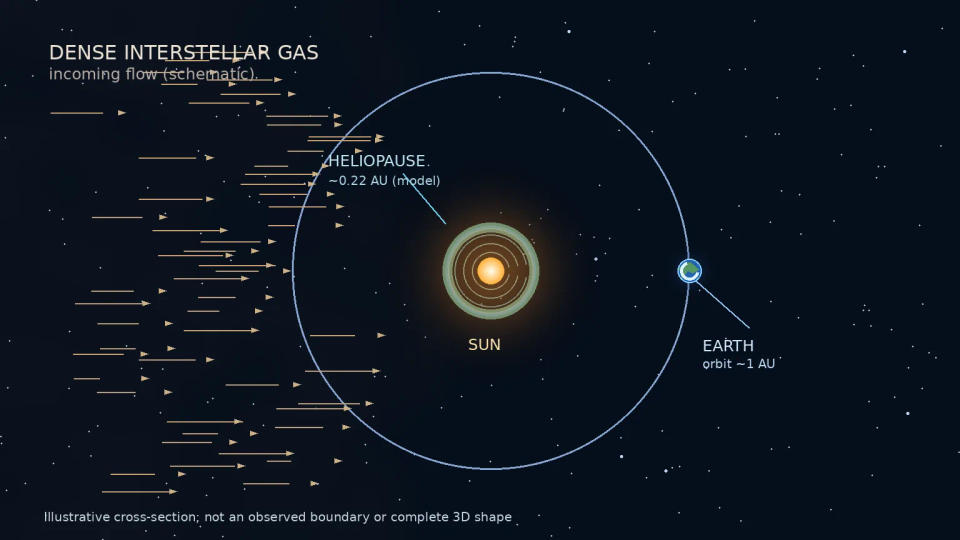
In a 2024 Nature Astronomy study, researchers reconstructed the motion of nearby cold clouds and modeled a possible encounter roughly 2–3 million years ago. For their assumed cloud conditions, the heliosphere's upstream boundary contracted to about 0.22 astronomical units (AU) from the Sun. Earth orbits at roughly 1 AU, so the model places our planet outside that compressed boundary for part of the encounter. That 0.22-AU value is a simulation result, not a measurement of the ancient heliosphere.
Think of a small wind-blown bubble pressing into a much stronger flow. Increasing external pressure moves the boundary closer to the source. The actual boundary would be three-dimensional, asymmetric and variable, rather than a neat sphere. The duration of exposure would depend on the cloud's thickness, relative motion and structure; a single model is not a forecast for every possible dust-cloud passage.
What Might Reach Earth and Its Atmosphere?
Dust and radiation would behave differently. Tiny interstellar dust grains have already been detected inside the Solar System. At Saturn, NASA's Cassini spacecraft identified 36 grains with interstellar characteristics among the millions sampled by its dust instrument. Their speed, direction and composition distinguished them from ordinary Saturn-system particles. That is direct spacecraft evidence of interstellar material entering our neighborhood, not evidence that a dangerous dense cloud is arriving now.
Grain size matters. Solar radiation pressure and magnetic forces influence the paths of small charged grains, while larger grains follow different trajectories. A compressed heliosphere could change that filtering and the material available to Earth's environment. But it would not automatically create an asteroid barrage. An interstellar dust cloud is not a swarm of planet-sized objects, and visible boulders filling the sky would be a misleading picture.
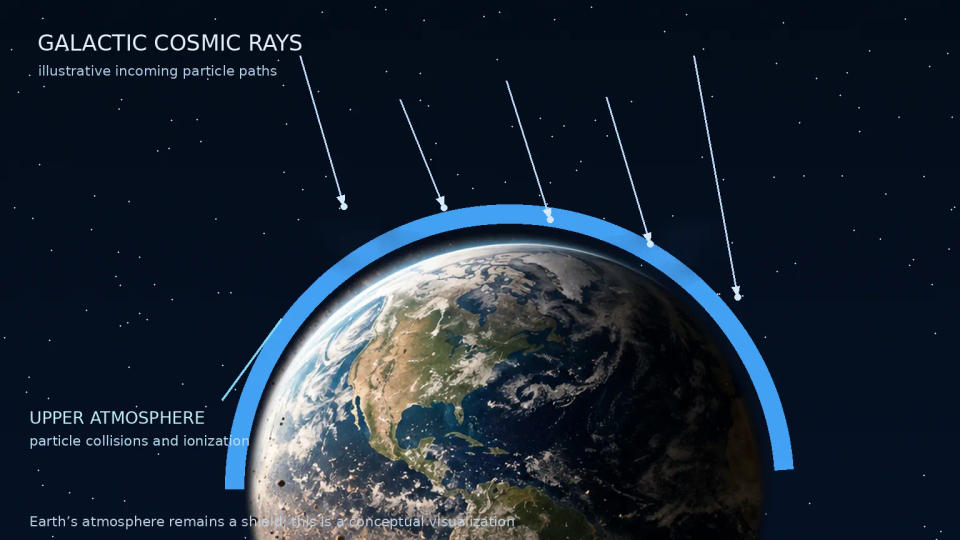
Radiation may be the more consequential change. With less heliospheric shielding, more galactic cosmic rays could reach near-Earth space. A 2026 Scientific Reports study simulated energetic particles during possible ancient cloud encounters and found substantially enhanced radiation in particular energy ranges. These are modeled conditions, not direct dose records from ancient humans or animals. Earth's magnetic field and atmosphere would still offer important protection at the surface.
As energetic particles interact with atmospheric gases, they can change ionization and chemistry. Another model, published in Geophysical Research Letters in 2024, examined the mesosphere, a high atmospheric layer. It predicted strong changes to polar mesospheric ozone and high-altitude ice clouds under specified dense-cloud conditions, but did not support a simple blanket of noctilucent clouds covering the whole planet. The effects varied by latitude and season.
What Do Ancient Clues Actually Tell Us?
Could a cloud make Earth colder? Researchers have investigated several possible links: altered high-altitude water vapor, changes in radiation, atmospheric chemistry and changes to the balance of incoming and outgoing energy. Yet a climate effect is not the same as a demonstrated ice age. Different atmospheric models can respond differently, and Earth's oceans, lower atmosphere and other climate drivers matter too.
The evidence for ancient encounters is indirect. The 2024 study proposed that the Sun may have crossed a cold-cloud structure near the constellation Lynx 2–3 million years ago. More recent work discussed possible events around 6–7 million and 13–14 million years ago as well. Astronomers infer these paths from cloud observations and reconstructed motions, then test their consequences with simulations; nobody directly watched the ancient crossings.
Researchers also study rare radioactive isotopes such as iron-60 and plutonium-244 found in terrestrial or lunar material. Such deposits indicate that material associated with stellar events reached our neighborhood. Their timing may be consistent with proposed cloud encounters, but the isotopes do not by themselves prove that a particular dense cloud compressed the heliosphere. Supernova-supplied dust and other transport histories remain relevant explanations.
A dense cloud would not necessarily blot out the Sun or make the daytime sky black. The optical effect depends on the total dust column along the line of sight, not merely the local number density. It is also unsound to assume universal meteor storms, immediate mass extinctions, or a precise temperature drop without establishing grain sizes, cloud thickness, duration and atmospheric response. Those specific outcomes are not established by the cited simulations.
The most useful picture is therefore a chain of conditional events: the Solar System enters unusually dense gas and dust; external pressure can shrink the heliosphere; dust filtering and energetic-particle exposure change; Earth's upper atmosphere may respond. Each link has its own evidence and uncertainty. Connecting that chain to long-term climate or biological changes requires additional observations and climate modeling.
Conclusion
If Earth passed through a dense interstellar cloud, the first big transformation might occur far beyond the visible sky: the Sun's protective magnetic environment could contract dramatically. Some interstellar dust already reaches the planets, but the larger scientific question is how stronger exposure to gas and cosmic radiation could affect atmospheric chemistry over time.
The possibility is grounded in real spacecraft measurements and published simulations. It is not proof of an imminent event, an ancient extinction, or a guaranteed ice age. The story matters because Earth is not isolated from the Galaxy; even the space between stars can help shape the environment around a planet.
Sources & Further Reading
- NASA — Starstruck: NASA Research Shows How Sun’s Ancient History Shaped Earth
- Opher et al. (2024), A possible direct exposure of the Earth to the cold dense interstellar medium 2–3 Myr ago
- Opher et al. (2026), Increased and varied radiation during the Sun’s encounters with cold clouds in the last 10 million years
- Miller et al. (2024), Earth’s Mesosphere During Possible Encounters With Massive Interstellar Clouds 2 and 7 Million Years Ago
- NASA JPL — Saturn Spacecraft Samples Interstellar Dust
- NASA — Heliosphere
Post a Comment