

Imagine looking up from a baseball field and seeing another neighborhood curving across the sky. In Interstellar, Cooper Station turns that strange view into everyday life: homes, fields, and people all inside a huge spinning space habitat.
Could we really build one? In principle, yes. Its most important trick—creating the feeling of gravity by spinning—follows ordinary physics. But building a safe, comfortable town in space would be far harder than building today's space stations. Here's how it could work, and what still stands in the way.
How Could a Spinning Cylinder Make People Feel Gravity?
Picture a playground merry-go-round. When it spins, you feel as though you are being pushed toward the edge. A rotating space habitat uses a similar effect, except its outer wall becomes the ground beneath your shoes.
The structure is spinning, and the floor must continually push inward on you to keep you moving in a circle. From inside the rotating habitat, that contact feels like a downward pull. Engineers call it artificial gravity, though the station is not creating a new gravitational field.
In Cooper Station's cylinder-like world, the houses, trees, and streets would sit on the inside of the curved wall. "Down" would point away from the central axis toward that wall. Closer to the center, the gravity-like effect would grow weaker. The center could even feel almost weightless.
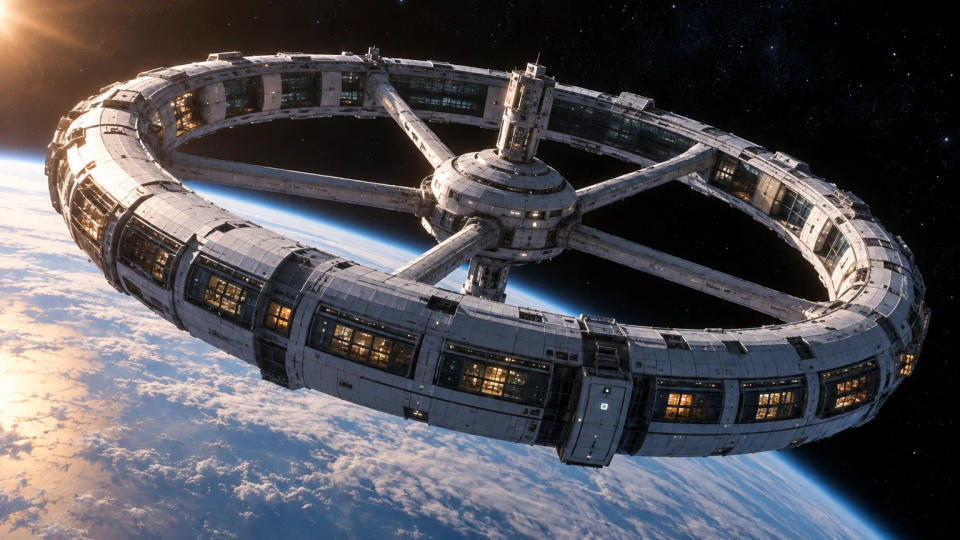
Size makes a big difference. Imagine a habitat with a floor about 900 meters (3,000 feet) from its rotation axis. At roughly one turn per minute, the acceleration at the floor would be close to Earth's gravity. That is a physics example, not a claimed measurement of the movie's station.
A much smaller habitat would need to spin faster to give the same effect. Faster spinning can make head movements feel strange or cause motion sickness. This is one reason real design studies often consider enormous rotating structures rather than tiny spinning rooms.
What Would a Normal Day Inside Feel Like?
If the station were big enough, walking to school, sitting at a table, or pouring a glass of water could feel surprisingly familiar. A dropped cup would fall toward the outer wall, just as a dropped cup falls toward Earth's ground.
The sky would be the unusual part. From a park, you might see houses and farmland climbing up the cylinder's opposite side. That landscape would not be upside down to the people living there. Everyone would have their own local "down," directed toward the habitat wall.
There would also be small reminders that you were living in a rotating world. A ball thrown across a long distance might follow a path that looks odd because it is moving through a spinning environment. Engineers call this the Coriolis effect. For ordinary daily activities in a sufficiently large, slowly rotating station, these effects could be less noticeable, but human comfort would need careful testing.
And the station would need a day-night routine. Sunlight could be guided by mirrors or controlled through windows and shutters; artificial lighting could help too. The schedule would be designed by people, rather than automatically created by sunrise over a natural horizon.
Could We Supply Air, Water, Food, and Protection?
Making the floor feel like Earth is only the beginning. A space habitat would need to function like a tiny planet, with most of its essential systems built by humans.
Water is a good example. On Earth, rain and rivers help move water around. In space, a settlement would have to collect, clean, and reuse it. NASA reported that the International Space Station's life-support system demonstrated roughly 98% water recovery in 2023. That is a major engineering achievement, but even a small continuing loss adds up in a town that must survive for years.
Air would need constant monitoring and recycling. Oxygen could be produced using equipment and perhaps supported by plants, while carbon dioxide and unwanted chemicals would need to be removed. Farms could provide vegetables, but feeding an entire population would require reliable lighting, nutrients, growing space, food storage, and backups when crops fail.
Then comes the danger you cannot see: space radiation. Far from Earth's protective magnetic environment, energetic particles from the Sun and deep space can harm people. A spinning wall does not stop those particles.
The habitat would need carefully designed shielding, potentially using water, dedicated materials, or material collected beyond Earth. Solar storms and high-energy cosmic rays are different hazards, so one thin shield would not solve everything. Micrometeoroids, leaks, fires, and mechanical failures would also demand emergency systems and separate safe compartments.
How Could We Build Something So Enormous?
Think about trying to build a whole neighborhood inside a gigantic metal pipe—then trying to launch the pipe into orbit. The problem becomes obvious: no ordinary rocket could carry a Cooper Station-sized settlement as one finished piece.
One possible approach would be to launch smaller sections and join them in space. We already have experience with part of this job. The International Space Station was assembled from modules using spacecraft, robotic equipment, and astronauts. It demonstrates orbital construction, not construction on the scale of a flying city.
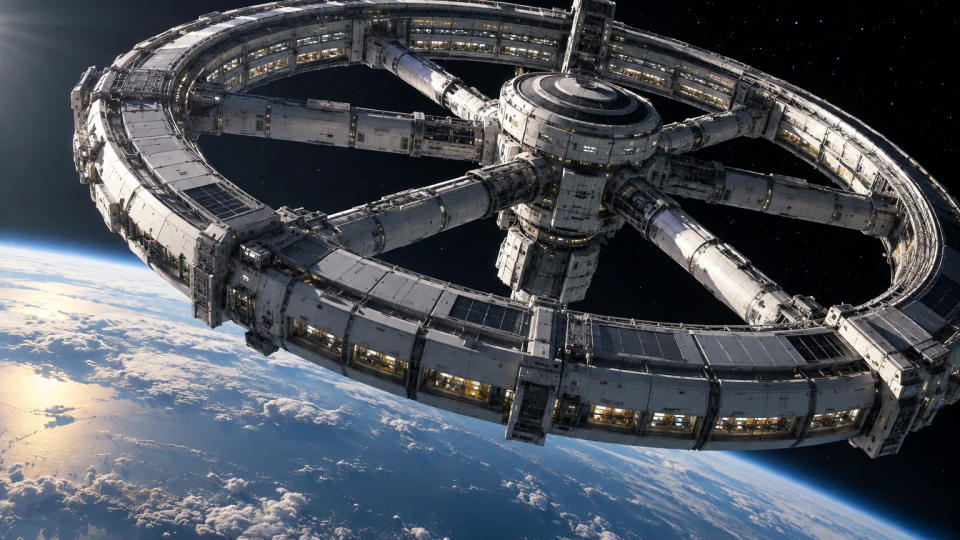
For a much bigger habitat, robots might assemble beams, pressure-tight living areas, power systems, radiators, and radiation shielding. Large structures must also be balanced before spinning. Imagine an unbalanced washing machine shaking during its spin cycle: now imagine that problem affecting a settlement full of people.
Materials would be another obstacle. Launching every steel beam and every ton of shielding from Earth would be extraordinarily demanding. Using resources from the Moon or asteroids is a possible future strategy, but mining, processing, and manufacturing those materials in space would themselves require major new industries.
Even docking becomes tricky. A spacecraft approaching a rotating outer wall would face moving surfaces. Engineers could instead consider docking near the axis or using a nonrotating docking section. These are solvable design problems in theory, not details we have already perfected for a city-sized habitat.
Does That Mean Cooper Station Is Actually Possible?
It helps to separate three different questions: Does the physics allow it? Yes. Do we understand some of the needed technologies? Yes. Can we currently build and operate a full-sized, self-sustaining settlement? No.
This is not a brand-new fantasy. A NASA-supported space-settlement study published in 1977 explored a huge rotating, wheel-shaped habitat that could house around 10,000 people. More recent NASA-funded concepts have investigated expandable structures on the kilometer scale. These are studies and proposals, not operating space cities.
Small steps would make more sense than starting with a giant colony. Engineers could first test rotating modules, learn how different spin rates affect people over long periods, improve recycling and radiation protection, and develop safer robotic assembly. Each would answer a problem that the film can solve in a few seconds of screen time.
There is no reliable date for when a real Cooper Station might appear. Its feasibility depends not only on physics but on money, infrastructure, reliability, and a compelling reason to support a large permanent community beyond Earth.
Conclusion
Cooper Station is an enormous engineering challenge wrapped around a sound scientific idea. Spinning could give its residents the feeling of gravity, but a livable space town would also need protection, supplies, repairs, and a carefully managed environment. The movie's rotating world is plausible in principle; actually building one remains a future achievement, not a present capability.
Sources & Further Reading
- The Art of VFX — Interstellar visual effects supervisor on Cooper Station's rotating-cylinder design
- NASA Technical Reports Server — Space Settlements: A Design Study (1977)
- NASA — Kilometer-Scale Space Structures from a Single Launch (2021 concept)
- NASA — ISS Water Recovery Milestone (2023)
- NASA Science — Protecting Astronauts from Space Radiation
- NASA — International Space Station, assembly and station facts
Post a Comment