
Comets grow dust and ion tails because sunlight and the solar wind act differently on grains and charged gas. Here is how it works.
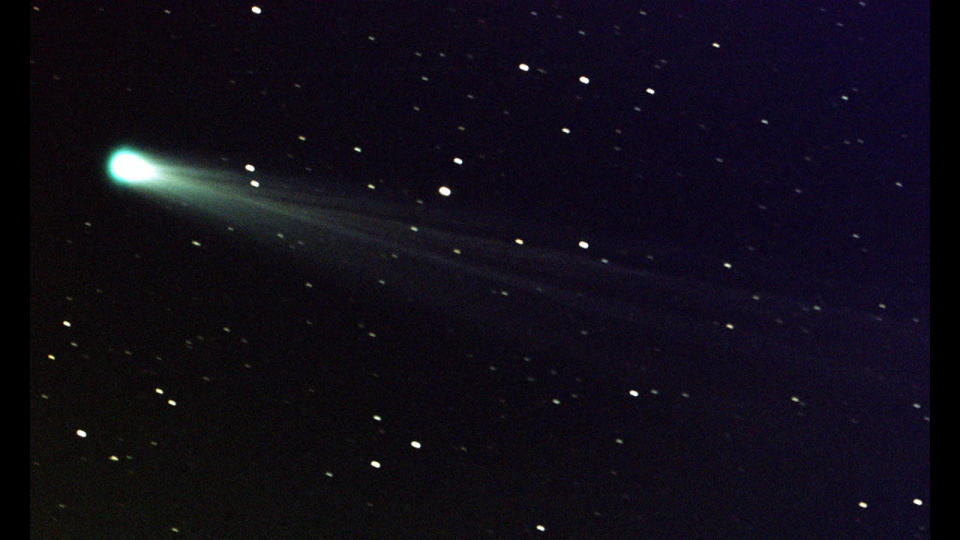
Observation: comet ISON. Image: NASA/MSFC/Aaron Kingery. Reframed with margins and converted to WebP; this view does not resolve two separate tails.
A comet can look like a single glowing brushstroke until a photograph reveals two streams leaving its head. The explanation is that dust grains and electrically charged gas respond differently to the Sun. Sunlight helps shape the dust tail, while the solar wind and its magnetic field organize the ion tail.
This distinction also explains why a comet is a poor model for a rocket with exhaust trailing behind it. The tail is shaped by the solar environment, rather than simply marking the direction opposite the comet’s travel. To understand the picture, begin with what leaves the nucleus, then ask which forces act on that material.
How a Frozen Nucleus Becomes an Active Comet
The solid nucleus is a mixture of ice, dust and rocky material. Far from the Sun, a comet can remain relatively inactive, with little of the spectacular surrounding structure that makes it recognizable in photographs. Closer in, solar heating allows volatile ice to become gas. Escaping gas can carry dust away from the surface.
That material forms the coma, the diffuse envelope surrounding the nucleus. The bright head in a distant photograph therefore need not show the solid body itself. Gas and dust around it can dominate the image, hiding the much smaller source that supplies them. A glowing patch is not a direct measurement of the nucleus’s size.
Spacecraft have made this distinction tangible. Rosetta’s close observations of comet 67P revealed a rugged body with two connected lobes and visible activity around it. The jets are local sources of material near the nucleus; the enormous tails seen from farther away are the later, larger-scale outcome of released material interacting with the solar environment.
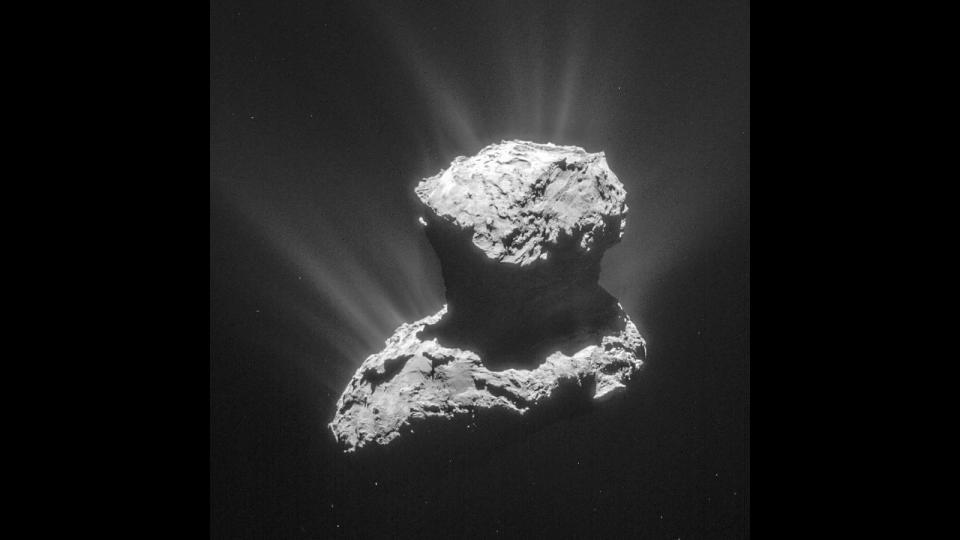
Comet 67P observation: ESA/Rosetta/NavCam, CC BY-SA 3.0 IGO. Resized, padded and converted to WebP; this image adaptation is available under the same license.
Nor does every comet have to display two obvious tails in every photograph. The supply of gas and dust, the observing geometry and the sensitivity of the camera all affect what stands out. A faint or overlapping component can be difficult to separate even when the underlying physical processes are operating.
Why Dust Fans Out While Ions Form a Narrower Tail
The dust tail consists of solid particles released with the escaping gas. These grains scatter sunlight, so a dust tail can appear whitish or yellowish. Light also transfers momentum to the grains: radiation pressure changes their motion. Together with the particles’ continuing orbital motion, this produces the familiar broad, curved fan.
The ion tail is a different population of material. Gas molecules can lose electrons under solar radiation, becoming electrically charged. The ions interact with the magnetized solar wind flowing outward from the Sun. The resulting tail usually follows a much straighter, approximately anti-solar direction. It is often blue in color observations, although color alone is not a complete chemical analysis.
ESA’s explanation of comet ZTF distinguishes another important point: the two components do not merely reflect light in the same way. Dust scatters incident sunlight, whereas gas can absorb solar photons and re-emit light through fluorescence. Photographs combine these emissions with the response of the detector and any processing applied afterward.
A useful observational example comes from Parker Solar Probe. On 5 July 2020, its WISPR instrument recorded comet NEOWISE. In the processed view, the broader lower feature is identified as the dust tail and the thinner upper feature as the ion tail. These are structures in an actual observation, rather than colored ribbons added to illustrate a theory.
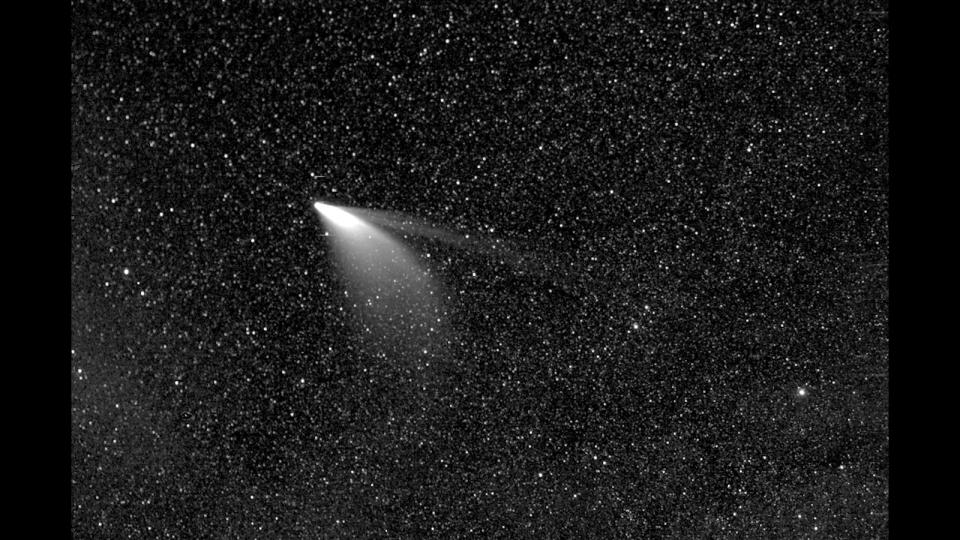
NEOWISE, 5 July 2020: NASA/Johns Hopkins APL/Naval Research Lab/Parker Solar Probe/Guillermo Stenborg. Contrast-processed observation, fitted with margins and converted to WebP; not a natural-color view.
That image also shows why an attractive picture should not be treated as a finished explanation. Processing brings out faint structure, and apparent branches need interpretation. The mission report noted a possible split in the ion tail, while explicitly saying that confirming an additional ion tail would require more evidence.
Why a Tail Can Appear to Point the Wrong Way
Changing the viewing position changes the apparent relationship between the tails. The broad distribution of dust is projected onto the sky, and that projection can compress or spread out its visible shape. A photograph provides a two-dimensional view of material occupying three-dimensional space.
Sometimes a comet appears to have a third feature pointing toward the Sun. This is called an anti-tail. ESA describes it as a viewing effect involving the dust distribution: the observer’s position makes part of the dust appear to extend on the sunward side. It does not require the ordinary ion tail to reverse its response to the solar wind.
The two-tail description is also an introduction, rather than a rule that every detail must obey. Research on comet McNaught examined its fine dust bands using spacecraft observations and modeling. A NASA account published in 2018 described evidence that changing magnetic conditions in the solar wind disturbed charged dust in those bands.
That result complicates the beginner’s division without making it useless. Radiation pressure remains central to understanding a broad dust tail, but real grains can acquire charge and respond to additional influences. Detailed tail structure can therefore reveal both properties of the released material and conditions in the surrounding solar wind.
When reading a comet image, ask three practical questions: is it an observation or an illustration, what processing was used, and which feature has the scientific team actually identified? Those questions are more reliable than counting bright streaks and assuming each one represents a separate kind of tail.
Conclusion
Comets develop two main tails because their released material includes both dust and ionized gas. The Sun illuminates and pushes dust, while its magnetized wind shapes the charged component. Their different responses create the broad fan and narrower stream that can appear side by side.
The complete picture still depends on activity, perspective and measurement. An anti-tail can be a projection effect, a hidden tail may simply be too faint to distinguish, and a complex dust pattern may record additional physics. A comet’s tail is a changing record of interaction with the Sun, not a fixed arrow showing where the comet has been.
Sources & Further Reading
- Comet Facts
- What Is a Comet?
- Comets: an overview
- Comet ZTF and its apparent three tails
- NASA’s Parker Solar Probe Spies Newly-Discovered Comet NEOWISE
- New Insights on Comet Tails Are Blowing in the Solar Wind
Post a Comment