
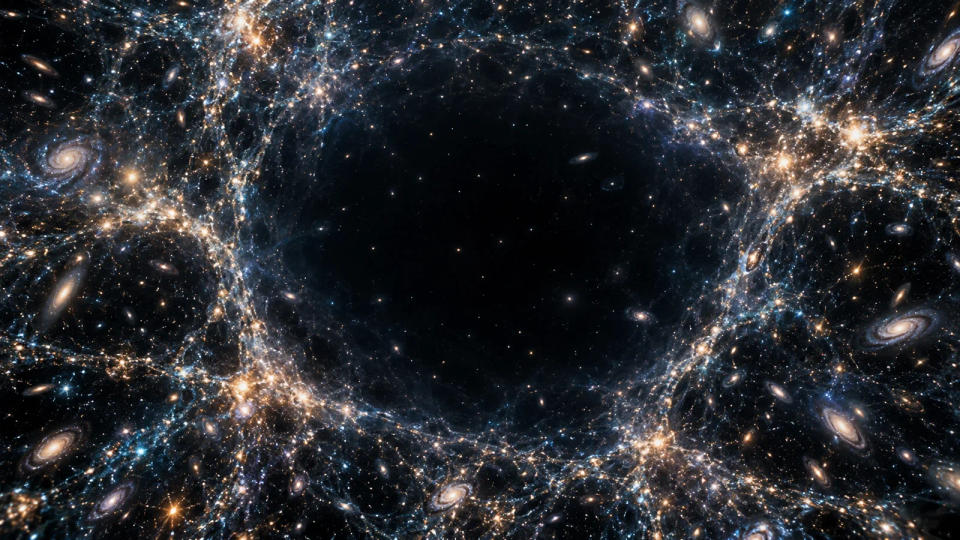
How can a universe packed with galaxies contain an enormous patch where almost none appear? Astronomers have found just such a place: the Boötes Void, an exceptionally galaxy-poor region often described as roughly 330 million light-years across. It is not a literal hole in space or a cosmic vacuum cleaner. It is an extreme example of how gravity has organized matter into an immense, uneven network.
The name sounds like science fiction, and the nickname “the Great Nothing” is even more dramatic. But the discovery began with ordinary scientific detective work: measuring galaxy light, estimating distances, and noticing that a large part of a three-dimensional map looked unexpectedly sparse.
What Astronomers Actually Discovered
In 1981, Robert Kirshner and colleagues reported evidence for a striking gap in the distribution of galaxies in the direction of the constellation Boötes. They were not staring through a telescope at a black sphere. They were taking spectra—spreading galaxy light into its component colors—to determine redshift. For distant galaxies, redshift helps astronomers estimate distance because expanding space stretches the light traveling toward us.
Imagine plotting the addresses of thousands of houses, then discovering that one enormous neighborhood has almost no houses. You would not conclude that the land itself had vanished. You would conclude that the houses are distributed very unevenly. The first Boötes surveys reached essentially that conclusion about galaxies.
A follow-up survey reported radial velocities for 231 galaxies across hundreds of small fields, confirming an unusually empty volume in the galaxy distribution. That early result is important because a blank-looking patch of sky alone would prove very little: galaxies behind the patch could still be present, only much farther away. Distance estimates helped reveal an underpopulated region in three dimensions rather than a trick of the camera.
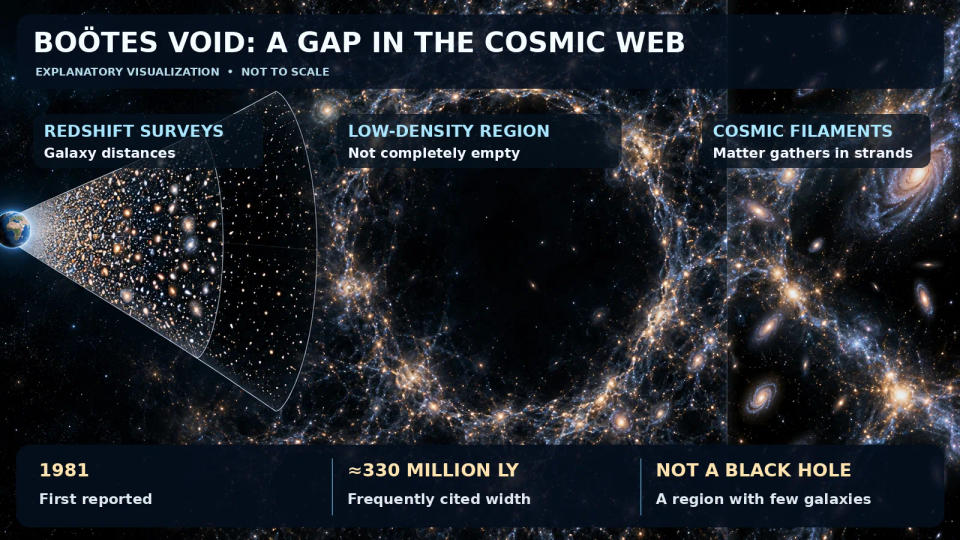
Popular descriptions place the void about 700 million light-years away and give it an approximate width of 330 million light-years. Both figures are broad-scale descriptions, not the dimensions of a solid-edged object. Its inferred boundary depends on how galaxies are sampled, which density threshold defines a void, and the distance model used. A void is a statistical feature in a galaxy map, not an object with a painted outline.
How Did Such an Empty Region Form?
The explanation begins long before galaxies existed. The early universe was remarkably smooth, but not perfectly so. Tiny differences in density gave some locations a slight gravitational advantage. Over billions of years, slightly denser regions gathered more dark matter, gas, and eventually galaxies, while less dense neighborhoods were increasingly left behind.
Picture a sheet of soap bubbles. The liquid tends to collect in the thin walls and especially where several walls meet, while the centers of the bubbles contain far less liquid. The analogy is imperfect, but it explains the shape of the cosmic web: galaxies and gas concentrate along filaments and walls, with comparatively empty voids between them.
Dark matter matters here even though telescopes cannot photograph it directly. Its gravity helped build the large-scale scaffolding into which ordinary gas flowed. NASA and the European Space Agency describe this cosmic web as the outcome of tiny early density differences amplified by gravity. The effect is not that a giant explosion blasted all the galaxies out of Boötes. Rather, matter accumulated unevenly as cosmic structure grew.
In the language of cosmology, the Boötes region is underdense: it contains fewer galaxies than a similarly sized region with an average cosmic distribution. Large voids can grow as surrounding structure develops, and the merger of smaller low-density regions is a proposed route toward especially large voids. Precisely reconstructing Boötes' individual history, however, is a modeling problem rather than a movie astronomers have observed frame by frame.
Is the Boötes Void Truly Empty—and Why Does It Matter?
No. The word void does not mean that every atom, galaxy, or gravitational influence is absent. Later observations identified galaxies inside Boötes, and descriptions of its population have changed as searches improved. Reports citing only several dozen known galaxies describe a surveyed population, not an absolute inventory of everything the volume contains.
Even places with few visible galaxies can contain extremely diffuse gas and dark matter. They can also be crossed by light. A void does not behave like a black hole: it has no event horizon, does not trap passing light simply because it is a void, and is not a tunnel outside the universe. It is ordinary expanding space with an unusually low concentration of galaxies.
That distinction makes the discovery more interesting, not less. Astronomy often learns from what is missing. If the universe had started with exactly equal density everywhere and nothing disturbed it, building today's complicated network would have been difficult. Real voids provide independent tests of how density differences grow and how galaxy populations respond to their environments.
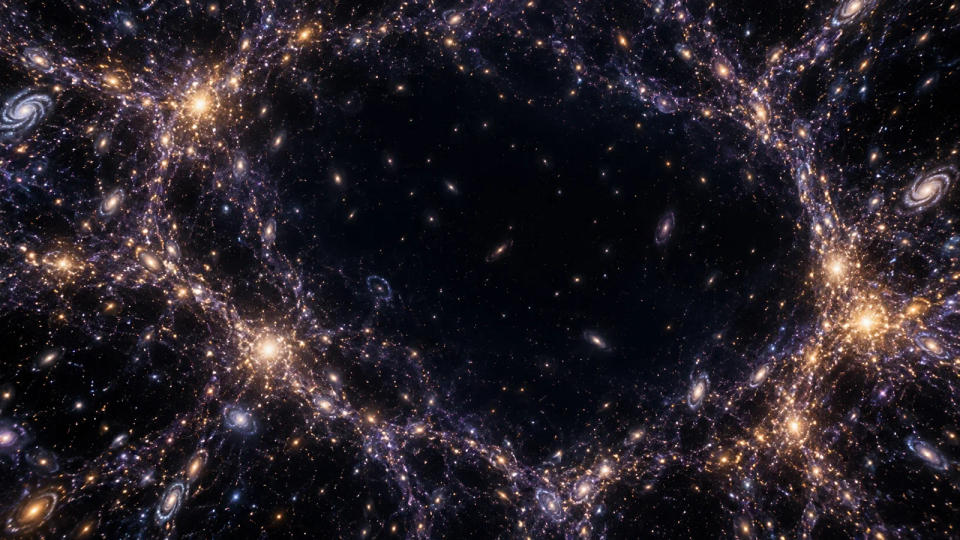
There is another important observational catch. A beautiful illustration of an empty sphere surrounded by glowing strands is usually an artist's reconstruction or simulation. It is not a single photograph of the Boötes Void. The evidence comes from surveys that combine sky positions with distance information. Similarly, an image showing a galaxy in a cosmic void does not necessarily depict a Boötes galaxy. NASA's Hubble example of the faint galaxy KK 246, for instance, belongs to the Local Void, a different region.
Researchers can compare observed voids with simulated universes to ask how quickly underdense areas evolve, how matter moves near their boundaries, and whether models explain the structures we see. The exact properties of any particular void are still subject to survey limitations and statistical definitions. What is secure is the broader picture: the universe is not evenly filled with galaxies.
Conclusion
The Boötes Void is not a missing piece of the cosmos. It is a spectacularly large, sparsely populated neighborhood within the cosmic web. Astronomers recognized it by mapping galaxy distances, and modern cosmology explains the general existence of voids through small early density differences amplified by gravity.
Its most surprising lesson may be that the emptiest-looking parts of the universe tell us about the structure of everything around them. To understand the cosmic web, scientists must study both the bright strands full of galaxies and the dark spaces between them.
Sources & Further Reading
- Kirshner et al., Survey of the Bootes Void (International Astronomical Union, 1983)
- BBC Science Focus, The Boötes Void (2022)
- BBC Sky at Night, the Boötes Void and its discovery (2026)
- NASA, Large Scale Structures
- ESA, History of Cosmic Structure Formation
- NASA, Hubble Sees Stellar Glitter in a Cosmic Void
Post a Comment