
How do asteroids form? Explore the Solar System's early building blocks and how NASA's Psyche mission will test their hidden history.
A small world orbiting between Mars and Jupiter may hold clues to a process that also shaped Earth. Asteroids originate in the material left from the Solar System's formation about 4.6 billion years ago, but their histories did not stop there. Growth, heating, collisions, and fragmentation transformed those early building blocks into the varied objects we see today.
Psyche brings that story into focus because it appears unusually rich in metal. Scientists want to discover whether it preserves part of an ancient body's core or formed by another route. That distinction matters: an asteroid can be a surviving building block, a fragment of a once-larger body, or material changed by several events. There is no single biography that fits every asteroid.
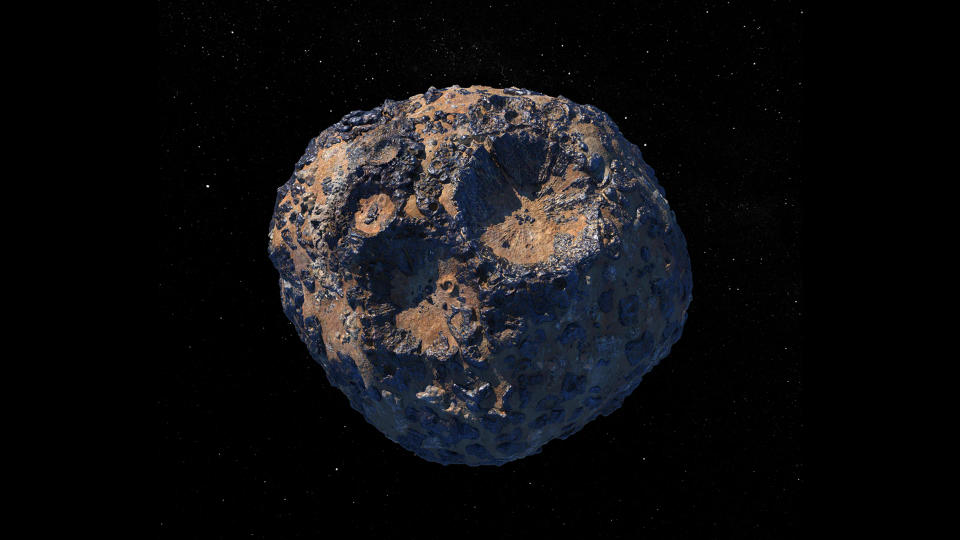
Cover: artist's illustration, not a close-up observation. Credit: NASA/JPL-Caltech/ASU, PIA24471. Reframed for this article.
From a dusty disk to surviving asteroids
The starting point was a collapsing cloud of gas and dust. As the young Sun formed at its center, surrounding material occupied a rotating disk. Solids gathered into larger bodies, and gravity became increasingly important as those bodies gained mass. Some continued growing into planets; others remained smaller or were broken apart during the Solar System's turbulent early development.
Scientists call early planetary building blocks planetesimals. Think of the term as a stage in construction rather than a promise that every object would become a planet. A planetesimal could grow through encounters with other material, survive without much further growth, or suffer a destructive collision. Asteroids preserve evidence of these different outcomes, rather than simply representing identical rocks that failed an admission test.
Most known asteroids occupy the main belt between Mars and Jupiter. NASA explains that the gravity of the growing Jupiter disrupted the formation of planetary bodies in this region and encouraged collisions. The familiar belt is therefore not best understood as the wreckage of one finished planet that suddenly exploded. It contains surviving material and fragments with a much more varied past.
Composition provides another clue. NASA groups asteroids broadly into carbon-rich C-types, stony S-types, and metallic M-types. These categories help describe differences in material, but they do not by themselves reconstruct an individual object's entire history. Some early bodies experienced enough heating to partially melt, changing where rock and metal ended up inside them.
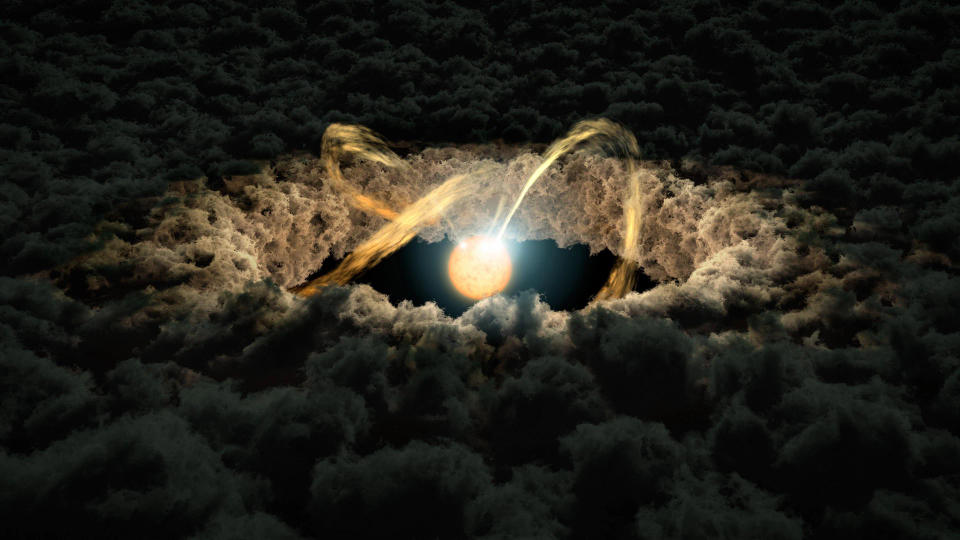
Generic protoplanetary disk artist's concept; not an image of our infant Solar System. Credit: NASA/JPL-Caltech, PIA20645.
Why Psyche could preserve a planet's hidden history
When an early body becomes sufficiently molten, its materials can separate. Dense metal tends to move inward while rocky material forms outer layers. This internal sorting is called differentiation. It helps explain why a rocky planet can have a metal-rich core hidden beneath a rocky exterior. Studying that process directly inside Earth is difficult because the core lies far beyond our reach.
One leading hypothesis proposes that Psyche belonged to a differentiated planetesimal. Later impacts may have stripped away much of its outer rocky material, leaving a metal-rich remnant. If that interpretation is correct, the asteroid could expose evidence of processes normally concealed inside larger worlds. It would offer a natural way to investigate planetary construction without drilling through an entire planet.
However, “Psyche is an exposed core” remains a hypothesis. JPL also describes the possibility that it is a remnant of a different kind of object formed from metal-rich material. The mission must distinguish among explanations instead of treating its destination as a solved mystery. An intriguing candidate is not the same thing as a confirmed planetary core.
Current estimates also complicate the image of a pure metal world. NASA reports that Psyche is probably a mixture of rock and metal, with metal estimated at 30% to 60% of its volume. That range is not a direct measurement from a surface sample. It reflects remote observations and interpretation, which the spacecraft's closer investigation is designed to improve.
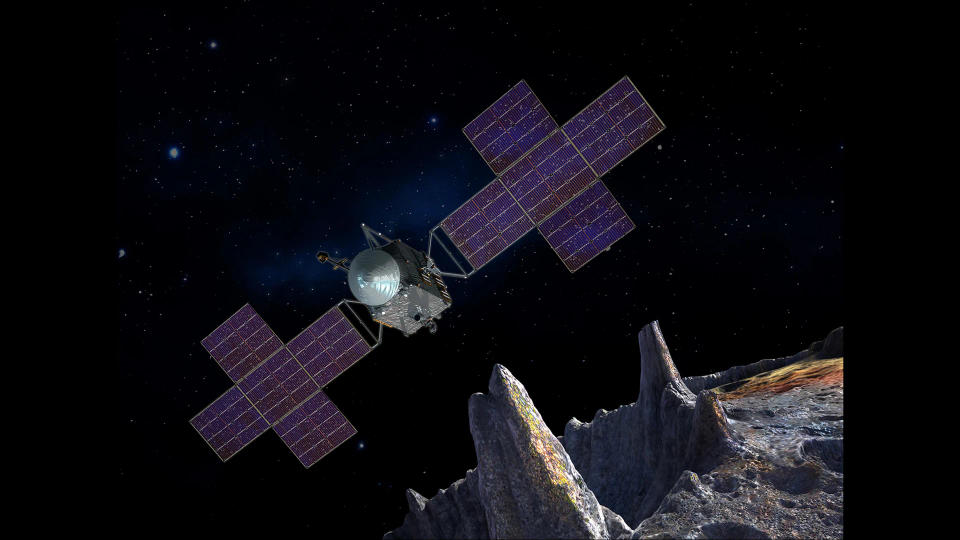
2017 mission artist's concept; asteroid terrain is speculative. Credit: NASA/JPL-Caltech/Arizona State Univ./Space Systems Loral/Peter Rubin, PIA21499. Fitted without cropping the spacecraft.
How the mission will test the origin story
The spacecraft and asteroid share the name Psyche, but they are different things: one is the robotic explorer, the other its destination. NASA's current mission information schedules the asteroid investigation to begin in August 2029. Until arrival, detailed artistic views of its surface remain illustrations rather than spacecraft photographs of the target.
The investigation combines complementary measurements. A multispectral imager will examine surface appearance and variations. A gamma-ray and neutron spectrometer will help identify elemental composition. A magnetometer will search for magnetic evidence, while radio tracking will support measurements of the asteroid's gravity. Together, these observations can constrain its structure and test competing explanations for its origin.
A surviving magnetic signature would be especially interesting because it could support a connection to a once-molten core. Yet no single attractive clue should carry the whole argument. The 2024 post-launch science summary frames the mission around testing whether Psyche is a remnant core or primordial, unmelted material. Composition, magnetism, geology, and gravity need to be interpreted together.
The journey is still underway. In an October 22, 2026 update, NASA reported that nearly continuous electric propulsion had begun on September 28 after the Mars gravity assist, keeping the spacecraft on course for summer 2029. This is progress toward a future investigation, not an announcement that the asteroid's origin has already been established.
Conclusion
Asteroids formed from the same broad reservoir of early Solar System material that built the planets, then followed different paths through growth, heating, and collisions. Psyche could preserve a particularly revealing chapter: the formation and possible exposure of a metal-rich interior. Whether that hypothesis survives close examination or gives way to another explanation, the mission can sharpen our understanding of how small building blocks became complex rocky worlds.
Sources & Further Reading
- NASA — Asteroid Facts
- NASA — Solar System Facts
- NASA — Asteroid Psyche
- JPL — Psyche Press Kit: Science
- Dibb et al. (2024) — A Post-Launch Summary of the Science of NASA's Psyche Mission
- NASA — Pedal to the Metal: NASA's Psyche Heads Toward Asteroid Belt
Post a Comment