
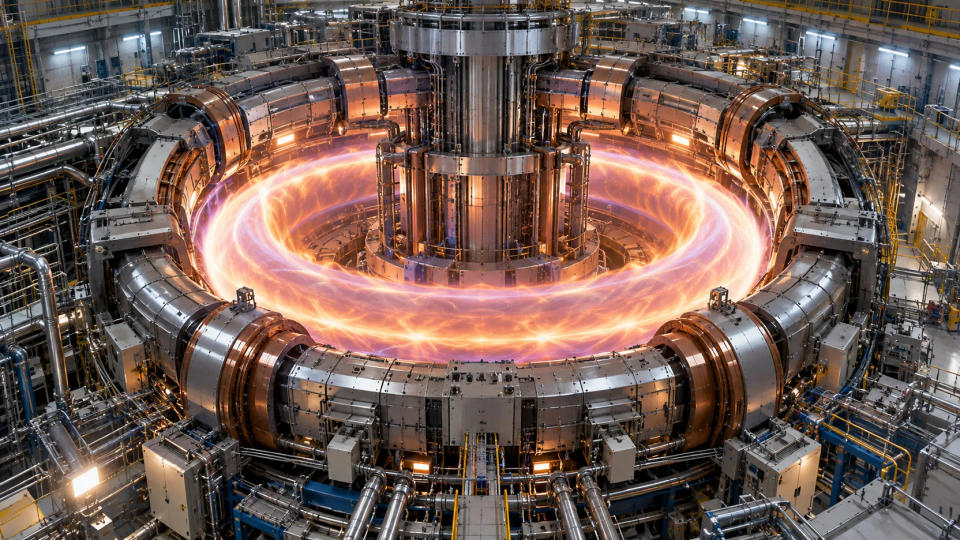
Calling a fusion reactor an “artificial sun” makes it sound as if scientists are trying to build a miniature star in a laboratory. They are not. What researchers are really trying to reproduce is one crucial process that powers stars: nuclear fusion, in which light atomic nuclei join together and release energy.
So can scientists build an artificial sun on Earth? In the popular sense, yes: laboratories can create fusion plasmas hotter than the Sun’s core, and some experiments have already produced more fusion energy at the target than the energy delivered directly to it. But no machine today is a self-sustaining miniature star or a commercial fusion power plant. The difficult part is not making fusion happen for a moment. It is making it happen reliably, efficiently, and continuously enough to produce useful electricity.
What Does “Artificial Sun” Actually Mean?
The phrase is a nickname, not a scientific category. It is often used for experimental fusion machines such as tokamaks, including China’s EAST facility, because they recreate some of the extreme conditions needed for fusion. They do not reproduce a star’s size, gravity, or exact nuclear reactions.
The Sun mainly fuses ordinary hydrogen through a chain of reactions that begins with protons. That works because the Sun has an enormous mass. Gravity squeezes its core to tremendous pressure, allowing fusion to continue at a temperature of roughly 15 million degrees Celsius.
Earth-based reactors cannot imitate that gravitational pressure. Instead, most near-term fusion research focuses on two heavier forms of hydrogen: deuterium and tritium. When those nuclei fuse, they form helium and a fast neutron while releasing energy. This reaction is much easier to trigger than the proton-proton process that dominates the Sun.
Why Must Fusion on Earth Be Hotter Than the Sun?
This is one of the strangest facts about fusion research: a laboratory “sun” has to be much hotter than the real Sun’s core.
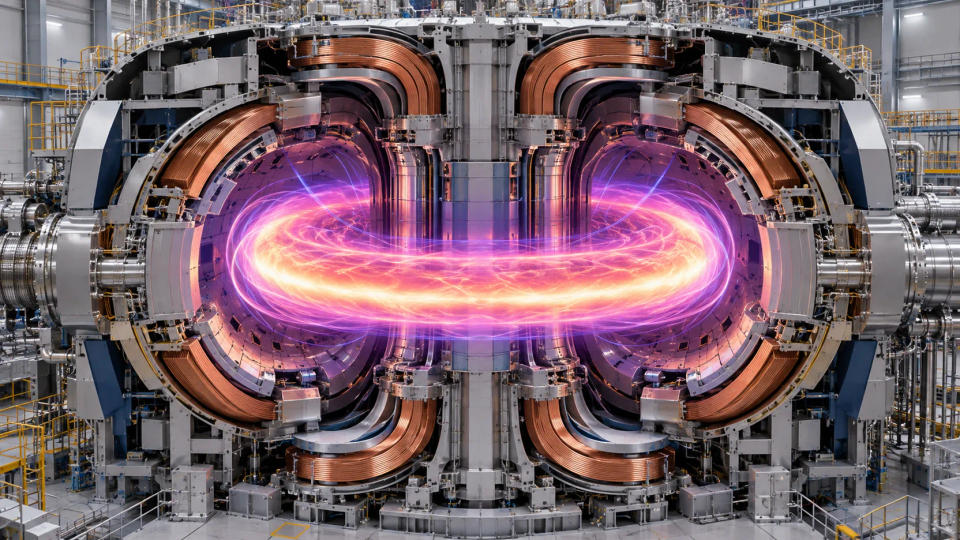
ITER, the huge international tokamak under construction in France, is designed to heat deuterium-tritium plasma to about 150 million degrees Celsius. At those temperatures, matter becomes plasma—a soup of free electrons and positively charged nuclei. The nuclei move so quickly that some can overcome their electrical repulsion and fuse.
The reason for the higher temperature is pressure. The Sun gets help from gravity; a reactor on Earth does not. Engineers compensate by pushing the plasma to much higher temperatures and by trying to confine it long enough and densely enough for large numbers of fusion reactions to occur.
No material wall could simply hold a 150-million-degree plasma. In a tokamak, powerful magnetic fields guide the charged particles around a donut-shaped vacuum chamber, keeping the hottest plasma away from the walls. The challenge is to maintain the right combination of temperature, density, and confinement time without the plasma becoming unstable or dumping its heat onto the machine.
A different route: laser fusion
Magnetic confinement is not the only approach. Tokamaks such as EAST, WEST, KSTAR, and the future ITER use magnetic fields to hold a relatively large plasma for seconds or minutes. Stellarators use a more complex set of twisted magnets to pursue a similar goal with different stability advantages.
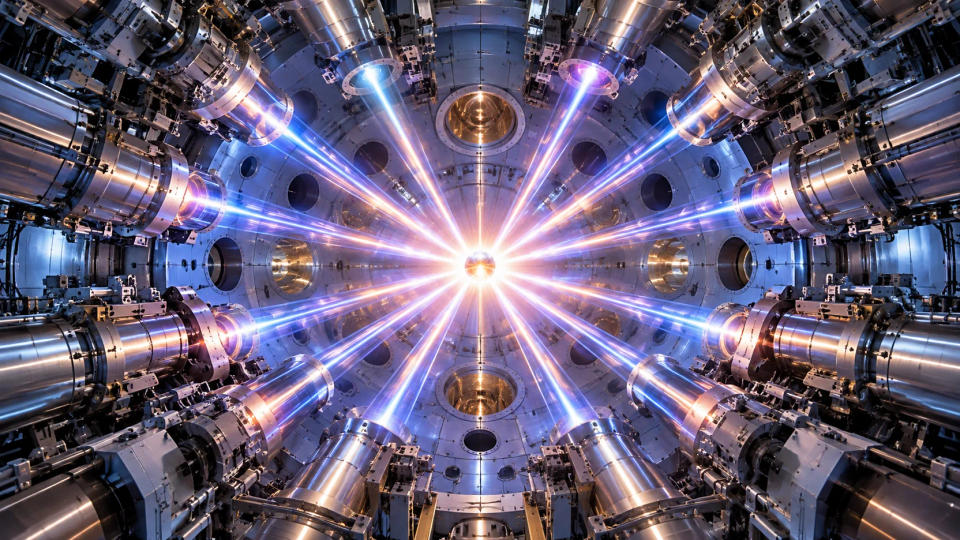
Inertial confinement takes a completely different route. At the U.S. National Ignition Facility, 192 laser beams deliver an intense burst of energy to a tiny target. The target implodes, compressing deuterium-tritium fuel so rapidly that fusion occurs before the material has time to fly apart.
These machines are not competing to make a glowing ball that behaves like the Sun. They are testing different ways to satisfy the physical conditions required for fusion and, eventually, to turn that reaction into a practical energy system.
What Do the Recent Fusion Records Really Show?
Fusion has moved beyond the stage where the question is whether the reaction can be produced at all. The more useful question now is how well it can be controlled and how much of the entire power-plant problem has been solved.
In January 2025, China’s EAST tokamak maintained a high-confinement plasma for 1,066 seconds. The following month, France’s WEST tokamak sustained a plasma for 1,337 seconds—more than 22 minutes. Those are important engineering and plasma-control achievements, but they do not mean either machine generated net electricity. Long plasma duration and net power production are different milestones.
Laser fusion has reached another milestone. Lawrence Livermore National Laboratory reported that a June 20, 2026 shot at the National Ignition Facility produced 7.9 megajoules of fusion energy, with a target gain of about 3.8. In other words, the fusion yield was several times the laser energy delivered to the target. That is a major physics result, but it is not the same as a power station producing more electricity than the whole facility consumes. NIF’s lasers, cooling systems, and other equipment require far more energy than reaches the tiny target.
ITER is aimed at yet another step. Its goal is a fusion gain of at least Q=10: about 500 megawatts of fusion power from 50 megawatts of heating power delivered to the plasma. ITER will not generate electricity for the grid. Under its current baseline, deuterium-tritium operations are planned to begin in 2039. As of July 2026, six of the nine massive tokamak sector modules had been installed in the machine pit.
Why Is a Fusion Power Plant Still So Difficult?
Producing fusion is only the center of a much larger engineering puzzle. A commercial reactor must survive an intense flow of high-energy neutrons, remove enormous heat loads, maintain its magnets and vacuum systems, and replace components that become damaged over time.
Fuel is another challenge. Deuterium is abundant in water, but tritium is rare and radioactive. Most deuterium-tritium power-plant concepts therefore plan to make their own tritium by using fusion neutrons to interact with lithium in a surrounding “breeding blanket.” That fuel cycle has to work reliably at industrial scale.
Then there is the energy balance of the entire facility. A reactor may achieve a high plasma gain and still consume substantial electricity for magnets, pumps, cryogenic equipment, heating systems, and fuel processing. A real power plant must produce enough thermal energy, convert it to electricity efficiently, feed its own systems, and still have a useful surplus for the grid.
That is why a record plasma temperature, a long-duration discharge, or even target-level energy gain should not be mistaken for the arrival of commercial fusion. Each solves a different piece of the problem.
Conclusion: We Can Recreate Fusion, Not a Star
Scientists can already reproduce the basic process that powers the Sun, and they can do it under controlled conditions on Earth. In that limited sense, the “artificial sun” nickname captures something real.
But a fusion reactor is not a miniature star. It uses different fuel, different confinement methods, and extreme engineering to compensate for the gravity Earth cannot provide. The breakthrough that matters most will not be a brighter plasma or a dramatic temperature record. It will be a complete system that can run repeatedly, breed or supply its fuel, survive its own neutrons, and deliver dependable net electricity. Fusion physics has crossed several remarkable thresholds; fusion power plants still have important ones ahead.
Sources & Further Reading
- ITER — Frequently Asked Questions
- ITER — Two-thirds of ITER tokamak core now in place
- Lawrence Livermore National Laboratory — Achieving Fusion Ignition
- Chinese Academy of Sciences — EAST 1,066-second plasma record
- CEA — WEST plasma duration record
- IAEA — Tritium Breeding
Post a Comment