
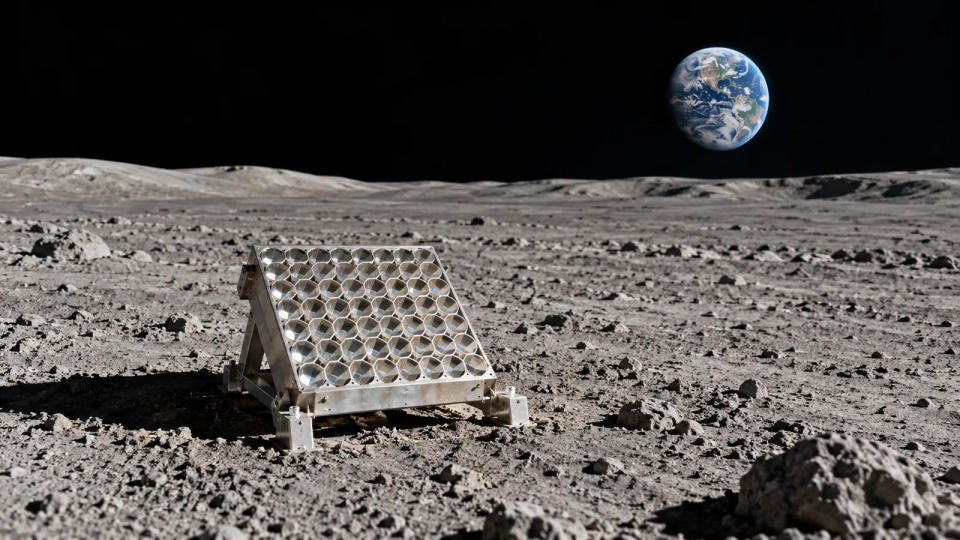
Imagine leaving a piece of scientific equipment on the Moon in 1969 and discovering that researchers could still use it more than half a century later. No battery replacements. No software updates. Not even a switch to turn on.
That is the surprising story of the mirrors carried to the Moon by Apollo astronauts. They are not looking glasses or abandoned decorations. They are laser retroreflectors, and observatories on Earth still use them to measure the Moon's distance, track its motion, and ask questions about gravity itself.
Why Did Apollo Astronauts Leave Mirrors on the Moon?
When Apollo 11 landed in July 1969, Buzz Aldrin deployed a square panel containing 100 small glass reflectors. Apollo 14 later delivered another 100-reflector array, and Apollo 15 left a larger panel with 300. Soviet Lunokhod rovers also carried reflectors, creating more targets for scientists on Earth.
The Apollo hardware looked modest beside the lunar module. Yet it was designed for an experiment that could continue after the astronauts and their spacecraft departed. The panels needed neither electricity nor radio communications because they did not have to produce a signal. They only had to return light sent from Earth.
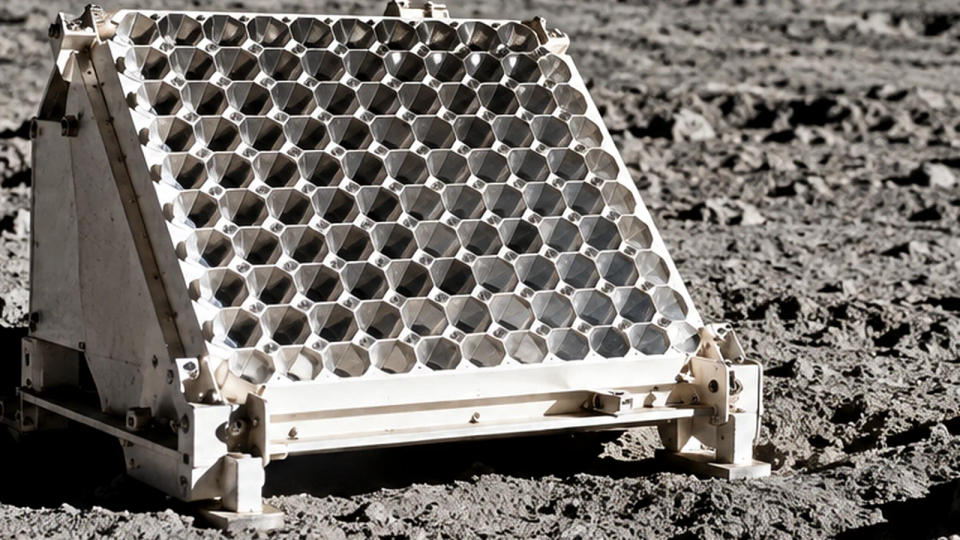
The trick lies inside each tiny glass prism. A normal bathroom mirror sends light away at an angle if you shine a flashlight onto it from the side. A corner-cube reflector is different: its three mutually perpendicular reflecting faces send incoming light back in nearly the direction it arrived from. Think of three mirror surfaces meeting at the corner of a room.
That simple geometry is why a small, powerless object sitting in lunar dust can communicate something useful across hundreds of thousands of kilometers. The panel does not know where Earth is, and it does not need to.
How Can a Laser Reach a Mirror So Far Away?
The average Earth–Moon distance is about 384,400 kilometers (238,900 miles). A telescope on Earth cannot pick out one of these small panels in an ordinary image. Instead, observers use the Moon's known location and carefully modeled orbit to aim powerful, short laser pulses toward an array.
Even a tightly focused laser spreads out during the journey. By the time its light reaches the Moon, the illuminated area can be several kilometers wide. Only an extraordinarily small share of the photons strike the reflectors, and fewer still find their way back through Earth's atmosphere into the receiving telescope.
That tiny return is enough. Scientists record when the outgoing pulse left and when the returning photons arrived. Light travels at roughly 300,000 kilometers per second, so the round trip takes about 2.5 seconds at a typical lunar distance.
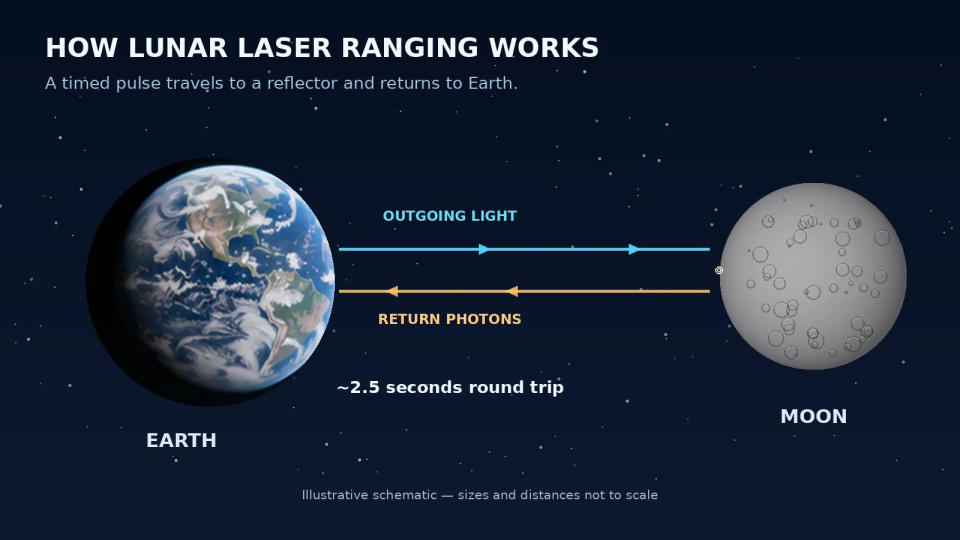
The calculation is simple in principle: multiply the travel time by the speed of light, then divide by two because the light made a return journey. In practice, researchers also account for atmospheric delays, the changing positions of Earth and Moon, and details of the observing equipment.
Modern measurements are remarkably fine. A study of Apache Point Observatory observations from 2006 through 2020 reported a median nightly ranging accuracy of about 1.7 millimeters. That refers to the precision of the analyzed range observations, not to knowing every part of the Moon's position to the nearest millimeter.
What Have These Mirrors Taught Us About the Moon?
The most famous result is that the Moon is slowly moving away from Earth, by roughly 3.8 centimeters (1.5 inches) per year. That sounds like a tiny change, but decades of precise measurements make it unmistakable.
Why is it happening? The Moon raises tides in Earth's oceans, and Earth's rotation carries the tidal bulges a little ahead of the Moon. Their gravitational pull transfers a small amount of rotational energy and angular momentum into the Moon's orbit. Earth's spin gradually slows while the Moon moves into a slightly wider orbit.
The mirrors have revealed something less obvious too: the Moon itself flexes under Earth's gravitational pull. Measurements show that the locations of the reflectors can shift vertically by as much as about 15 centimeters over a month. This helps scientists investigate how the lunar crust and interior respond to tidal stress.
Long-term tracking also contributes evidence that the Moon has a fluid core and helps determine its rotation and orientation. In effect, a quiet panel of glass lets astronomers listen to the subtle motion of a world they cannot simply open up and examine.
There is a bigger question hiding in those measurements: does gravity treat different materials in exactly the same way? Because Earth and Moon have different compositions, tracking their motion around the Sun offers a demanding test of the equivalence principle, a central idea behind Einstein's general relativity. So far, lunar ranging has found no composition-dependent difference that overturns it.
Are the Apollo Mirrors Still Working Today?
Yes—but “working” needs a little explanation. The Apollo arrays are passive targets: they do not switch on, transmit messages, or perform maintenance. They continue to return detectable laser light when observatories successfully target them.
They are not unchanged, however. Over the decades, some arrays have reflected weaker signals than expected. Researchers have investigated possible causes, including lunar dust and temperature-related effects. Dust is a plausible explanation, not a problem that has been conclusively solved.
That is one reason newer reflectors matter. In March 2025, the Next Generation Lunar Retroreflector, called NGLR-1, landed aboard Firefly Aerospace's Blue Ghost mission. NASA reported that the instrument successfully returned laser light to two lunar laser-ranging observatories. New targets in different locations can help researchers improve their measurements of the Moon's shape, motion, and internal structure.
Precise reference points also help future lunar exploration. If spacecraft operators know where features and instruments sit within a well-measured lunar coordinate system, it becomes easier to relate orbital maps, landing sites, and navigation measurements.
The most remarkable part is the continuity. An Apollo experiment conceived for one short visit to the Moon has grown into a long-running network of measurements, strengthened by better lasers, better clocks, and new reflectors.
Conclusion
The mirrors NASA left on the Moon are still there because their job is beautifully simple: send a little light back toward home. Every successful return provides another precise clue about the changing Earth–Moon system—and another chance to test how gravity works across space.
Sources & Further Reading
- NASA JPL — The Apollo Experiment That Keeps on Giving (2019)
- NASA — Laser Beams Reflected Between Earth and Moon Boost Science (2020)
- NASA Technical Reports Server — Fifteen Years of Millimeter Accuracy Lunar Laser Ranging With Apollo
- NASA — Science Data Received, Blue Ghost Captures Eclipse From Moon (2025)
- International Laser Ranging Service — Lunar Laser Ranging
Post a Comment