

A planet has been caught so early in its life that the system around it is still a construction site. Elias 2-24 b is embedded in the gas and dust from which planets are born, and astronomers now say it is less than 1 million years old — making it the youngest confirmed exoplanet known.
That age is not just a record. The planet sits far from its star, at roughly 55 astronomical units, yet it has already grown into a giant world. That is surprisingly fast compared with many standard models of giant-planet formation and gives astronomers a rare chance to test those models against a planet that is still close to its birth.
The confirmation was reported in NASA's September 16, 2026 announcement and in a new study published in The Astrophysical Journal Letters.
What Makes Elias 2-24 b So Unusual?
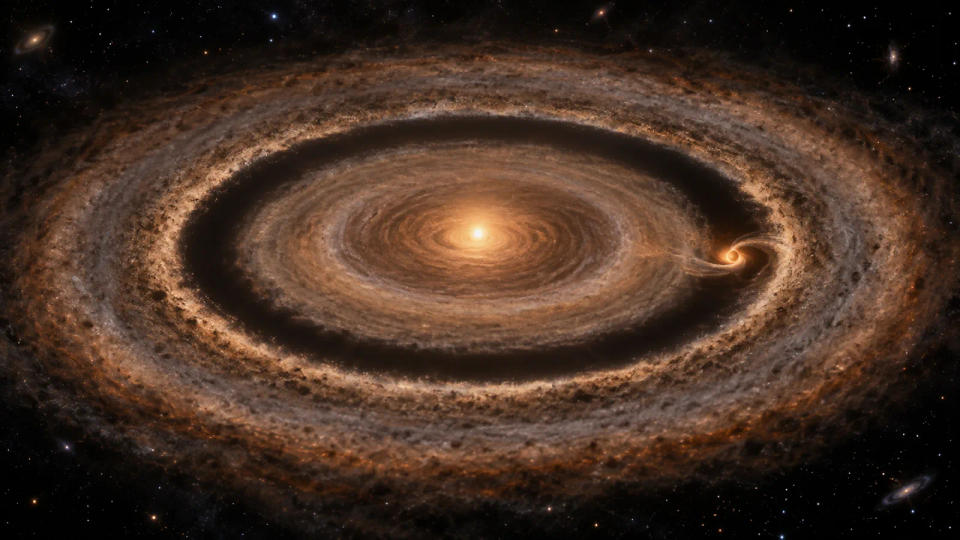
Elias 2-24 is a very young star about 450 light-years from Earth. Like many newborn stars, it is surrounded by a broad protoplanetary disk: a rotating mixture of gas, microscopic dust, ice, and larger solid particles. Over time, material in such a disk can collide, stick together, and eventually build planets.
Elias 2-24 b is not orbiting in a clean, mature planetary system like Jupiter does today. It lies inside a prominent gap in the disk, where its gravity is thought to be interacting with the surrounding material. The new study places the planet at about 54.9 astronomical units from its star, or roughly 10 times Jupiter's distance from the Sun.
Its mass is harder to pin down because newborn planets can glow from both their own heat and ongoing accretion. Using brightness-based evolutionary models and ignoring extra light from accretion, the researchers estimated about 1.9 to 4.0 Jupiter masses. NASA described it more generally as a Jupiter-class world. Either way, this is a giant planet appearing extraordinarily early in the life of its system.
The phrase “less than 1 million years old” also needs the right context. Astronomers cannot put a timestamp on the planet itself. The age comes from estimates for the extremely young star and its surrounding disk. Within those uncertainties, Elias 2-24 b is younger than the previous confirmed record holders, including the planets around PDS 70 and WISPIT 2, which are more than 5 million years old.
How a Faint Point of Light Became a Confirmed Planet
The story did not begin with a clean photograph of a new world. Years ago, ALMA observations revealed a gap in the dusty disk around Elias 2-24. Gaps are interesting because a planet can sweep up, scatter, and gravitationally reshape material along its orbit. But a gap alone is not proof. Magnetic effects, changes in dust properties, and other disk processes can also produce structure.
Later observations with the Very Large Telescope detected a faint source near the gap. That made a planet an attractive possibility, but young disks are messy places to image. Clumps of dust, scattered starlight, background objects, and image-processing artifacts can all imitate a planet-like point.
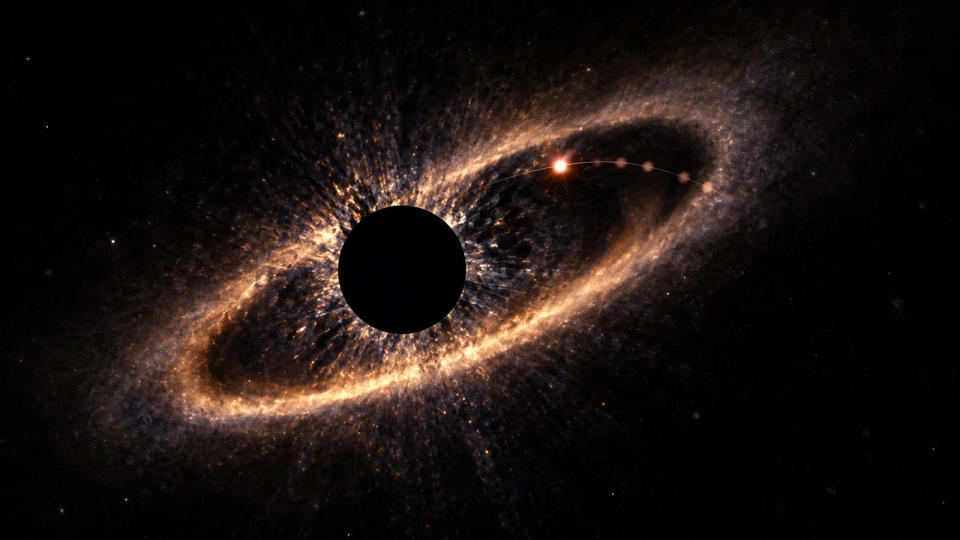
The new confirmation came from combining observations taken at different times. A team led by Andrea Bernardi searched the Keck Observatory Archive for data from the NIRC2 instrument and its vortex coronagraph. A coronagraph suppresses much of a star's glare, making nearby faint objects easier to see.
The team found the source in Keck observations from 2018 and 2020 and compared its position across multiple epochs. The motion matched an object associated with Elias 2-24 better than a stationary background star or an imaging defect. Just as importantly, the source sits where a forming planet was already expected: inside the narrow gap in the disk.
That combination — a point source, consistent motion, and a matching disk structure — turned a long-standing candidate into Elias 2-24 b, a confirmed planet.
Why Its Age Challenges Planet-Formation Models
The most widely discussed route to making a gas giant is called core accretion. First, solid material builds a large rocky and icy core. Once the core becomes massive enough, it can pull in enormous amounts of hydrogen and helium from the surrounding disk.
The basic idea works well, but timing matters. According to NASA's summary of the new result, current models can require roughly 5 million years to build a Jupiter-size planet at Jupiter's distance from the Sun, and formation is generally expected to be even slower much farther out. Elias 2-24 b is around 55 astronomical units from its star and belongs to a system younger than 1 million years.
That does not mean core accretion is wrong. The new study instead argues that giant planets can apparently form through core accretion much faster, and much farther from their stars, than many conventional calculations have suggested. Some disks may be massive enough, structured enough, or dynamically efficient enough to accelerate the process.
Another possibility often discussed for massive planets at large distances is gravitational instability, in which part of a very massive disk collapses more directly under its own gravity. The new paper favors a core-accretion interpretation for Elias 2-24 b, based in part on the planet's location and its interaction with the narrow disk gap. But one extremely young system cannot settle every question about how giant planets form.
What makes Elias 2-24 b valuable is that it gives theorists a real object to explain. Instead of asking only what a simulation can produce after several million years, researchers can now ask how a multi-Jupiter-mass planet could appear while the system is still in its first million years.
A Glimpse of Planet Formation While It Is Still Happening
Most of the more than 6,000 confirmed exoplanets are mature worlds. We detect many of them by watching for repeated transits across their stars or by measuring the gravitational wobble they produce. Those methods are powerful, but they are not ideal for planets buried in dusty disks or orbiting far from their stars.
Elias 2-24 b shows why direct imaging of very young systems is so important. Its disk is not background decoration; the disk is part of the evidence. The planet and the structure around it can be studied together, allowing astronomers to compare the planet's brightness, mass estimates, orbital position, and influence on nearby material.
It may also help explain a much broader mystery. High-resolution observations of young stars have revealed rings and gaps in many protoplanetary disks. Astronomers have long suspected that some of those gaps are carved by hidden planets, but direct confirmation has been rare. Finding a planet inside the gap of Elias 2-24 strengthens the case that at least some of these beautiful disk patterns really are planetary footprints.
Future instruments should make this kind of work easier. NASA notes that the Nancy Grace Roman Space Telescope, launched on August 30, 2026, carries an advanced coronagraph designed to demonstrate technologies for blocking starlight and imaging faint companions. New ground-based adaptive-optics systems will push in the same direction.
For now, Elias 2-24 b is a remarkable snapshot of a stage we normally cannot see: a giant planet still surrounded by the raw material of its birth. The most interesting part of the discovery is not simply that the planet is young. It is that it appears to have become a giant before many models expected it to be possible.
That makes Elias 2-24 b more than a record holder. It is a new clock for planet formation — and it suggests that, in at least some newborn systems, planets may grow up much faster than we thought.
Post a Comment