
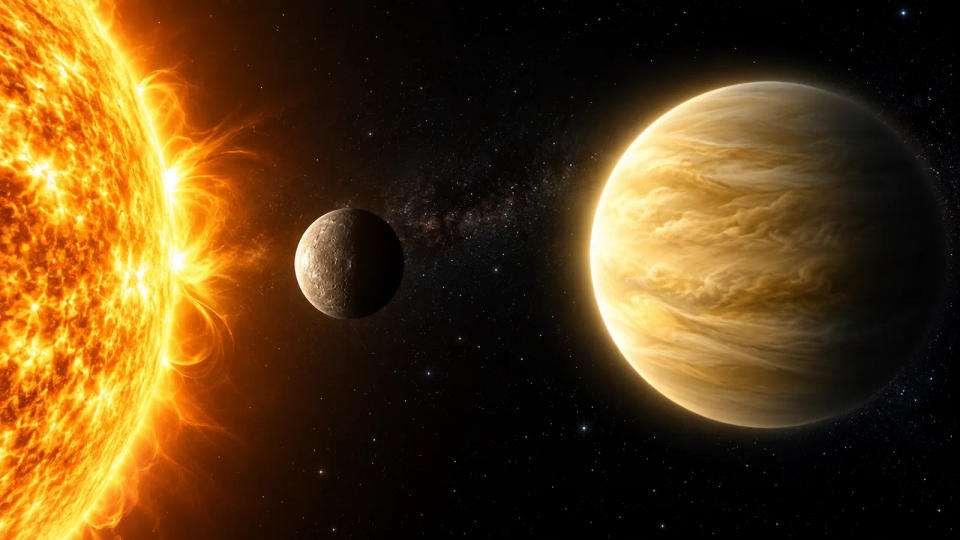
Why Is Venus Hotter Than Mercury Even Though Mercury Is Closer to the Sun?
Mercury orbits at just over half Venus’s average distance from the Sun, so it seems obvious that Mercury should be the hotter planet. Its daytime surface can reach about 430°C (800°F). Yet Venus is hotter overall, with an average surface temperature of about 464°C (867°F).
The reason is not simply how much sunlight a planet receives. What matters just as much is what happens to that energy after it arrives. Mercury has almost no atmosphere to hold on to heat, while Venus is wrapped in an enormously thick carbon-dioxide atmosphere that makes it much harder for heat to escape.
Distance from the Sun Is Only Half the Story
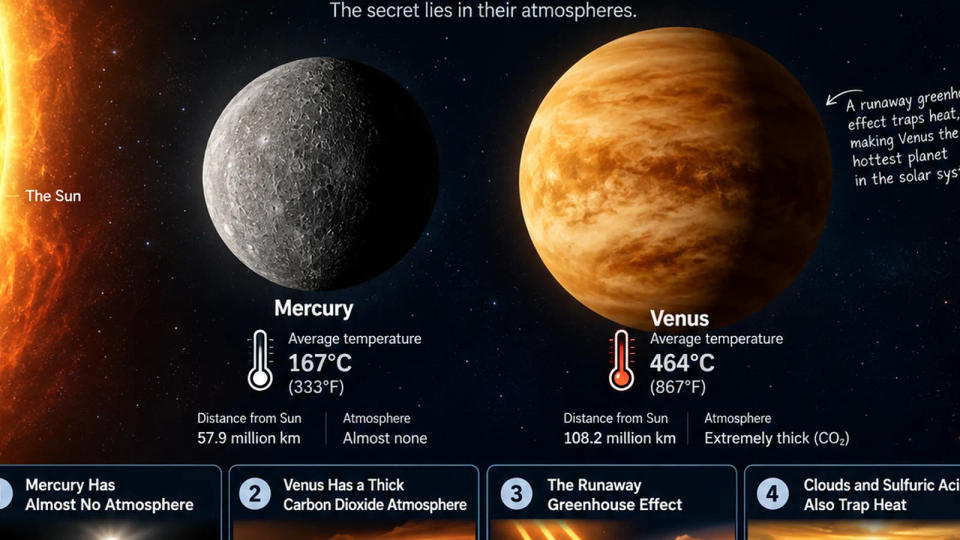
Mercury orbits the Sun at an average distance of about 58 million kilometers (36 million miles). Venus is much farther out, at roughly 108 million kilometers (67 million miles). Because sunlight becomes weaker with distance, Mercury receives several times more solar energy than Venus.
That extra sunlight makes Mercury’s daytime surface brutally hot. But a planet’s temperature is set by an energy balance: sunlight comes in, the surface and atmosphere warm, and infrared energy eventually radiates back to space. A world becomes especially hot when something slows that outgoing energy.
Mercury has almost nothing to do that. It does not have a substantial atmosphere. Instead, it has an extremely thin exosphere made of atoms knocked from its surface by sunlight, the solar wind, and micrometeoroid impacts. That exosphere is far too sparse to act like a thermal blanket.
So although Mercury absorbs intense sunlight during its long day, it can also lose heat efficiently. When the Sun sets, the surface cools dramatically. Nighttime temperatures can plunge to about -180°C (-290°F).
Mercury Gets Hot, but It Cannot Keep the Heat
Mercury is a useful example of the difference between a maximum temperature and a planet’s average temperature. A patch of ground facing the Sun can become hotter than many ovens, but that does not mean the whole planet stays that hot.
Mercury rotates very slowly. One solar day — from one noon to the next — lasts about 176 Earth days. That gives its sunlit surface a long time to heat up, but it also gives the night side a long time to cool down. With no thick air to carry heat efficiently from day to night, the temperature swing is enormous.
This is why Mercury can experience both scorching heat and deep cold. Near the equator, sunlight can push daytime temperatures toward 430°C, while darkness can send the surface far below freezing. Deep craters near the poles that never receive direct sunlight are cold enough for water ice to survive.
Mercury’s closeness to the Sun therefore creates extreme heating, not uniform heating. It is exposed to powerful solar radiation, but it lacks the atmosphere needed to store and redistribute much of that energy.
Venus Has a Planet-Sized Heat Blanket
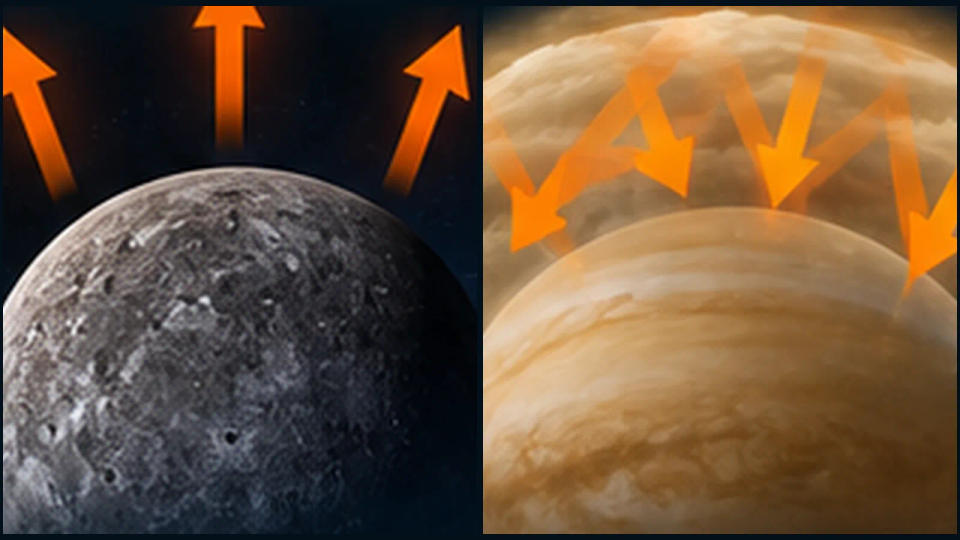
Venus is different almost from the moment sunlight reaches it. Its atmosphere is overwhelmingly carbon dioxide and is so massive that the pressure at the surface is about 90 times Earth’s sea-level pressure. Above the surface lies a global cloud deck made largely of sulfuric-acid droplets.
Those bright clouds actually reflect a large fraction of incoming sunlight back to space. That might sound as if Venus should be cooler. But the sunlight that is absorbed still warms the surface and lower atmosphere, and the dense carbon-dioxide atmosphere strongly absorbs outgoing infrared radiation.
Heat is not literally trapped forever. Venus still radiates energy to space. The key is that infrared energy leaving the hot lower atmosphere is absorbed and re-emitted many times on its way upward. To send enough energy back to space to balance the sunlight Venus absorbs, the lower atmosphere and surface settle at an extremely high temperature.
The result is a remarkably steady furnace. Surface temperatures remain near 460°C across much of Venus, with far smaller day-night differences than on Mercury. Venus rotates even more slowly than Mercury, yet its thick atmosphere transports heat around the planet so effectively that the night side does not experience Mercury-like deep freezes.
Why Scientists Talk About a Runaway Greenhouse
Today’s Venusian atmosphere is the result of a long planetary history, and scientists are still working out exactly how that history unfolded. A leading explanation for its evolution involves a runaway greenhouse process.
Early Venus may have had more water than it does today, and some climate models allow the possibility of ancient surface oceans. Because Venus receives more sunlight than Earth, warming could have increased evaporation. Water vapor is itself a powerful greenhouse gas, so more water in the atmosphere could have caused additional warming, leading to still more evaporation.
Once water reached high altitudes, ultraviolet sunlight could break water molecules apart. Lightweight hydrogen could then escape to space. Over time, losing surface water would also remove an important part of the system that can help lock carbon into oceans and rocks. Carbon dioxide could build up in the atmosphere, pushing Venus toward the dense, hot state we see today.
The broad greenhouse picture is well established, but the timing and details of ancient Venus remain active areas of research. Scientists are especially interested in whether Venus ever had long-lived oceans and how quickly it changed from a potentially milder world into its present extreme environment.
Venus and Mercury Show Why Atmospheres Matter
The contrast between these two planets is a useful lesson for worlds far beyond our Solar System. Distance from a star tells us how much energy a planet receives, but it does not tell us the surface temperature by itself.
A planet’s atmosphere, cloud cover, reflectivity, rotation, surface properties, and ability to move heat all matter. Two planets receiving similar amounts of starlight can develop very different climates if their atmospheres evolve differently. That is one reason astronomers studying exoplanets want to know not only where a world orbits, but also what gases surround it.
Mercury is closer to the Sun and receives much more sunlight, but it has almost no atmosphere to retain or spread that heat. Venus receives less sunlight, yet its massive carbon-dioxide atmosphere makes it much harder for infrared energy to escape from the lower atmosphere.
So the hottest planet is not the one closest to the Sun. Mercury shows what intense sunlight can do to an almost airless world; Venus shows how strongly an atmosphere can reshape the climate of an entire planet.
Post a Comment