

Step outside on a clear night and most of the sky is black. That seems perfectly normal—until you remember that the universe is crowded with stars in almost every direction. With so many sources of light, why is darkness the thing we see most?
The answer is not that there are too few stars. The universe has not existed forever, and it is still expanding. Light from endlessly distant stars has not had unlimited time to reach us, while cosmic expansion stretches much of the oldest, most distant light beyond the wavelengths our eyes can see.
Even “trillions of stars” is a huge understatement. Rough estimates place the number of stars in the observable universe somewhere around 1022 to 1024. Yet the spaces between visible stars still look overwhelmingly dark. That simple observation turns out to reveal something fundamental about the history of the cosmos.
The Puzzle Hidden in a Dark Sky
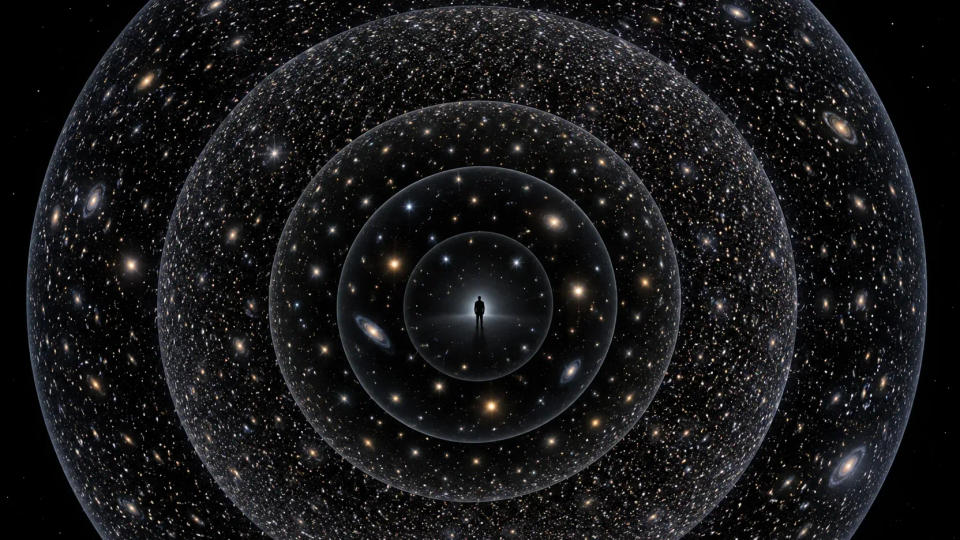
This problem is known as Olbers’ paradox. Imagine an idealized universe that is infinite, unchanging, and infinitely old. If stars are spread throughout that universe, the sky should not look dark at all.
One way to see why is to picture space as a series of enormous spherical shells centered on you. Stars in a shell twice as far away look four times fainter because their light spreads out with distance. But that more distant shell also has about four times as much surface area, so it can hold about four times as many stars.
The dimming and the growing number of stars cancel each other. Keep adding shells forever and every line of sight should eventually end on a star. Instead of isolated points against blackness, the whole sky should glow.
Clearly, it does not. The geometry is not the problem. The unrealistic part is the assumption that the real universe has existed forever without changing.
The Universe Has Not Had Forever to Light Up
Modern measurements put the age of the universe at about 13.8 billion years. Stars did not appear immediately after the Big Bang; they formed later, after the early universe expanded, cooled, and gathered matter into the first generations of stars and galaxies.
That finite age changes everything because light also needs time to travel. Looking farther into space means looking farther into the past. There has simply not been enough time for light from an infinite sequence of ever more distant stars to reach us.
This does not mean scientists know that the entire universe is finite in size. We can observe only the region whose light has had time to reach us. The universe beyond that observable region may be much larger, and science still does not have a reliable measurement of the total size of the whole universe.
Stars also have finite lives. They form, burn through nuclear fuel, evolve, and eventually fade or explode. The cosmos has never contained an eternal, perfectly steady population of stars shining without interruption.
Expansion Stretches Ancient Light Out of Sight
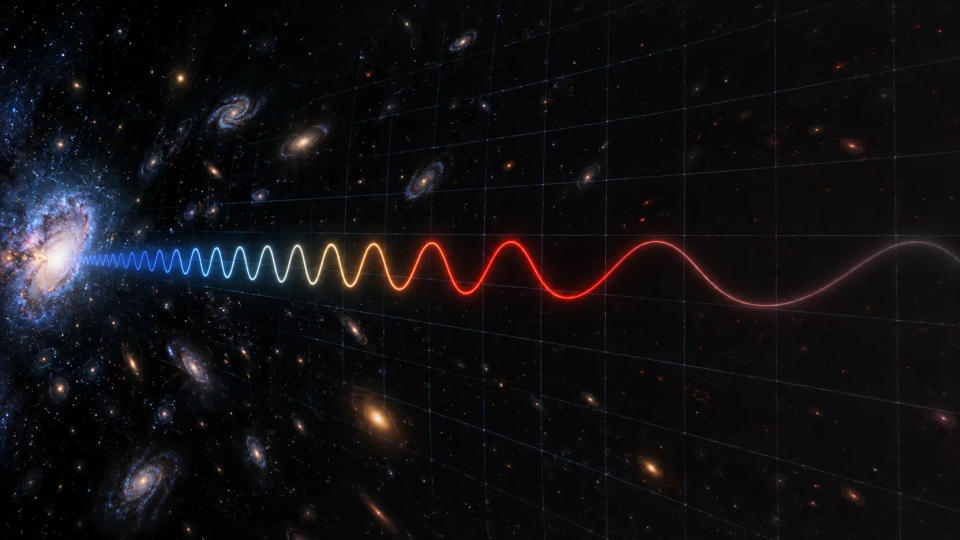
The universe’s finite age is a major part of the answer, but expansion adds another. As light travels through expanding space, its wavelength is stretched. Astronomers call this cosmological redshift.
A distant galaxy may have emitted visible or ultraviolet light billions of years ago. By the time that light reaches us, the expansion of space can shift it into the infrared. Radiation from even earlier cosmic times can be stretched to still longer wavelengths.
The clearest example is the cosmic microwave background, the afterglow of the early universe. It was released when the universe became transparent about 380,000 years after the Big Bang. Since then, expansion has stretched that ancient radiation so dramatically that today we detect it mainly as microwaves with a temperature of about 2.7 kelvin.
So the universe is not truly black at every wavelength. If our eyes could see microwaves, the sky would carry a faint glow from the young universe in every direction. Infrared observatories such as the James Webb Space Telescope reveal another hidden layer by detecting distant galaxies whose light has been shifted beyond the visible range.
Why Distance and Dust Cannot Explain the Darkness by Themselves
It may seem enough to say that distant stars are simply too faint. But Olbers’ paradox shows why that cannot be the whole explanation. Individual stars fade with distance, yet the amount of space available for stars increases at the same time. In an infinite, static, eternal universe filled uniformly with stars, distance alone would not keep the sky dark.
Dust is not a complete answer either. Dust can absorb visible light, but that energy does not vanish. The dust warms up and reradiates energy, mostly at infrared wavelengths. In a universe that had existed forever, dust would eventually come into thermal balance with the surrounding radiation instead of acting as a permanent black curtain.
And even the real sky is not perfectly black. Faint background light comes from unresolved stars and galaxies, while sunlight scattered by dust in our Solar System creates zodiacal light. Spacecraft measurements made far from the bright inner Solar System have helped astronomers estimate how dim the cosmic optical background really is.
The darkness we experience is therefore partly about our eyes. Human vision samples only a narrow band of the electromagnetic spectrum, while the universe shines across radio, microwave, infrared, visible, ultraviolet, X-ray, and gamma-ray wavelengths.
The black between the stars is not empty space winning a battle against light. It is a visible consequence of a universe with a finite past, evolving stars, and expanding space. Something as ordinary as a dark night sky quietly tells us that the cosmos has changed with time—and is still changing now.
Post a Comment