
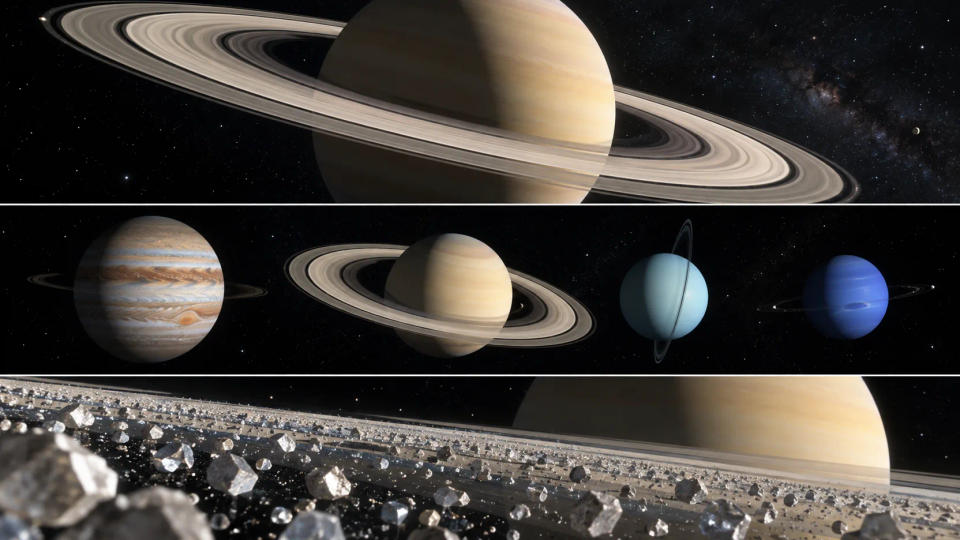
Saturn is the planet that seems to have claimed rings as its personal trademark. Through even a modest telescope, its bright, broad ring system is unmistakable. Jupiter, Uranus, and Neptune are giant planets too, yet none of them looks anything like Saturn at first glance.
The surprising answer is that all four giant planets have rings. Saturn stands out because its main rings are unusually wide, dense, and rich in bright water ice. The other giant planets have ring systems made of darker, thinner, dustier, or more widely separated material, so they reflect far less sunlight toward us.
Every Giant Planet Has Rings — Saturn’s Are Just Hard to Miss
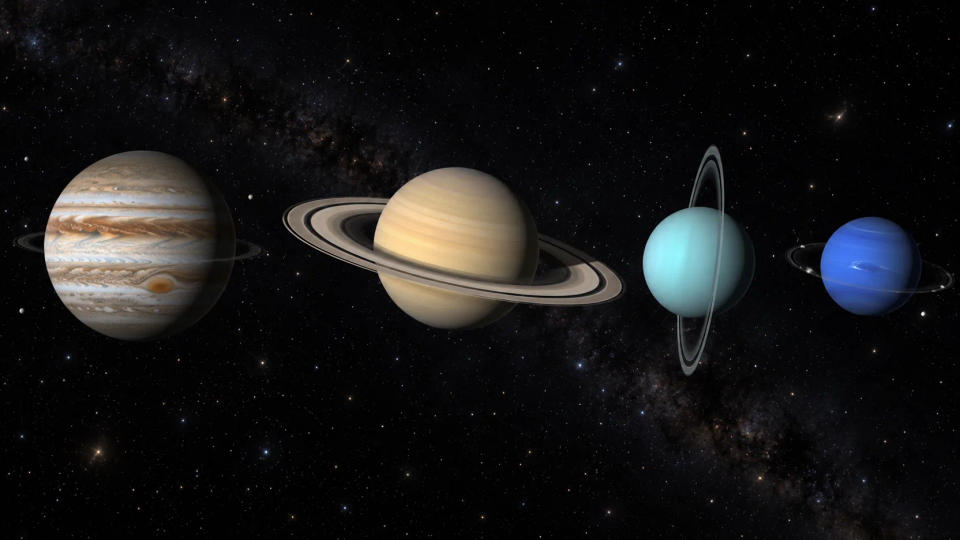
Saturn is not an exception because it has rings. It is an exception because its rings are so visually dominant. Jupiter has a faint dusty ring system. Uranus has a collection of narrow, dark rings. Neptune has several faint rings, including structures that appear unusually clumpy. They were difficult to discover precisely because they do not reflect much visible light.
Saturn’s main rings are different. The bright A, B, and C rings spread across a huge area around the planet, with smaller ringlets, gaps, and divisions woven through them. The main ring system spans roughly 280,000 kilometers from edge to edge, yet much of it is astonishingly thin — only about tens of meters thick in many places.
That combination of enormous width and tiny thickness turns the rings into something like a gigantic sheet of orbiting material. From above the ring plane, they can dominate the view. From exactly edge-on, they can become surprisingly difficult to see.
Why Saturn’s Rings Are So Bright
The biggest visual advantage Saturn has is composition. Its rings are made mostly of water ice, mixed with smaller amounts of rocky and dusty material. Fresh or relatively clean ice reflects sunlight very efficiently, which makes the rings shine.
This is why Saturn can look spectacular even though it is farther from the Sun than Jupiter. Its rings are not glowing on their own; they are reflecting sunlight. Their enormous surface area gives them plenty of material to scatter that light back into space.
The contrast with the other giant planets is dramatic. Jupiter’s rings contain lots of fine dust. Uranus’s rings are extremely dark, reflecting only a small fraction of the light that reaches them. Neptune’s rings are also faint and dusty. In visible light, those systems can almost disappear next to the bright disks of their planets.
Saturn therefore looks different not because the basic physics of rings works only there, but because its ring material happens to be especially reflective and abundant.
Why the Rings Form a Thin Disk Instead of Becoming a Moon
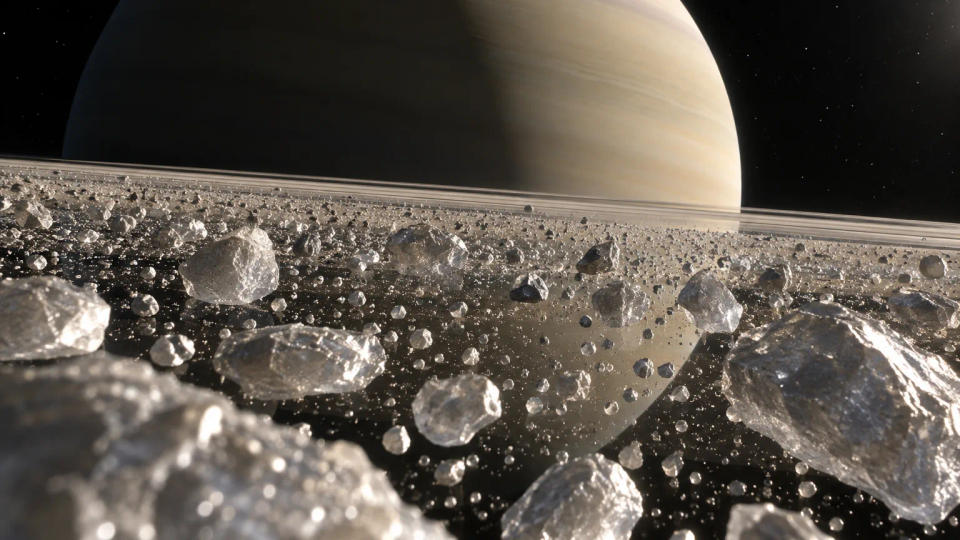
Saturn’s rings are not a solid object. They are made of countless individual particles, from tiny grains to much larger chunks, each following its own orbit around the planet. Collisions between particles gradually reduce random up-and-down motion, which helps flatten the system into a thin disk.
There is another important piece of the puzzle: much of the bright ring material orbits inside a region where Saturn’s tidal gravity can prevent loose material from easily assembling into one large moon. This boundary is connected to what astronomers call the Roche limit.
Inside that region, Saturn’s gravity pulls slightly harder on the near side of a clump than on the far side. A small, loosely held collection of material can therefore be stretched apart faster than gravity can bind it into a large satellite. Farther from Saturn, where tidal forces are weaker, moons can survive much more easily.
That is why Saturn can have both rings and moons at the same time. The system is not static, either. Small moons can sculpt gaps, confine narrow ring edges, or exchange material with the rings through repeated gravitational interactions.
Why Jupiter, Uranus, and Neptune Look So Different
Each giant planet has its own ring history, source material, moons, and environment. Jupiter’s rings are closely associated with dust released from small inner moons, especially when those moons are struck by tiny impactors. Dust is excellent at scattering light in certain viewing geometries, but it does not produce Saturn’s broad, brilliant appearance.
Uranus presents almost the opposite look from Saturn. Its rings are narrow and exceptionally dark. Some are only a few kilometers wide, and their particles absorb far more sunlight than Saturn’s icy material. Because Uranus itself rotates on its side, the entire ring system also appears at unusual angles as the planet travels around the Sun.
Neptune’s rings are faint as well, and some sections contain brighter arcs rather than appearing perfectly uniform all the way around. Gravitational interactions with nearby moons help maintain some of that structure.
So there is no single rule saying that a giant planet should have a Saturn-like halo. Ring systems can be dusty or icy, broad or narrow, bright or dark, smooth or clumpy. Saturn simply occupies the most eye-catching part of that range.
Are Saturn’s Rings Temporary?
Probably — but scientists are still working out exactly how temporary. Ring particles slowly change through collisions, interactions with moons, incoming micrometeoroids, and the gradual loss of material into Saturn’s atmosphere. The rings we see today are not necessarily a permanent feature of the planet.
Their age is also still debated. Analyses of Cassini data have supported the idea that the main rings could be relatively young on Solar System timescales, perhaps only a few hundred million years old. One reason is that they contain so little dark contamination despite constant bombardment by tiny meteoroids.
But that argument is not settled. A 2024 study in Nature Geoscience used impact simulations to suggest that much of the dark material from micrometeoroids may be vaporized and removed rather than permanently coating the rings. If that process is efficient, Saturn’s rings could look cleaner and younger than they really are.
That uncertainty matters because it changes the story we tell about Saturn. The rings may have formed after the breakup of an icy moon or another violent event, or they may preserve material from a much earlier chapter of the Saturn system. What is clear is that the giant planets are not frozen in time: their rings can grow, erode, darken, spread, and disappear.
Saturn’s real distinction, then, is not that it alone has rings. It is that we happen to see a ring system with an extraordinary combination of bright ice, large surface area, strong contrast, and intricate structure. Jupiter, Uranus, and Neptune show the same basic idea in quieter forms — reminders that planetary rings are common, but spectacular rings are not.
Post a Comment