
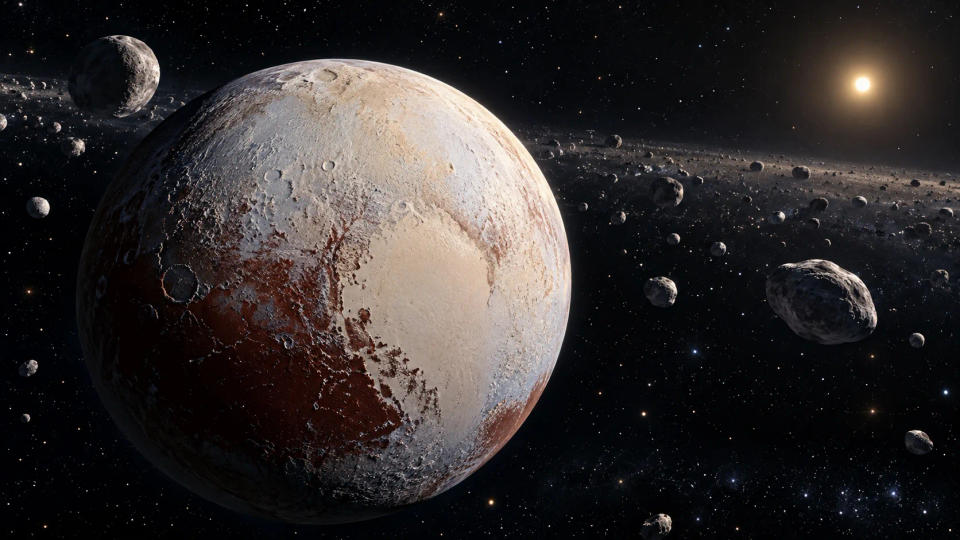
For 76 years, Pluto was taught as the ninth planet. Then, in 2006, it became a dwarf planet almost overnight. The formal reason is simple: under the International Astronomical Union’s definition, Pluto orbits the Sun and is round, but it has not cleared the neighborhood around its orbit.
The deeper reason is more interesting. Pluto itself did not suddenly change; astronomy did. As telescopes began revealing a large population of icy worlds beyond Neptune—and especially after the discovery of Eris—astronomers had to decide whether the Solar System should contain an ever-growing number of planets or whether the word “planet” needed a stricter definition.
The Real Trigger Was the Kuiper Belt, Not Pluto's Size
Pluto was discovered in 1930, when the outer Solar System was still mostly mysterious. At the time, there was no known family of objects surrounding it, so calling Pluto the ninth planet seemed reasonable. It was unusual—small, distant, and on an orbit that is more tilted and elongated than those of the eight major planets—but there was no obvious alternative category.
That changed in the 1990s. Astronomers started finding many icy bodies beyond Neptune in a broad region now known as the Kuiper Belt. Pluto began to look less like a lone oddball planet and more like one large member of a much bigger population.
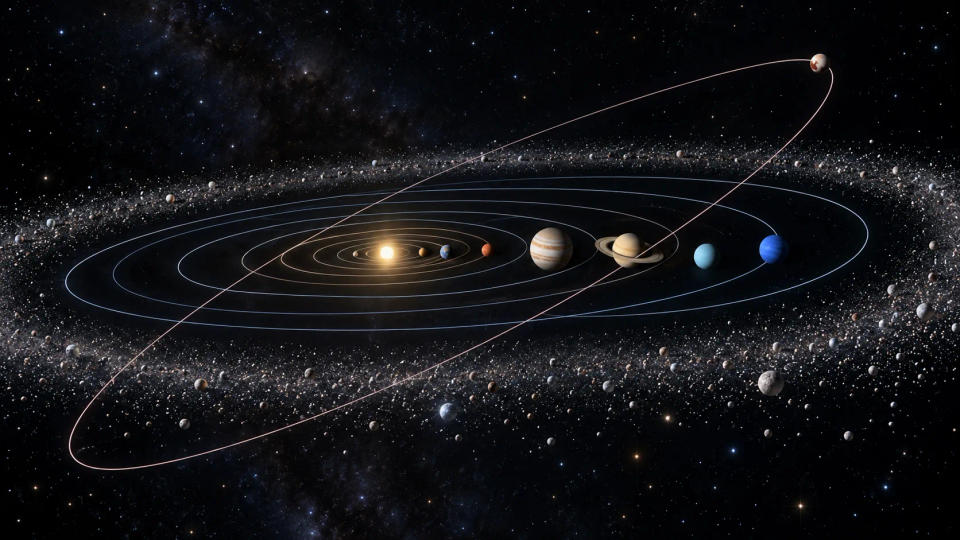
Then came the discovery announced in 2005 of Eris, another distant world comparable to Pluto in size. That created an immediate classification problem. If Pluto was a planet, should Eris be one too? And if similar objects kept being discovered, how many new planets would eventually have to be added?
This is the real historical pressure behind Pluto’s reclassification. It was not simply that astronomers decided Pluto was “too small.” In fact, size alone is not what disqualified it. The discoveries beyond Neptune forced astronomers to define what separates a planet from the many smaller worlds that share its region.
The 2006 Rule Pluto Could Not Pass
At its 2006 General Assembly in Prague, the International Astronomical Union, or IAU, adopted a definition for planets in our Solar System. A planet must meet three conditions: it must orbit the Sun, it must have enough gravity to pull itself into a nearly round shape, and it must have cleared the neighborhood around its orbit.
Pluto easily passes the first two. It orbits the Sun once every 248 Earth years, and its gravity is strong enough to make it roughly spherical. The third condition is where it fails.
The same resolution created the category “dwarf planet” for objects that orbit the Sun, are nearly round, are not moons, but have not cleared their orbital neighborhood. That category includes Pluto. The IAU also recognizes Ceres, Eris, Haumea, and Makemake as dwarf planets.
One detail often causes confusion: “dwarf planet” sounds as though it should mean a small type of planet, but in the IAU system it is a separate category. Under that naming system, Pluto is not one of the eight planets even though the word planet appears in the phrase dwarf planet.
What “Clearing the Neighborhood” Actually Means
The phrase does not mean that a planet’s orbit must be perfectly empty. Earth has near-Earth asteroids, Jupiter shares its orbital region with Trojan asteroids, and Neptune has smaller bodies influenced by its gravity. “Clearing” is about gravitational dominance, not spotless space.
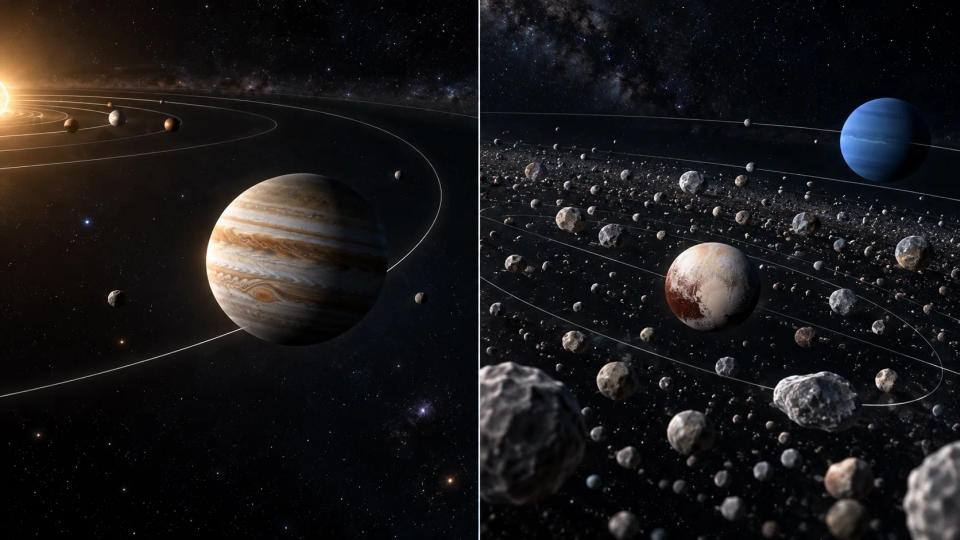
Over the age of the Solar System, a major planet becomes the overwhelmingly important gravitational body in its orbital zone. It can scatter smaller objects, capture them into stable relationships, or sweep some of them up. Pluto, by contrast, lives among many Kuiper Belt objects and does not dominate that region in the same way.
Its relationship with Neptune makes the point especially well. Pluto’s path is eccentric enough that it can be closer to the Sun than Neptune during part of its orbit, yet the two do not collide. They are locked in a stable 3:2 orbital resonance: for every two trips Pluto makes around the Sun, Neptune makes three. Pluto is dynamically shaped by the architecture of the outer Solar System rather than ruling its orbital zone.
So the phrase “Pluto has not cleared its orbit” should not be pictured as Pluto failing to vacuum up every rock in its path. It means Pluto lacks the kind of long-term gravitational dominance that the eight planets have in their respective orbital regions.
Was the Decision the End of the Debate?
No. The 2006 definition remains the IAU’s official definition for planets in the Solar System, and the IAU says it has not changed that definition. But the scientific debate over what the word “planet” should mean has not completely disappeared.
Some planetary scientists argue that classification should focus more on an object’s intrinsic physical properties—whether it is round, geologically complex, and planet-like as a world—rather than on where it happens to orbit. New Horizons principal investigator Alan Stern, for example, has publicly rejected the IAU definition and continues to describe Pluto as a planet.
That disagreement does not change Pluto’s current IAU classification, but it does reveal something important: scientific categories are tools humans create to organize nature. The objects themselves do not rearrange when the labels change. When NASA’s New Horizons spacecraft flew past Pluto in 2015, it revealed mountains of water ice, vast nitrogen-ice plains, glaciers, haze layers, and a remarkably active-looking surface. Pluto became more fascinating scientifically after its reclassification, not less.
And that is why “Pluto was demoted because it was too small” misses the real story. Pluto lost planet status because discoveries in the Kuiper Belt exposed a classification problem, and the IAU solved that problem by adopting a definition based partly on orbital dominance.
Conclusion
Pluto was reclassified in 2006 because it does not satisfy the IAU’s third requirement for a planet: clearing the neighborhood around its orbit. The discoveries of many Kuiper Belt objects, especially Eris, are what forced astronomers to confront the definition in the first place. Pluto did not become less of a world; our map of the Solar System simply became more detailed.
Sources & Further Reading
- International Astronomical Union — Astronomy FAQs: Pluto
- International Astronomical Union — List of Resolutions, including 2006 Resolutions B5 and B6
- NASA Science — What Is a Planet?
- NASA Science — Pluto Facts
- NASA — Exploring the Unexplored: New Horizons’ Mission to Pluto
Post a Comment