
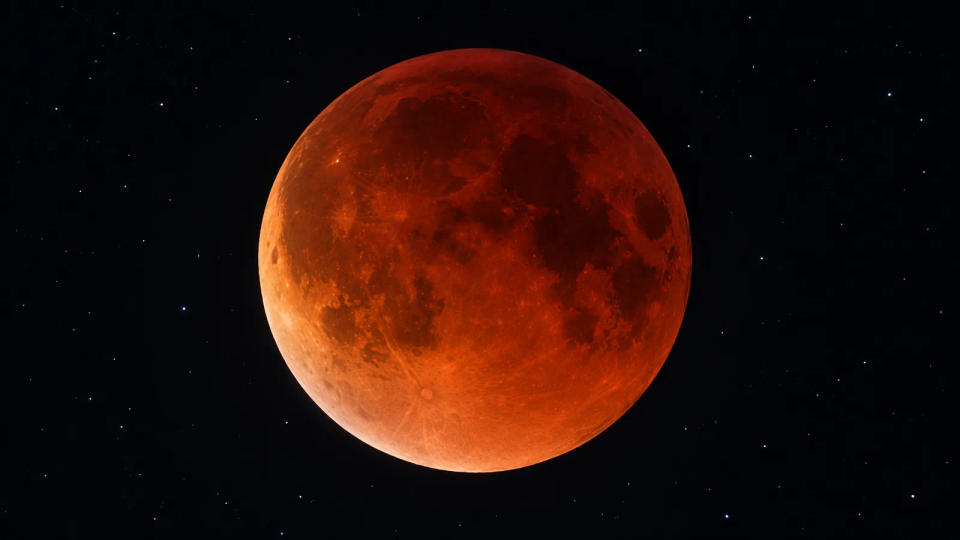
A total lunar eclipse seems as if it should make the Moon disappear. Earth moves directly between the Sun and the Moon, blocking the sunlight that normally illuminates the lunar surface. Yet instead of going completely black, the Moon can glow copper, orange, or deep red.
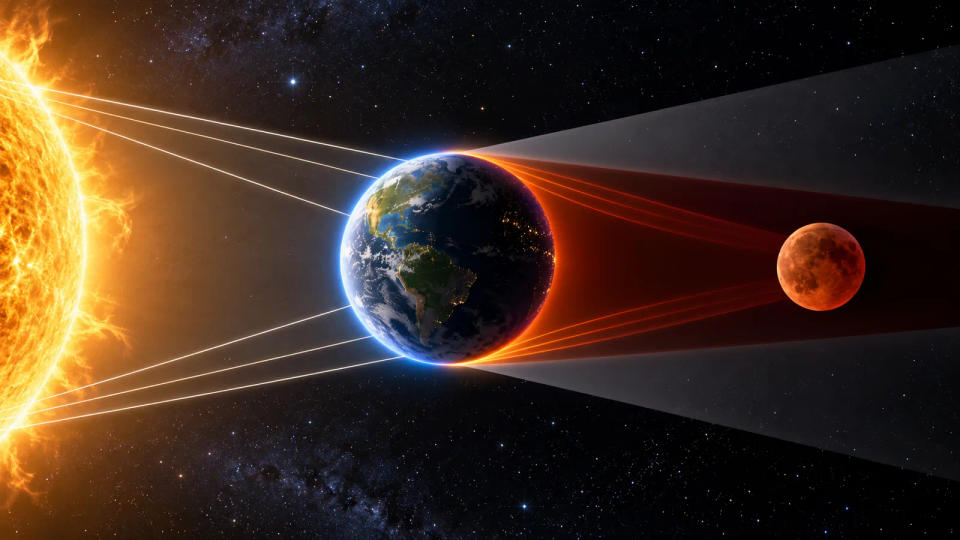
The reason is Earth’s atmosphere. During totality, the sunlight that still reaches the Moon has skimmed through the air around our planet. That atmosphere scatters much of the shorter-wavelength blue light while allowing more red and orange light to continue onward. It also bends some of that remaining light into Earth’s shadow. In other words, the red Moon is being lit by filtered sunlight from around the edge of Earth.
Earth Blocks the Sun, but Not Every Ray of Light
A lunar eclipse happens at full Moon, when the Sun, Earth, and Moon line up closely enough for the Moon to pass through Earth’s shadow. The darkest central part of that shadow is called the umbra. During a total lunar eclipse, the entire lunar disk enters the umbra.
If Earth had no atmosphere, the Moon inside the umbra would be much darker because our planet would block the direct path from the Sun. But Earth does have a deep layer of air wrapped around it. Sunlight passing near the planet’s edge travels through that atmosphere before continuing into space.
Some of those rays are redirected into the shadow behind Earth. The result is not enough light to make the Moon bright, but it is enough to keep the lunar surface faintly visible. The color of that surviving light is what gives totality its famous reddish appearance.
The Same Physics Behind Blue Skies and Red Sunsets
Sunlight looks white, but it contains many visible wavelengths. Blue and violet light have shorter wavelengths, while orange and red light have longer wavelengths. When sunlight passes through Earth’s atmosphere, tiny gas molecules scatter the shorter wavelengths much more efficiently. This process is known as Rayleigh scattering.
That is why the daytime sky looks blue. Blue light is being scattered across the sky and into our eyes from many directions. Near sunrise and sunset, however, sunlight has to travel through a much longer path in the atmosphere before reaching an observer. Much of the blue light gets scattered out of the direct beam along the way, so the light that survives is richer in yellow, orange, and red wavelengths.
A total lunar eclipse uses the same basic optical effect on a planetary scale. The sunlight reaching the eclipsed Moon has passed through long, low-angle paths around Earth’s atmospheric rim. By the time that light emerges back into space, its color balance has shifted toward the red end of the visible spectrum.
NASA often describes the effect with a memorable comparison: it is as though the glow of Earth’s sunrises and sunsets were being projected onto the Moon. That is not a separate source of light; it is ordinary sunlight filtered through the atmosphere before it reaches the lunar surface.
How Red Light Gets Into Earth’s Shadow
Scattering explains why the transmitted light becomes redder, but there is another important part of the story: refraction. Earth’s atmosphere becomes denser closer to the surface. As sunlight moves through layers of air with changing density, its path bends slightly.
Around the entire edge of Earth, the atmosphere therefore acts like a very broad, imperfect lens. Some sunlight that would otherwise continue past the planet is bent toward the region behind Earth. Because the shorter blue wavelengths have already been scattered more strongly, much of the light that makes this journey into the umbra is orange or red.
When that reddish light reaches the Moon, the lunar soil simply reflects it back toward Earth. The Moon is not producing red light of its own, and its surface has not physically changed color. We are seeing the normal gray Moon illuminated by an unusually colored source.
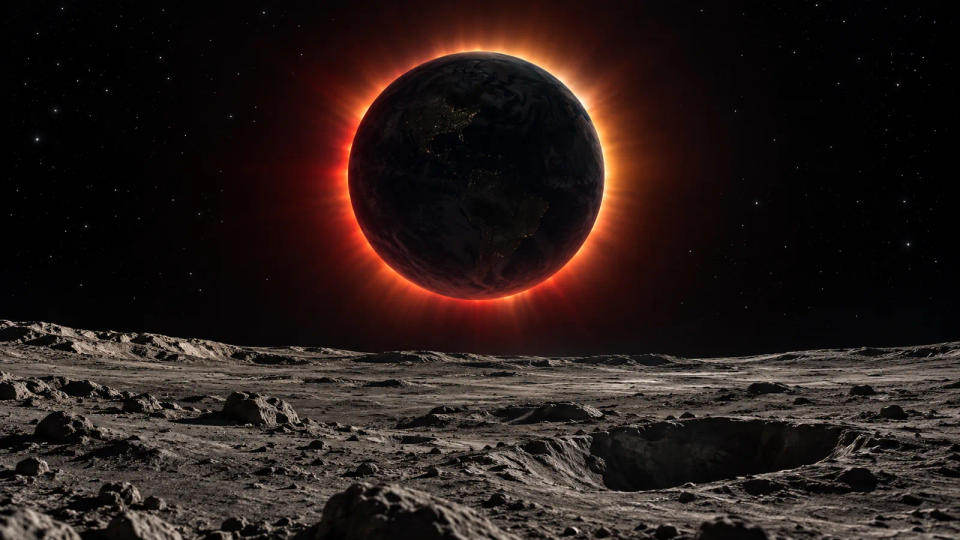
The geometry is especially striking if you imagine standing on the Moon during totality. From there, Earth would cover the Sun, while a glowing red-orange ring would surround the dark silhouette of our planet. That ring is sunlight passing through Earth’s atmosphere before reaching the lunar surface.
Why Every Lunar Eclipse Has a Different Shade of Red
A total lunar eclipse does not come with one guaranteed color. Some look bright copper-orange. Others are brick red, brownish, or so dark that the Moon is difficult to see. That variation comes from both eclipse geometry and the condition of Earth’s atmosphere.
The Moon’s path through the umbra matters because different parts of the shadow receive different amounts of refracted light. A Moon passing closer to the darker central region can look dimmer than one traveling nearer the edge.
The atmosphere also changes from one eclipse to another. Clouds, dust, smoke, and other aerosols can alter how much sunlight is scattered, absorbed, or transmitted. High-altitude particles from major volcanic eruptions can have especially noticeable effects. Depending on the amount, altitude, and type of particles, an eclipse may become darker or shift in color rather than simply becoming a brighter shade of red.
That is why the popular term “blood Moon” can be misleading if taken too literally. It is a nickname, not a separate kind of Moon or an official scientific category. The actual color can range widely, and the atmosphere of Earth helps decide what observers see.
Conclusion
The Moon turns red during a total lunar eclipse because Earth blocks the direct sunlight but its atmosphere lets a small amount of filtered light reach the lunar surface. Shorter blue wavelengths are scattered away more strongly, while longer red and orange wavelengths are more likely to survive the long atmospheric path. Refraction then bends some of that reddened light into Earth’s shadow.
So a red eclipsed Moon is really a view of Earth’s atmosphere in action. The same physics that paints a blue daytime sky and a red sunset can, for a few hours, color the Moon as well.
Sources & Further Reading
- NASA Science — Eclipses and the Moon
- NASA Jet Propulsion Laboratory — Red, Red Moon and Other Lunar Eclipse Phenomena
- NASA Goddard Space Flight Center — Visual Appearance of Lunar Eclipses
- NOAA NESDIS — Why Is the Sky Blue?
Post a Comment