
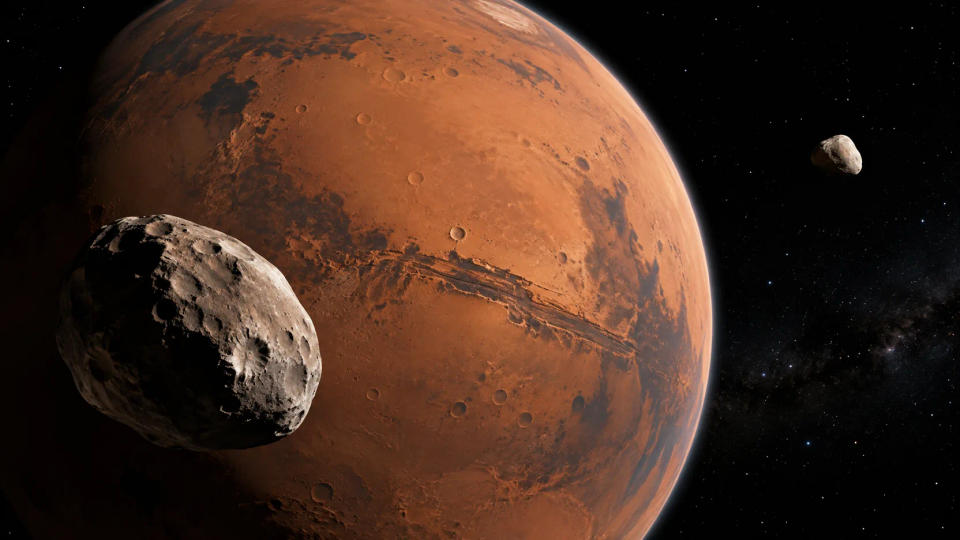
Earth has one enormous, round Moon that dominates the night sky. Mars has something completely different: two lumpy little companions that look more like wandering asteroids than proper moons.
The short answer is that Phobos and Deimos probably have a very different origin story from Earth’s Moon. Scientists still do not know exactly how they formed, but the leading ideas involve either captured small bodies or debris left behind after a violent event near Mars. In some impact models, Mars may once have had larger temporary moons, while only two small outer survivors remained.
That makes the real mystery more interesting than simply asking why Mars has two moons. The question is why the Martian system ended up with these two tiny moons on the orbits we see today.
Phobos and Deimos Are Tiny Even by Moon Standards
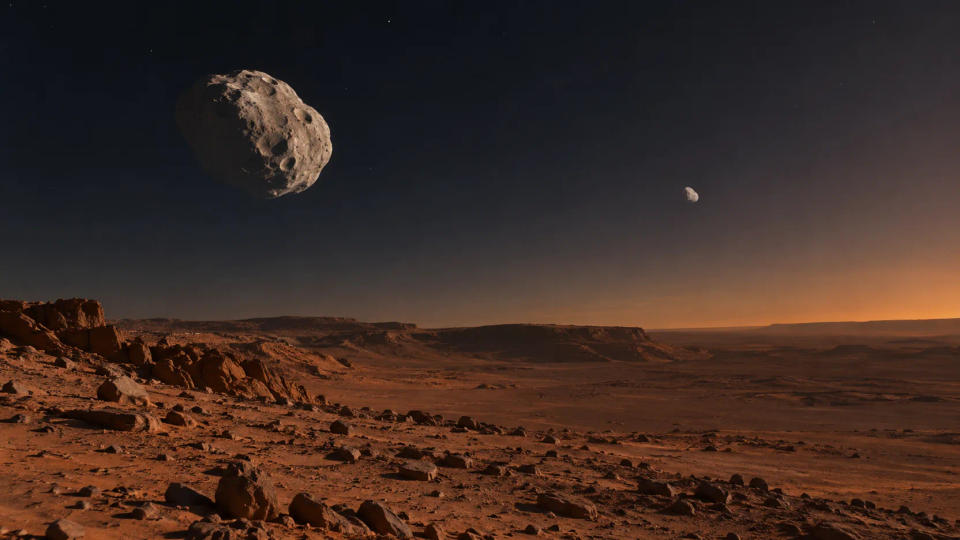
Phobos, the larger moon, measures only about 27 by 22 by 18 kilometers. Deimos is smaller still, roughly 15 by 12 by 11 kilometers. By comparison, Earth’s Moon is about 3,475 kilometers across.
They are also too small for their own gravity to pull them into spheres. Instead, both are irregular, heavily cratered worlds. Phobos circles extremely close to Mars and races around the planet about three times a day, while Deimos takes about 30 hours to complete one orbit.
Their appearance immediately suggests an obvious explanation: perhaps Mars simply captured two asteroids. Their dark surfaces resemble some asteroid materials, and small rocky objects were abundant in the young Solar System.
But their orbits make that simple picture harder to accept. Phobos and Deimos travel on nearly circular paths that lie close to Mars’s equatorial plane. A randomly captured asteroid would more naturally arrive on a tilted, elongated orbit. Something would have to remove a great deal of orbital energy and reshape that path without sending the object into Mars or back into space.
Could Mars Have Captured Two Passing Asteroids?
The capture idea has not disappeared. In fact, newer models have made it more interesting.
Instead of imagining Mars grabbing two intact asteroids one at a time, researchers have explored scenarios in which a larger asteroid passed close enough to Mars to be torn apart by tidal forces. Some fragments could have escaped, while others remained bound to Mars. Repeated collisions among the captured fragments could then create a disk of material around the planet.
That matters because a disk gives the fragments a way to lose energy, collide, and settle into more circular, equatorial orbits. In other words, the moons might still have started with asteroid-like material without requiring Mars to neatly capture two finished moons in their present form.
This kind of model also makes a useful prediction: if Phobos and Deimos came mostly from an asteroid, their chemistry should look more like primitive Solar System material than like rock blasted off Mars.
A Giant Impact Could Have Made Many Moons Before Leaving Two
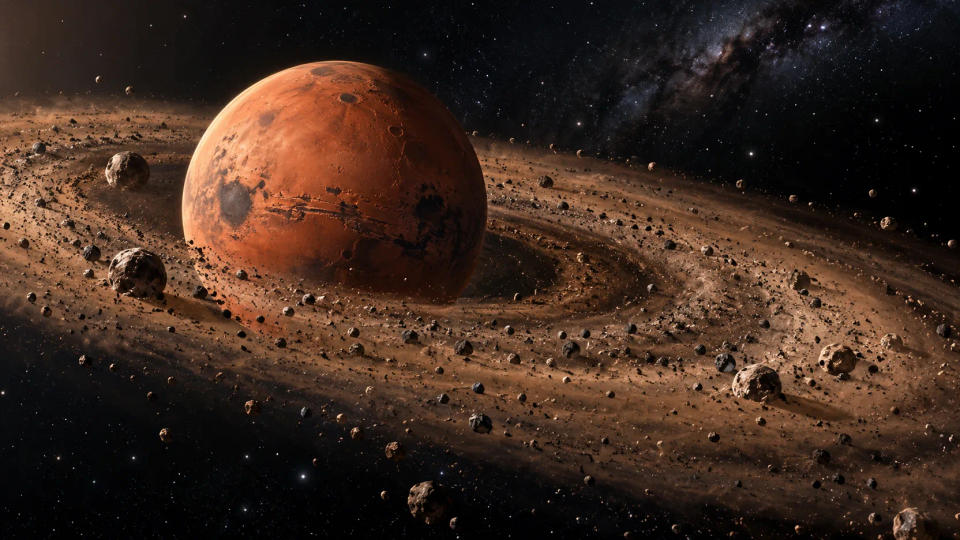
The other major idea begins with a giant collision. Early in Solar System history, large impacts were common. If a sizable object struck Mars, the impact could have thrown a mixture of Martian rock and impactor material into orbit.
That debris would not necessarily have assembled into one large moon. Simulations show that a dense inner disk could first build larger moonlets close to Mars, while a thinner outer region produced much smaller bodies farther away. Gravitational interactions among the disk, the moonlets, and Mars could then rearrange the system.
In one family of models, the large inner moons do not survive. They gradually spiral back toward Mars and fall onto the planet. Smaller moons forming farther out can remain, eventually evolving into objects resembling Phobos and Deimos.
This is one reason the Martian moons are so scientifically valuable. Their small size may not mean Mars failed to make a larger moon. It could mean the larger members of an early moon system were temporary, and the two objects we see today are the last survivors of a much more complicated past.
Why Earth Ended Up With One Big Moon but Mars Did Not
It is tempting to say the difference comes down to planet size: Earth is bigger, so it got a big moon, while smaller Mars got small ones. Reality is not that simple.
Moon systems depend on how material arrived, how much of it entered orbit, where it settled, and how tides changed those orbits over billions of years. The geometry and energy of an impact matter. So does the distance at which debris can safely clump together instead of being pulled apart by the planet’s gravity.
Earth’s Moon appears to have grown from a very massive debris disk after a giant impact. Mars may have experienced a smaller or differently structured event, or it may have gained its moons through some form of disrupted capture instead. Either route could naturally produce a system with far less material than the Earth–Moon system.
There is also evidence that Mars’s moon system is still evolving. Phobos is slowly moving inward because of tidal interactions with Mars. Over tens of millions of years, it is expected either to break apart or collide with the planet, depending on exactly how its structure and tidal evolution play out. The two-moon system we see now is therefore not necessarily permanent.
A Sample From Phobos May Finally Reveal the Answer
The best way to distinguish between these origin stories is to examine the moons directly. JAXA’s Martian Moons eXploration mission, or MMX, is designed to do exactly that.
JAXA currently plans to launch MMX on October 20, 2026. The spacecraft is intended to travel to the Mars system, study both moons, land near Phobos, collect at least 10 grams of surface material, and return the sample to Earth in fiscal year 2031.
The chemistry of that sample could be decisive. If Phobos’s indigenous material contains the chemical fingerprints expected from Martian and impactor debris, an impact origin would become much more persuasive. If that indigenous material instead closely resembles primitive asteroid material, a capture-related origin would gain support. The real answer may also turn out to be more complicated than either simple version.
For now, Mars’s two tiny moons are a reminder that planetary systems do not have to follow a single blueprint. Earth ended up with one giant satellite. Mars ended up with two battered fragments—or perhaps two survivors of a vanished family of moons. Finding out which story is true could reveal not only where Phobos and Deimos came from, but also how chaotic the early Solar System really was.
Post a Comment