
If you could look down on the Solar System from far above, the eight planets would seem surprisingly orderly. Their orbits are nearly circular, and most stay close to the same broad plane around the Sun. Pluto does not follow that pattern. Its path is more stretched, tilted steeply compared with the planetary plane, and for part of each orbit it even comes closer to the Sun than Neptune.
That does not mean Pluto is on an unstable or accidental route. Its unusual orbit is a long-lived gravitational arrangement shaped by the outer Solar System. The key is Pluto’s membership in the Kuiper Belt and, especially, a precise orbital resonance with Neptune that keeps the two worlds safely separated.
Pluto’s Orbit Is More Tilted and More Elliptical
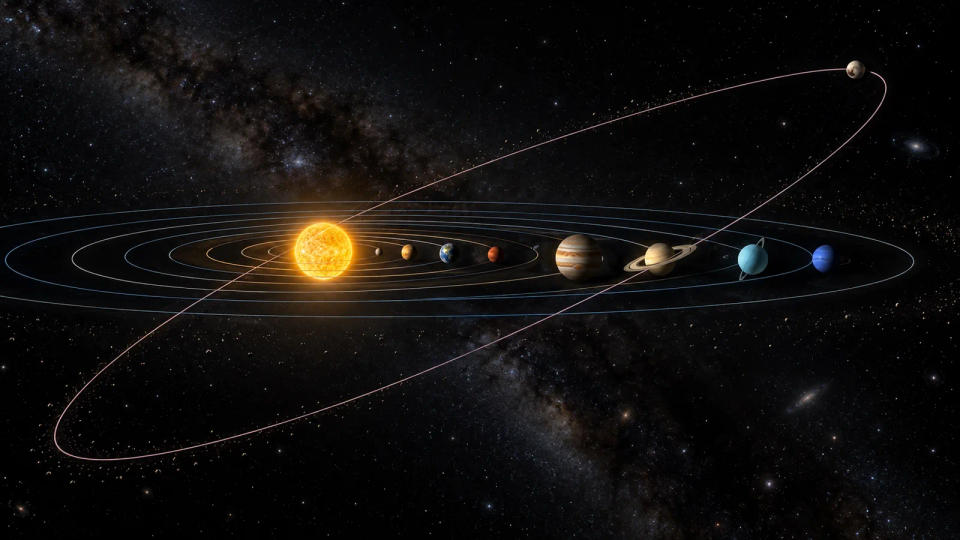
Earth travels around the Sun on an orbit that is very close to a circle. Most of the other planets are similar, although none is perfectly circular. Pluto is different enough that the contrast is easy to see in a diagram.
Its orbit is inclined by about 17 degrees to the ecliptic, the reference plane based on Earth’s orbit. Pluto’s orbital eccentricity is about 0.25, which means its path is noticeably more oval than the orbits of most planets. During one 248-Earth-year trip around the Sun, Pluto ranges from roughly 30 astronomical units (AU) away to about 49.3 AU. One AU is the average distance between Earth and the Sun.
That changing distance has a curious consequence. From 1979 to 1999, Pluto was actually closer to the Sun than Neptune. Yet Pluto did not suddenly become Neptune’s neighbor in any dangerous sense. The geometry of the two orbits is only part of the story; their timing matters even more.
The 3:2 Resonance With Neptune Is the Key
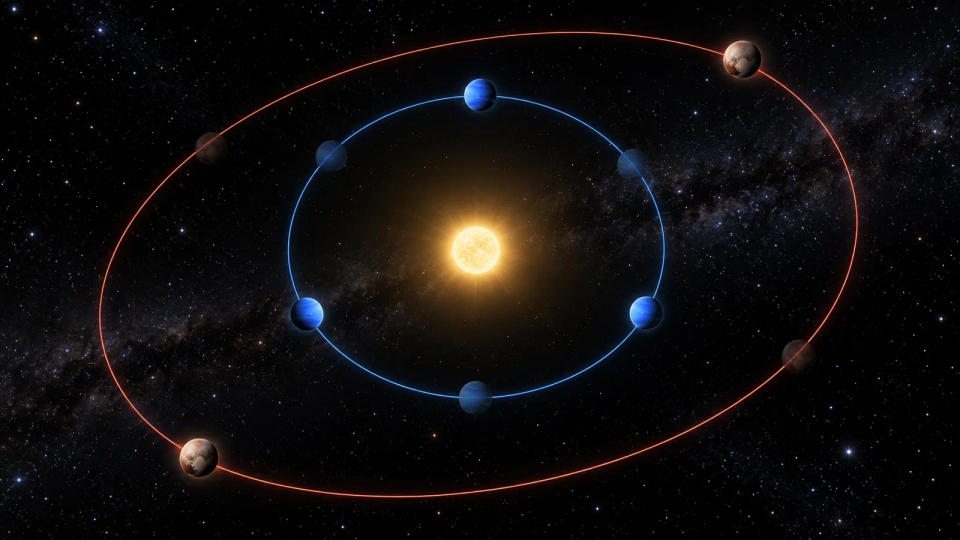
Pluto and Neptune are locked in what astronomers call a 3:2 mean-motion resonance. For every three orbits Neptune completes around the Sun, Pluto completes two. Their orbital periods therefore repeat in a regular rhythm.
This is not just a mathematical curiosity. The resonance controls where Pluto and Neptune are likely to be relative to each other. When Pluto reaches parts of its orbit that, on a flat drawing, seem to overlap Neptune’s distance from the Sun, Neptune is elsewhere. The two bodies repeatedly return to a protected configuration rather than wandering into random close encounters.
Pluto’s tilted orbit adds another layer of separation. Its path rises above and below the main planetary plane, so two orbital tracks that appear to cross in a simple top-down sketch do not represent two objects passing through the same place at the same time. NASA notes that Pluto actually gets physically closer to Uranus than it ever does to Neptune.
This stable resonance is one reason Pluto’s strange-looking path can survive for extremely long periods. It is unusual compared with the eight planets, but it is not chaotic in the everyday sense of being about to break apart or collide with Neptune.
Neptune May Have Helped Create Pluto’s Strange Orbit
The leading explanation reaches back to the early Solar System, when the giant planets had not yet settled into the orbits we see today. After the planets formed, large amounts of leftover icy and rocky material still surrounded them. Repeated gravitational encounters with that debris could exchange energy and angular momentum with the planets, causing their orbits to migrate.
Models of the outer Solar System indicate that Neptune moved outward during this era. As it migrated, its orbital resonances swept through populations of smaller icy bodies. Some objects could be captured into those resonances and carried into new orbital configurations. Pluto’s 3:2 resonance is a classic example of this idea.
In this picture, Pluto did not simply form on its present orbit and stay untouched for 4.5 billion years. Its path was dynamically sculpted as Neptune and the surrounding planetesimals rearranged the young outer Solar System. Resonant capture can naturally increase orbital eccentricity, helping explain why Pluto’s orbit is more stretched than the nearly circular paths of the major planets.
The exact history is still reconstructed from computer simulations, present-day orbits, and the distribution of Kuiper Belt objects. Scientists did not observe Neptune migrating billions of years ago, so details of the process remain model-dependent. But the modern Kuiper Belt contains many resonant populations, providing strong evidence that Neptune’s early movement played a major role in shaping the region.
Pluto Is Less of an Oddball Once You Look at the Kuiper Belt
Pluto seemed exceptionally strange when it was treated as the ninth planet and compared mainly with Mercury through Neptune. The discovery of the Kuiper Belt changed that context. Astronomers now know that the region beyond Neptune contains a large population of icy bodies with a wide range of eccentric and inclined orbits.
Pluto is not even alone in its particular resonance. Other Kuiper Belt objects share the same 3:2 relationship with Neptune, and astronomers call this group the plutinos. Pluto is the most famous member, but its orbital behavior is part of a broader dynamical structure rather than a one-object exception.
This also helps explain why Pluto’s classification and its orbit are related but not identical issues. Pluto was reclassified as a dwarf planet in 2006 because it does not meet the International Astronomical Union’s requirement that a planet must have cleared its orbital neighborhood. Its tilted, eccentric orbit is not itself the reason for the classification. Instead, both facts reflect Pluto’s place in a busy outer region filled with other small bodies.
So why is Pluto’s orbit so different from the eight planets? Because Pluto belongs to a different dynamical population. The major planets grew into dominant bodies on relatively flat, nearly circular paths, while Pluto remained part of the icy outer population whose orbits were strongly reshaped by Neptune. Its eccentricity, inclination, and 3:2 resonance are a fossil record of that early gravitational rearrangement.
Pluto’s orbit looks disorderly only if we expect it to behave like a ninth major planet. Seen as a resonant Kuiper Belt world, its path is remarkably organized.
Sources: NASA Pluto Facts; NASA Kuiper Belt Facts; Renu Malhotra, “The origin of Pluto’s peculiar orbit,” Nature.
Post a Comment