
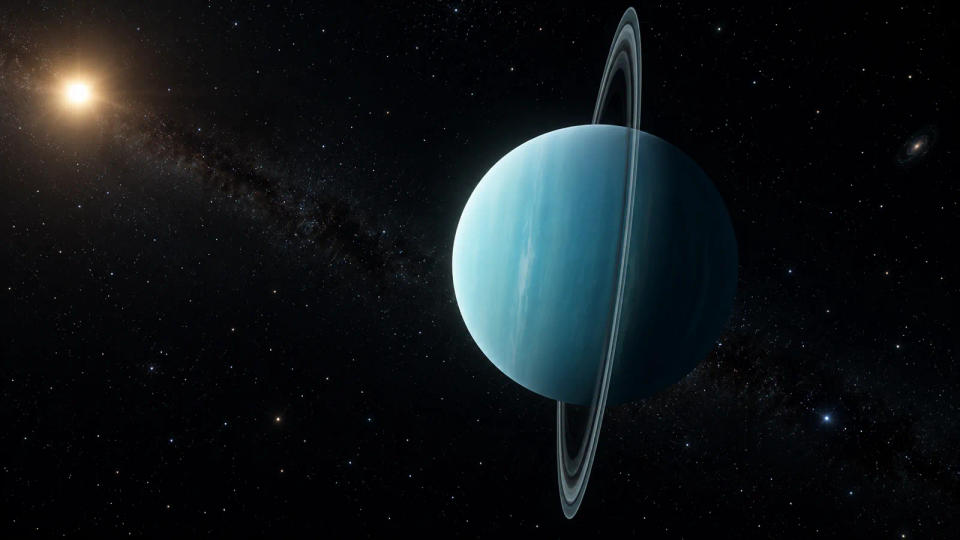
If the planets were spinning tops, Uranus would look like the one that had fallen over but somehow kept going. Its rotation axis is tilted by about 97.77 degrees, so instead of spinning nearly upright as it travels around the Sun, Uranus appears to roll along its orbit on its side.
The short answer is that something probably changed Uranus dramatically after it formed. A huge collision early in the Solar System is still the leading explanation, but scientists have not proved that this is what happened. Other models show that long-term gravitational interactions, possibly involving a large lost moon, could also have tipped the planet over.
That uncertainty is exactly what makes Uranus so interesting: its strange posture may be a fossil record of events that happened more than four billion years ago.
Uranus Is Not Just Tilted — It Is Almost Lying Down
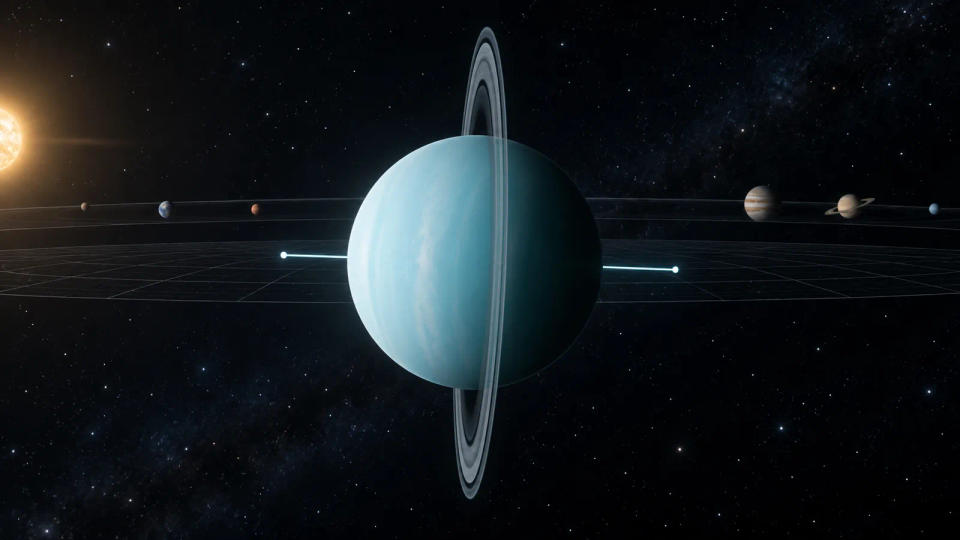
Every planet has an axial tilt, the angle between its spin axis and the direction perpendicular to its orbital plane. Earth is tilted by about 23.5 degrees, which is why we have seasons. Jupiter leans only about 3 degrees, so it spins almost upright. Neptune is tilted by about 28 degrees.
Uranus is in a completely different category. NASA lists its axial tilt as 97.77 degrees. That puts its spin axis almost in the same plane as its orbit around the Sun. Imagine a basketball rolling around the edge of a large circular track while also spinning around a line that runs roughly through its sides. That is closer to Uranus than the familiar image of a planet spinning like a top.
The planet completes one rotation in roughly 17 hours, so Uranus is not rotating slowly. What is unusual is the direction of that rotation axis.
Its rings and major moons are tilted with it. They orbit near Uranus’s equatorial plane, so the entire system looks as though it was turned sideways together. That shared orientation is one of the most important clues to the planet’s history.
Uranus is not the Solar System’s only rotational oddball. Venus spins in the opposite direction from most planets, for example. But Uranus is unique because its equator is nearly perpendicular to the usual planetary arrangement.
The Leading Explanation Is a Giant Impact
The early Solar System was not a quiet place. Planets grew through repeated collisions among smaller bodies, and even after large planets had formed, major impacts could still reshape them.
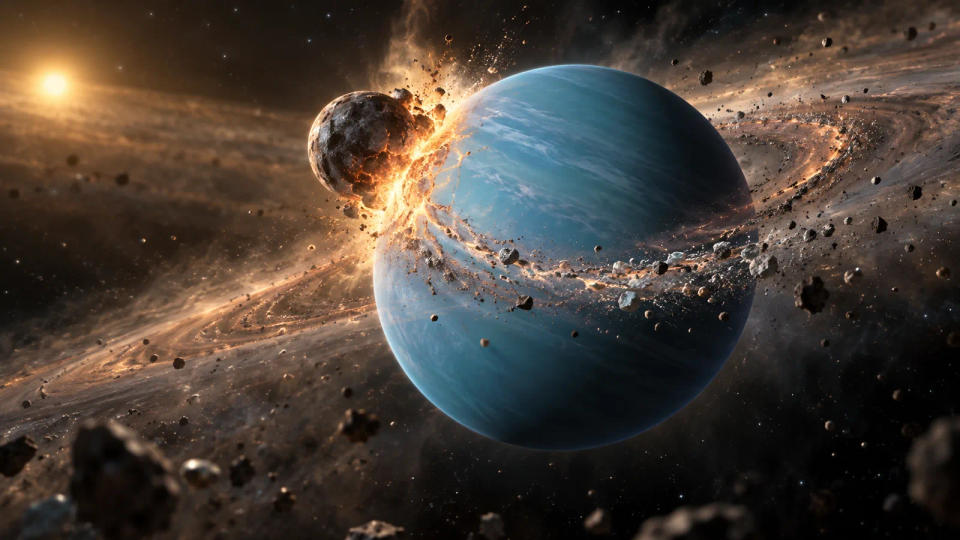
The most widely discussed explanation for Uranus is that a large protoplanet struck the young ice giant at an oblique angle. A glancing collision could have delivered enough angular momentum to tip Uranus dramatically without destroying it.
Computer simulations have shown that such impacts can produce a large tilt and, under some conditions, also throw material into orbit around the planet. That debris could help explain why Uranus’s regular moons now orbit in the same highly tilted plane as its equator.
The details are not simple. A collision strong enough to reorient a planet the size of Uranus has to reproduce more than one observation at the same time. It should leave a realistic rotation rate, internal structure, debris disk and satellite system. Some simulations can match several of these features, but no single reconstruction has been accepted as a complete answer.
Scientists have also explored whether Uranus suffered one enormous impact or several smaller ones. Either way, the basic idea is the same: the young planet received a powerful sideways shove during a violent stage of planet formation.
This makes the giant-impact scenario plausible, not proven. No crater or surviving impactor can be inspected today. Researchers are working backward from the planet we see now.
A Lost Moon Could Have Tipped Uranus More Gradually
There is another intriguing possibility: Uranus may not have been knocked sideways in one sudden collision at all.
A 2022 study in Astronomy & Astrophysics explored a model in which Uranus once had a substantial moon whose orbit slowly migrated outward. As the moon moved, gravitational resonances could have changed the way Uranus’s spin axis precessed — in other words, the slow wobble of the planet’s rotational direction.
Under the right conditions, that interaction could gradually drive Uranus toward a very large tilt. The moon’s orbit could eventually become unstable, ending with the satellite being ejected or colliding with the planet.
This scenario is attractive because it shows that a planet can reach an extreme obliquity without requiring one perfectly tuned giant collision. But it also requires a moon with the right mass, migration history and orbital evolution. Scientists do not have evidence that such a moon definitely existed.
Other dynamical models have examined gravitational resonances involving the giant planets themselves. The common theme is that Uranus’s tilt may record a complicated history of orbital migration and gravitational interactions, not just one catastrophic moment.
At present, the giant-impact explanation remains the most familiar and widely used picture, while alternative models remind us that the case is still open.
Sideways Rotation Gives Uranus Extreme Seasons
Whatever caused the tilt, its consequences are still playing out today.
Uranus takes about 84 Earth years to orbit the Sun. Because the planet is almost lying on its side, each pole can point broadly toward the Sun for part of that long orbit. A Uranian season lasts roughly 21 Earth years, and regions near a pole can spend decades in prolonged sunlight before later entering decades of darkness.
That is very different from Earth, where our 23.5-degree tilt changes the Sun’s height in the sky but never points a pole almost directly at the Sun for years at a time.
When Voyager 2 flew past Uranus in January 1986, the southern pole was turned strongly toward the Sun. Decades later, the geometry has changed as the planet has moved around its orbit. Uranus passed northern spring equinox in 2007, and its northern hemisphere is now moving toward summer solstice in 2028.
Hubble observations have watched the northern polar region brighten and develop a prominent atmospheric cap as the season changes. That does not mean sunlight alone controls all Uranian weather — its atmosphere, chemistry and internal heat also matter — but the extreme tilt gives researchers a natural experiment in long-duration planetary seasons.
The strange orientation also affects the magnetosphere. Uranus’s magnetic field is itself strongly tilted relative to the rotation axis, so the planet’s magnetic environment sweeps through space in an unusually complicated way as Uranus spins.
Uranus therefore does more than look sideways. Its tilt influences its lighting, seasons, atmosphere and space environment.
The mystery of Uranus’s sideways spin is really a question about how planets acquire their final form. A giant impact may have knocked the young planet over, or a more gradual gravitational process may have done the job. Until a future spacecraft can study Uranus in far greater detail, its 97.77-degree tilt remains one of the Solar System’s clearest reminders that planets carry the scars — and the dynamics — of their ancient past.
Post a Comment